
March 8, 2023: Biostatistics Core Sponsors This Week’s PCT Grand Rounds on Estimands in Cluster Randomized Trials

Headshot of Brennan KahanIn this Friday’s PCT Grand Rounds, Brennan Kahan of University College London will present “Estimands in Cluster-Randomized Trials: Choosing Analyses That Answer the Right Question.” This session is sponsored by the NIH Pragmatic Trials Collaboratory’s Biostatistics and Study Design Core Working Group.

The Grand Rounds session will be held on Friday, March 10, 2023, at 1:00 pm eastern.

Kahan is a senior research fellow in the Institute of Clinical Trials and Methodology at University College London.

Join the online meeting.

February 14, 2023: IMPACT Collaboratory to Host Grand Rounds on Treatment Effect Heterogeneity in Cluster Randomized Trials

Headshot of Dr. Fan Li
Dr. Fan Li

Dr. Fan Li, a member of the NIH Pragmatic Trials Collaboratory’s Biostatistics and Study Design Core, will present “Methods for Designing Cluster Randomized Trials to Detect Treatment Effect Heterogeneity” during IMPACT Grand Rounds on Thursday, February 16, at 12:00 pm eastern. IMPACT Grand Rounds is hosted by the NIA IMPACT Collaboratory.

Fan Li, PhD, is an assistant professor in the Department of Biostatistics at Yale School of Public Health, and faculty member in the Center for Methods in Implementation and Prevention Science and the Yale Center for Analytical Sciences. He is the principal investigator of a Patient-Centered Outcomes Research Institute (PCORI)–funded methods award that investigates new study planning methods and software for testing treatment effect heterogeneity in cluster randomized trials.

Zoom Conferencing
Join from PC, Mac, iOS or Android: https://hebrewseniorlife.zoom.us/j/97344810673
Dial-In:  +1 312 626 6799 (US Toll) or  +1 470 250 9358 (US Toll)
Meeting ID:  973 4481 0673

Read more about this IMPACT Grand Rounds session.

Toward Causal Inference in Cluster Randomized Trials: Estimands and Reflection on Current Practice

Methods: Minds the Gap Webinar Series
“Toward Causal Inference in Cluster Randomized Trials: Estimands and Reflection on Current Practice”
Fan Li, PhD; Yale School of Public Health
National Institutes of Health, Office of Disease Prevention

Cluster randomized trials (CRTs) involve randomizing groups of individuals to different interventions. While model-based methods are extensively studied for analyzing CRTs, there has been little reflection around the treatment effect estimands at the outset. In the first part of this presentation, we describe two relevant estimands that can be addressed through CRTs and point out that they can differ when the treatment effects vary according to cluster sizes. As a cautionary note, we demonstrate how choices between different analytic approaches can impact the interpretation of results by fundamentally changing the question being asked. In the second part, we revisit the linear mixed model as the most commonly used method for analyzing CRTs. The linear mixed model makes stringent assumptions, including normality, linearity, and typically a compound symmetric correlation structure, all of which may be challenging to verify. However, under certain conditions, we show that the linear mixed model consistently estimates the average causal effect under arbitrary misspecification of its working model. Under equal randomization, its model-based variance estimator, surprisingly, remains consistent under model misspecification, justifying the use of confidence intervals output by standard software. These results hold under both simple and stratified randomization, and serve as an important causal inference justification for linear mixed models. Caveats and extensions of our findings will also be mentioned.

For more information, visit https://prevention.nih.gov/education-training/methods-mind-gap/toward-causal-inference-cluster-randomized-trials-estimands-and-reflection-current-practice.

August 16, 2022: Biostatistics Core Develops Tools and Strategies for Common Research Challenges

Head shot of Dr. Patrick HeagertyHead shot of Dr. Liz TurnerIn an interview at the NIH Pragmatic Trials Collaboratory’s annual Steering Committee meeting and 10th anniversary celebration, we asked Dr. Liz Turner and Dr. Patrick Heagerty to reflect on the role of the Biostatistics and Study Design Core Working Group in helping the NIH Collaboratory Trial teams design their trials and analyze the data, and to discuss their focus for the Core's future contributions to pragmatic clinical trials.

Based on your experience working with the NIH Collaboratory Trials, what are some of the common challenges of the Core?

Given the pragmatic nature of the NIH Collaboratory Trials, most use a design that involves some kind of clustering of outcomes. This could be a cluster randomized design or an individually randomized group treatment trial. As a consequence, nearly all projects face the challenge of how to account for clustering in both the design and analysis of the trial.

For the NIH Collaboratory Trials that use a cluster randomized design, one of the most common challenges is deciding between a stepped-wedge design and a standard parallel-arm design. The Core’s recommendation is clear: only use a stepped-wedge design if you have to! Likewise, only use a cluster randomized design if you have to and, if possible, use an individually randomized design. Nevertheless, a cluster randomized design is often the design of choice to address a pragmatic research question, and a stepped-wedge cluster randomized design may be the only way to perform a randomized evaluation of an intervention (for example, when all centers wish to receive the intervention in order to agree to participate in the trial).

From an analysis perspective, common challenges involve how to handle missing outcome data and how to handle longitudinal (that is, repeated) measures data. For both design and analysis, as you can imagine, the COVID-19 pandemic has posed huge challenges, including how to handle the disruption of an ongoing stepped-wedge trial (as in the GGC4H NIH Collaboratory Trial). In short, clustering of outcomes is the biggest theme (and challenge) across the NIH Collaboratory Trials.

What strategies have NIH Collaboratory Trials used to overcome these barriers?

A common strategy used by the NIH Collaboratory Trials to overcome these barriers has been to leverage what we call the “Core group process.” This dynamic process is driven by the NIH Collaboratory Trials and supported by the Core, together with NIH Collaboratory leadership. The process is centered around the monthly Core meeting to which all NIH Collaboratory Trial teams are invited and that involves all Core members. These meetings provide dedicated time for each study team to provide project updates and elicit feedback from the Core and the other NIH Collaboratory Trial teams. In particular, all the study teams are invited to present at least once during the UG3 planning phase and on multiple occasions during the UH3 implementation phase. Core members are also available for ad hoc, smaller group meetings, as requested. What this process allows is for the NIH Collaboratory Trials to present challenges and for us to jointly identify solutions.

How are the NIH Collaboratory Trials’ experiences with the Core helping the field of pragmatic research?

Through the challenges and ideas that have been brought to the Core, the NIH Collaboratory Trials have pushed the field of pragmatic research. In particular, through the Core group process, they have pushed the Core to solve methodological challenges and provide tools to tackle the design issues that arise in the changing research landscape.
Thumbnail image of the COVID-19 checklist

A key example of the Core’s methodological work was inspired by the STOP CRC NIH Collaboratory Trial and is related to the design and analysis choices faced in the unique context of embedded pragmatic trials. This example addresses a common challenge in embedded pragmatic trials, namely how to handle varying cluster sizes, something that arises in so many of the NIH Collaboratory Trials. The research, recently published in Contemporary Clinical Trials, highlights that a seemingly natural analysis in this context may produce a biased inference about intervention effectiveness, which is clearly problematic.

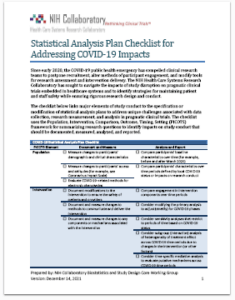
The second example is the Core’s recently published Statistical Analysis Plan Checklist for Addressing COVID-19 Impacts. Development of this tool was inspired by the many challenges faced by the NIH Collaboratory Trials as a result of the COVID-19 pandemic, such as delayed recruitment (as in the BackInAction NIH Collaboratory Trial) and adjustments to how interventions were delivered (as in the ACP PEACE NIH Collaboratory Trial).

What do you think the Core can contribute over the next decade?

The Core has a lot to contribute over the next decade. A key goal is to ensure we are building and diversifying the next generation of statisticians who are experts in pragmatic trials and who can engage deeply in the design and analysis of pragmatic trials embedded in healthcare systems.

To achieve this, we need to continue to bring trainees into the Core, as we have done over the past 6 years, through funded graduate research assistant positions. By doing this, we should be able to not only build the next generation of pragmatic trial experts but also build scholarship in pragmatic trial methodology by identifying methodological gaps needed to be filled so the NIH Collaboratory Trials study teams—and pragmatic trialists in the broader research community—have the best methods available to them.

The opportunity to participate in a cross-institution working group such as ours is surprisingly rare. As a consequence, we are in a unique position to not only build the next generation of experts but also to strength our own collective expertise and knowledge by learning from each other’s perspectives.

December 16, 2021: NIH Collaboratory Publishes COVID-19 Checklist for Statistical Analysis Plans in Pragmatic Trials

Thumbnail image of the COVID-19 checklistA new tool from the NIH Collaboratory assists investigators in identifying impacts of the COVID-19 public health emergency on ongoing pragmatic clinical trials. The Statistical Analysis Plan Checklist for Addressing COVID-19 Impacts summarizes impacts on trial conduct that study teams should document, measure, analyze, and report.

The new checklist was developed by the NIH Collaboratory’s Biostatistics and Study Design Core Working Group. Since the beginning of the COVID-19 pandemic, many of the NIH Collaboratory Trials have had to postpone recruitment, alter methods of participant engagement, and modify tools for research assessment and intervention delivery.


The leaders of the Biostatistics Core, Dr. Patrick Heagerty and Dr. Liz Turner, spoke in a recent interview about the impacts of the pandemic on the NIH Collaboratory Trials. Early next year, the Coordinating Center will report the results of a survey of the study teams about their experiences with these impacts.

Download the Statistical Analysis Plan Checklist for Addressing COVID-19 Impacts.

August 26, 2021: Li Receives PCORI Award to Study Methods for Cluster Randomized Trials

Headshot of Dr. Fan Li
Dr. Fan Li

Dr. Fan Li, a longtime member of the NIH Collaboratory’s Biostatistics and Study Design Core, has received approval for a $1 million grant award from the Patient-Centered Outcomes Research Institute (PCORI) to develop methods and software for designing cluster randomized trials. Li is an assistant professor of biostatistics in the Yale School of Public Health.

The study, entitled “New Methods for Planning Cluster Randomized Trials to Detect Treatment Effect Heterogeneity,” will contribute new methods, guidance, and user-friendly software for planning parallel and stepped-wedge cluster randomized trials to enable confirmatory “heterogeneity of treatment effect” (HTE) analyses with sufficient statistical power.

HTE occurs when there is systematic variation in treatment effect across predefined patient or provider subgroups that can arise due to diverse practices, varying responses to treatment, or differing vulnerability to certain diseases, among other reasons. While understanding of HTE has been a recognized goal in individually randomized trials, methods for planning cluster randomized trials with HTE analyses are limited. This PCORI-funded study will expand the current cluster randomized design toolbox to accommodate confirmatory HTE analysis and meet a growing interest in better understanding how patient- and provider-level characteristics moderate the impact of new care innovations in pragmatic trials.

The award has been approved pending completion of a business and programmatic review by PCORI staff and issuance of a formal award contract.

Joining Li on the research team are coinvestigators Dr. Patrick Heagerty of the University of Washington, Dr. Rui Wang of Harvard Medical School and the Harvard Pilgrim Health Care Institute, and Dr. Denise Esserman of the Yale School of Public Health. Heagerty and Wang are members of the NIH Collaboratory’s Biostatistics and Study Design Core. The team will work closely with other NIH Collaboratory colleagues and stakeholders, including Dr. Adrian Hernandez of Duke University, Dr. Jerry Jarvik of the University of Washington, and Dr. Richard Platt of Harvard Medical School and the Harvard Pilgrim Health Care Institute.

August 19, 2021: Biostatistics Core Helps Projects ‘Roll With the Punches’ of the Pandemic

Leaders of the NIH Collaboratory’s Biostatistics and Study Design Core Working Group spoke in a recent interview about the impacts of the COVID-19 pandemic on the NIH Collaboratory Trials, including the 2 newest projects, BeatPain Utah and GRACE.

“BeatPain Utah and GRACE are fascinating studies, as all our NIH Collaboratory Trials are, and are giving us lots of food for thought at the Biostatistics Core,” said Dr. Liz Turner, associate professor of biostatistics and bioinformatics at Duke University and a cochair of the Core. View the full video.

The 2 studies “have been pretty well positioned to roll with some of the distancing required or the lack of in-person visits,” said Dr. Patrick Heagerty, professor of biostatistics at the University of Washington and the other cochair of the Core. “The BeatPain project had a remote delivery from the beginning, so I think the impact of COVID was not as dramatic as it’s been for other projects. But GRACE, where acupuncture is part of it, they have to figure out what are the elements of the research protocol they can do remotely but still need to get folks in person to do that acupuncture,” Heagerty said.

“There really have been some considerable challenges for several of the other NIH Collaboratory Trials,” said Turner. “Good examples of these challenges are those faced by 2 stepped-wedge cluster randomized trials, ACP PEACE and PRIM-ER. …They had to really restructure the design and respond very quickly to what was happening in practice out in the field. Interestingly, on the flip side, the disruptions last spring in 2020 did provide opportunities to address other research questions and perhaps generate other interesting evidence,” Turner said.

(Learn more about the ACP PEACE study’s COVID-19 supplement: “Can a Primary Care Telehealth Intervention Change the Paradigm for Advance Care Planning?”)

Heagerty and Turner also described ongoing projects of the Core to support pragmatic research, including guidance on longitudinal analysis in randomized trials, considerations for studies with multiple outcomes, and handing of studies with variable cluster sizes. Learn more about the Biostatistics and Study Design Core.


Screen shot of interview with Patrick Heagerty and Liz Turner

Methods: Mind the Gap Webinar July 14: Overview of Statistical Models for the Design and Analysis of Stepped Wedge Cluster Randomized Trials

Speaker: 

Fan Li, PhD
Yale University School of Public Health

Description:

The stepped-wedge cluster randomized design has received increasing attention in pragmatic clinical trials (PCTs) and implementation science research. Since the design’s introduction, a variety of mixed-effects model extensions have been proposed for the design and analysis of PCTs. In this talk, Dr. Fan Li of Yale University will provide a general model representation and regard various model extensions as alternative ways to characterize secular trends, intervention effects, and sources of heterogeneity. He will also review key model ingredients and clarify their implications for the design and analysis of stepped-wedge trials.

Registration required: 

https://www.prevention.nih.gov/education-training/methods-mind-gap/overview-statistical-models-design-and-analysis-stepped-wedge-cluster-randomized-trials

April 9, 2020: Biostatistics Core Brings Experience to PRISM Challenges: An Interview With Dr. Patrick Heagerty and Dr. Liz Turner

The NIH Collaboratory’s Biostatistics and Study Design Core Working Group supports the Demonstration Projects by offering guidance on their statistical plans and study designs during the planning phase and documenting new statistical and methodological issues that arise during planning and implementation.

At the NIH Collaboratory PRISM kickoff meeting in November, we spoke with the leaders of the Biostatistics and Study Design Core, Dr. Patrick Heagerty and Dr. Liz Turner, to learn more about how the Core is supporting the new PRISM Demonstration Projects.

“Conducting these studies in living health systems is fraught with challenges and opportunities—things changing in the healthcare system that will affect a planned design that’s no longer possible to conduct, and building partnerships with the systems so that it’s possible to flexibly react in terms of the study design along the way,” said Dr. Turner. “We’ll be there to help support [the PRISM projects] and identify some of those challenges,” she said.

The new Demonstration Projects are part of the PRISM program (Pragmatic and Implementation Studies for the Management of Pain to Reduce Opioid Prescribing), a component of the NIH’s Helping to End Addiction Long-term (HEAL) Initiative. The NIH Collaboratory serves as the PRISM Resource Coordinating Center.

“The Core group meetings bring all these amazing minds together in one spot to listen: What are we hearing that specific projects are thinking about or wrestling with?” said Dr. Heagerty. “What are ideas that we can bring to solve it? And what are new questions that we need to dig a little deeper and learn more about?” he said.

Learn more about the PRISM Demonstration Projects:

  • AcuOA: Pragmatic Trial of Acupuncture for Chronic Low Back Pain in Older Adults
  • FM TIPS: Fibromyalgia TENS in Physical Therapy Study
  • NOHARM: Non-pharmacological Options in Postoperative Hospital-Based and Rehabilitation Pain Management
  • OPTIMUM: Group-based mindfulness for patients with chronic low back pain in the primary care setting

The NIH Collaboratory PRISM Resource Coordinating Center is supported by the National Center for Complementary and Integrative Health. Support is also provided by the NIH Common Fund through a cooperative agreement from the Office of Strategic Coordination within the Office of the NIH Director.