August 10, 2022: PCT Grand Rounds to Highlight Strategies for Including Diverse Participants in Pragmatic Trials

Head shot of Dr. Consuelo WilkinsIn this Friday’s PCT Grand Rounds, Dr. Consuelo Wilkins of Vanderbilt University will present “Equitably Including Diverse Participants in Pragmatic Clinical Trials.” The Grand Rounds session will be held on Friday, August 12, 2022, at 1:00 pm eastern.

Dr. Wilkins is senior vice president and senior associate dean for health equity and inclusive excellence and a professor of medicine at Vanderbilt University Medical Center.

Join the online meeting.

June 15, 2022: PCT Grand Rounds to Feature PREPARE Study of a Patient-Centered Asthma Management Strategy

Headshot of Dr. Elliot IsraelIn this Friday’s PCT Grand Rounds, Dr. Elliot Israel of Harvard Medical School will present “PREPARE: A Successful, Primarily Remote Pragmatic Trial in a Black and Latinx Population With Asthma: Challenges and Successes.” The Grand Rounds session will be held on Friday, June 17, 2022, at 1:00 pm eastern.

Dr. Israel is a professor of medicine at Harvard Medical School and director of clinical research in the pulmonary division at Brigham and Women’s Hospital. The PCORI-funded Person Empowered Asthma Relief (PREPARE) study was a pragmatic clinical trial of a patient-centered approach to managing moderate to severe asthma for African-American/Black and Hispanic/Latino adults.

Join the online meeting.

June 14, 2022: Including Diverse Participants in Pragmatic Clinical Trials

In an interview at the NIH Pragmatic Trials Collaboratory Steering Committee meeting in April, Drs. Rosa Gonzalez-Guarda, Rachel Gold, and Karen A. Kehl discussed the importance of including diverse participants in pragmatic clinical trials and the challenges investigators and community health centers face engaging underrepresented populations in research.

During the discussion, Gonzalez-Guarda, Gold, and Kehl identified some of the challenges investigators must address in order to include diverse populations in pragmatic trials, such as inequalities in access to healthcare, under-resourced community health centers and funding mechanisms that do not accommodate research in community settings, and lack of infrastructure for research in settings outside of academic health centers.

“I think the biggest challenge that we have is that we know there are inequities in access to healthcare to begin with so if we are not thoughtful about the integration of pragmatic clinical trials within a system that already lacks accessibility to many populations, I think that is a huge challenge that we need to overcome,” said Gonzalez-Guarda of Duke University.

Changes to the way research is funded is one step that could better support research that includes diverse populations.

“Through the Collaboratory, we have used a lot of collaborative mechanisms that allow some of that building of community-based resources in the planning phases,” said Kehl of the National Institute of Nursing Research. “The Collaboratory and HEAL Initiative have had some particular supplements that are looking just at engaging diverse populations and adding to the diversity and inclusion of a study.”

Other areas to focus on include building relationships within the community, developing partnerships and infrastructure for research at community health centers, and ensuring the study content is of interest to the clinic and patients.

“My experience of 15 years of doing pragmatic trials with community health centers has focused on outcomes that are of most interest to the primary care providers, which is a lot of times going to be around maternal-child health, opioid pain management, hypertension, and diabetes—what the patients are coming in for the most and in a lot of cases [what] the clinics have a quality metric that they have to report on,” said Gold of Kaiser Permanente Center for Health Research.

Gonzalez-Guarda hopes the NIH Pragmatic Trials Collaboratory will help lead the way in putting change into action.

“There’s a lot of expertise already in the Collaboratory and success on engaging diverse populations, not only as participations of those studies [but also] as partners, and those are things that I would love to elevate and integrate into our Living Textbook as well as creating some trainings,” Gonzalez-Guarda said. “Another strategy that we need to think about is diversifying the workforce of individuals and investigators that have the expertise in this area because we do know that makes an impact in terms of encouraging diverse participation and engagement in clinical trials.”.

View the full interview.

See the complete materials from the 2022 Steering Committee meeting.

May 4, 2022: Ethics Core Members Pen Guest Editorial for AJOB Focus on Machine Learning in Healthcare

In a guest editorial in the American Journal of Bioethics, members of the NIH Pragmatic Trials Collaboratory’s Ethics and Regulatory Core introduced the issue’s target article and peer commentaries on artificial intelligence and machine learning in healthcare. Prof. Kayte Spector-Bagdady and Drs. Vasiliki Rahimzadeh and Kaitlyn Jaffe, who are Core members, were joined by coauthor Dr. Jonathan Moreno in writing the editorial.

The target article of the themed collection proposes a research ethics framework for the clinical translation of healthcare machine learning. In several peer commentaries accompanying the article, experts offer their perspectives on the proposed framework, including critiques of “the insufficiency of current ethics and regulatory solutions to adequately protect communities at higher risk for [machine learning] bias.”

Read the full editorial, “Promoting Ethical Deployment of Artificial Intelligence and Machine Learning in Healthcare.” Learn more about our Ethics and Regulatory Core.

April 14, 2022: FDA Announces New Draft Guidance for Increasing Enrollment of Diverse Populations in Clinical Trials

FDA logoThe US Food and Drug Administration (FDA) issued draft guidance yesterday recommending clinical trial sponsors develop a “Race and Ethnicity Diversity Plan” to ensure representative enrollment of racially and ethnically diverse participants in clinical trials developing medical products.
The draft guidance, Diversity Plans to Improve Enrollment of Participants From Underrepresented Racial and Ethnic Populations in Clinical Trials Guidance for Industry, updates previous FDA guidance issued in October 2016. The “Race and Ethnicity Diversity Plan” is recommended for studies submitting IDE or IND applications to the FDA for approval of an investigational drug or device. The updated guidance provides information about 5 elements that should be included in the plan:

  • Overview of the disease/condition
  • Scope of medical product development program
  • Goals for enrollment of underrepresented racial and ethnic participants
  • Specific plan of action to enroll and retain diverse participants
  • Status of meeting enrollment goals

Achieving heath equity for underrepresented racial and ethnic populations starts with appropriate representation in clinical trials. Disease burden is often higher for underrepresented populations, yet barriers to participation in clinical trials may prevent adequate enrollment. Improving racial and ethnic diversity in clinical trials ensures that results are generalizable and medical discoveries are safe and effective for all patients.

The draft guidance was a collaborative effort between the Oncology Center of Excellence’s Project Equity, the Center for Drug Evaluation and Research, the Center for Biologics Evaluation and Research, and the Center for Devices and Radiological Health.

Read the FDA news release.

March 10, 2022: New Guidance From IMPACT Collaboratory Provides Best Practices for Advancing Health Equity in Pragmatic Trials for Dementia

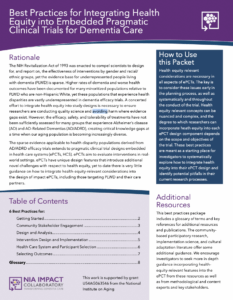
IMPACT Collaboratory DocumentThe NIA IMPACT Collaboratory has created an new document with Best Practices for Integrating Health Equity into Pragmatic Clinical Trials for Dementia Care

The IMPACT Collaboratory’s Leadership and Health Equity Team developed the document to bolster the inclusion of underrepresented people living with dementia in pragmatic trials embedded in healthcare systems, including trials that study Alzheimer disease and related dementias.

The packet provides a best practices for:

  • Getting started
  • Community stakeholder engagement
  • Design and analysis
  • Intervention design and implementation
  • Healthcare system and participant selection
  • Selecting outcomes

The NIA IMPACT Collaboratory is supported by a grant from the National Institute on Aging. Its mission is to advance care for persons with dementia and their caregivers in real-world settings by building national capacity to conduct pragmatic clinical trials that test interventions embedded in healthcare systems.

Read the full document.


February 18, 2022: Building a Resource: The Process of Developing a Trans-stakeholder Framework to Enable Pediatric Drug Development (Perdita Taylor-Zapata, MD)

Speaker

Perdita Taylor-Zapata, MD
Best Pharmaceuticals for Children Act (BPCA) Program Lead and NICHD Program Officer
Obstetric and Pediatric Pharmacology and Therapeutics Branch
National Institute of Child Health and Human Development

Keywords

NIH Best Pharmaceuticals for Children Act; Pediatric Trial Network; Trial design; Pediatric drug development

Key Points

  • The current model for pediatric drug development can be slow and neglect neonates and rare pediatric conditions.
  • The NIH Best Pharmaceuticals for Children Act (BPCA) allows the NIH to conduct clinical trials with off-patent drugs in children.
  • Goals of the BPCA program include developing novel trial designs and including diverse and understudied populations.
  • A new framework to enable pediatric drug development could identify resources to assist in drug development, identify areas in need of further research, provide a pathway for integrating approaches, and connect pediatric researchers.
  • The BPCA went through a rigorous systematic approach to develop a comprehensive resource listing for best practices for pediatric drug trials.

Discussion Themes

Most data collected through the opportunistic model presented is PK data to determine dosing so that a more traditional drug trial can be conducted in the future.

With the right infrastructure in place, such as the Pediatric Trials Network, can substantially improve time to conduct trials.


Read more about the BPCA and their commitment to diversity in pediatric drug trials.


Tags

#pctGR, @Collaboratory1

October 20, 2021: HCSRN Calls for Abstracts and Panel Presentations for 2022 Annual Conference

The Health Care Systems Research Network (HCSRN) is accepting abstracts and panel presentation submissions for the HCSRN 2022 Annual Conference until November 5, 2021. This year’s meeting will be held in Pasadena, California, from April 12 to 14, 2022.

Read complete submission information here.

The HCSRN is a 19-member research network focused on supporting research institutes aligned with healthcare delivery systems. The HCSRN’s mission is to improve individual and population health through research that connects the resources and capabilities of learning healthcare systems.

Learn more about the HCSRN here.

From its founding in 1994, the HCSRN has hosted an annual conference geared toward bringing together a diverse group of researchers, study managers, clinicians, funding agency personnel, and patient-partners to promote collaboration and share findings about research in the real-world care delivery setting. This year’s meeting will focus on “Promoting Collaboration and Partnerships to Advance Health Equity.”

Topic areas for abstracts and panel presentations include:

• Addiction Science/Substance Use
• Cancer
• Cardiovascular Disease
• Chronic Conditions, Multi-Morbidity & Aging Populations
• COVID-19
• Data Science, Informatics & Data Models
• Epidemiology & Surveillance
• Genomics & Precision Medicine
• Health Equity & Social Needs
• Health Care Delivery & Coverage
• Health Policy
• Implementation Science
• Learning Health Systems
• Maternal, Child & Family Health
• Mental Health
• Methods, Design & Analytic Tools
• Patient, Clinician & Health Systems Engagement
• Population Health Improvement
• Technology and Digital Health

Inclusion of Diverse Participants in Pragmatic Clinical Trials: NIH-Hosted Workshop (May-August 2021)

Inclusion of Diverse Participants in Pragmatic Clinical Trials: NIH-Hosted Workshop (May-August 2021)

A workshop focused on the inclusion of diverse participants in pragmatic clinical trials with insights about planning for diversity, engaging participants, learning from implementation science to maximize diversity, and developing a pipeline of diverse investigators

September 21, 2020: IMPACT Collaboratory Opens Application for 2022 Training Workshop

Logo for the NIA IMPACT CollaboratoryThe IMPACT Collaboratory is inviting applications from early- and mid-career researchers for its second annual training workshop, “Building Skills to Conduct Embedded Pragmatic Clinical Trials (ePCTs) Among People Living With Dementia (PLWD) and Their Care Partners.” A limited number of participants will be accepted to attend the event on January 26 and 27, 2022.

This virtual 1.5-day workshop will provide a foundation in practical aspects of designing and conducting ePCTs in Alzheimer disease and related dementias through a combination of panel discussions, small group sessions, and networking opportunities with experts in the field. Workshop modules will focus on integrating health equity into ePCTs, ethical considerations for ePCTs for PLWD and their care partners, and the challenges and opportunities related to conducting ePCTs with care partners of people living with dementia.

Read more about the event and how to apply.

The IMPACT Collaboratory is supported by a grant from the National Institute on Aging. Its mission is to advance care for persons with dementia and their caregivers in real-world settings by building national capacity to conduct pragmatic clinical trials that test interventions embedded in healthcare systems.