April 2, 2021: Lessons from COVID-19: The First Year of the REMAP-CAP Global Adaptive Platform Trial (Derek Angus, MD, MPH)

Speaker

Derek C. Angus, MD, MPH
Chief Healthcare Innovation Officer, University of Pittsburgh Medical Center
Associate Vice Chancellor for Healthcare Innovation, University of Pittsburgh Schools of the Health Sciences
Distinguished Professor and Mitchell P. Fink Endowed Chair
Department of Critical Care Medicine
University of Pittsburgh and UPMC

Topic

Lessons from COVID-19: The First Year of the REMAP-CAP Global Adaptive Platform Trial

Keywords

COVID-19; REMAP-CAP; Adaptive platform trial; Learning health system; Response-adaptive randomization

Key Points

  • REMAP-CAP (Randomized, Embedded, Multifactorial, Adaptive Platform Trial for Community-Acquired Pneumonia) uses a novel adaptive trial design to evaluate a number of treatment options simultaneously and efficiently. This design is able to adapt in the event of pandemics, and increases the likelihood that patients will receive the treatment that is most likely to be effective for them.
  • REMAP-CAP is an international trial with multiple coordinating centers and 300 sites in 19 countries.
  • The REMAP-CAP trial was initially drafted with a prespecified Pandemic Appendix to be activated in the event of an emergent pandemic. In 2020, this mode was activated as REMAP-COVID, which expanded enrollment to include all hospitalized patients with clinically diagnosed or microbiologically confirmed COVID-19.
  • While adaptive platform trials are likely here to stay, there is a need to build comfort with the modeling, inference, and interpretation; build appropriate infrastructure to keep up with the power of the engine; and invest in common data models.

Discussion Themes

It is possible to design adaptive platform trials with a smaller sample size, depending on the research question.

How did you convince study teams to join your effort rather than start their own?

In the future, small trials could be hosted within the REMAP-CAP adaptive platform.

Given the massive inertia in investment to develop adaptive infrastructures, what are your thoughts for funders across institutions and nations?

Read more about REMAP-CAP and how the REMAP-CAP platform was modified to respond to the COVID-19 pandemic.

Tags

#pctGR, @Collaboratory1

April 1, 2021: Grand Rounds Podcast with Dr. Susan Ellenberg on DSMBs for COVID-19 Trials is Available

Prof. Susan EllenbergIn the latest episode of the NIH Collaboratory Grand Rounds podcast, Dr. Adrian Hernandez and Dr. Susan Ellenberg continue their discussion about the challenges of DSMBs and COVID-19 trials. The full March 5 Grand Rounds webinar with Dr. Ellenberg is also available.

March 11, 2021: TSOS Study Intervention Reduces PTSD Symptoms in Injured Patients at Level I Trauma Centers

Photo of Dr. Doug Zatzick
Dr. Doug Zatzick

A collaborative care intervention for injured patients at trauma centers can reduce symptoms of posttraumatic stress disorder (PTSD), according to the results of the Trauma Survivors Outcomes and Support (TSOS) study. The results were published online this week in JAMA Surgery.

The TSOS study, an NIH Collaboratory Demonstration Project, was a stepped-wedge, cluster randomized pragmatic clinical trial testing the delivery of a stepped collaborative care intervention vs usual care for 635 injured patients with PTSD symptoms and comorbid conditions at 25 level I trauma centers in the United States.

Patients in the control group received usual care plus nurse notification about the patient’s high level of distress. Patients in the intervention group received collaborative care consisting of evidence-based medication, cognitive behavioral therapy, and case management. Patients in the intervention group whose PTSD symptoms persisted after initial treatment received stepped-up care, such as medication adjustments or additional psychotherapeutic elements.

After 6 months, the intervention group experienced a significant reduction in PTSD symptoms as compared with the control group. The treatment effect was greater for patients with higher baseline PTSD risk.

“Our study shows that a brief, approximately 2-hour collaborative care intervention delivered by frontline trauma center providers can significantly reduce PTSD symptoms in diverse injury survivors, including survivors of firearm injuries,” said Dr. Doug Zatzick of the University of Washington School of Medicine, the TSOS study’s principal investigator. “Collaborative care may therefore be an optimal treatment approach for trauma-exposed patients treated in acute care medical settings,” he said.

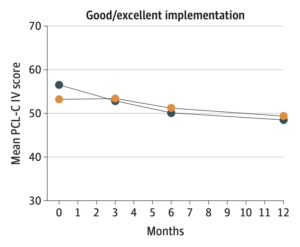
Figure from the TSOS main outcomes paper
Source: JAMA Surg. 2021 Mar 10. doi: 10.1001/jamasurg.2021.0131.

The study also included an implementation process assessment to allow the investigators to examine how the quality of each site’s implementation of the protocol affected study outcomes. The effect of the intervention on PTSD symptoms was greater at trauma centers with good or excellent protocol implementation.

“The upfront integration of an implementation process assessment into the TSOS pragmatic trial design allowed us to identify sites with good/excellent versus fair/poor protocol implementation, a key characteristic in discriminating patient-level PTSD treatment effects,” Zatzick said.

Overall, reduction in PTSD symptoms did not differ significantly between the study arms at 3 and 12 months, and there was no effect on secondary outcomes. However, the subgroup of patients who had firearm injuries and who were treated at sites with good or excellent implementation had among the largest 6-month treatment effects and demonstrated significant treatment effects at 12 months.

TSOS was supported within the NIH Collaboratory by a cooperative agreement from the National Institute of Mental Health and by the NIH Common Fund through a cooperative agreement from the Office of Strategic Coordination within the Office of the NIH Director. Learn more about the NIH Collaboratory Demonstration Projects.

March 5, 2021: Data and Safety Monitoring Boards for Trials of COVID-19 Vaccines: The Challenges (Susan S. Ellenberg, PhD)

Speaker

Susan S. Ellenberg, PhD
Professor of Biostatistics, Medical Ethics, and Health Policy
Perelman School of Medicine
University of Pennsylvania

Topic

Data and Safety Monitoring Boards for Trials of COVID-19 Vaccines: The Challenges

Keywords

COVID-19; Data Monitoring Committee (DMC); Data and Safety Monitoring Board (DSMB); Pandemic; Vaccine trials; Monitoring boundaries; Safety and efficacy; NIH

Key Points

  • With COVID-19, everyone, globally, is an “affected community.” This brings a strong sense of urgency for DSMBs.
  • Several COVID-19 vaccine candidates are studied under the NIH umbrella. A single DSMB, constituted in mid-2020, oversees all these COVID-19 trials and reports to that trial’s Oversight Group.
  • Subgroup issues have been important in COVID-19 vaccine trials. The DSMB monitors carefully for representation of subgroups of interest in trial participants, including those over age 65, Black, Hispanic, and participants with comorbidities that may predispose them to more serious disease.

Discussion Themes

Has there been pressure to prematurely discontinue any of the COVID-19 vaccine trials?

How accurate is the post-vaccine data being collected—especially since these vaccines have only emergency use authorization?

What are your thoughts on future trial design if we have another pandemic?

See more COVID-19 resources for researchers and access other webinars in the COVID-19 Grand Rounds series on the Collaboratory’s COVID-19 resource page. Read more about data and safety monitoring in the Living Textbook.

Tags

#pctGR, @Collaboratory1

March 9, 2021: COVID-19 Grand Rounds Continues With the Gates MRI Virtual COVID-19 Trial

Drs. Mohamed Bassyouni and Jintanat AnanworanichIn this week’s COVID-19 Grand Rounds session, Drs. Mohamed Bassyouni and Jintanat Ananworanich of the Bill and Melinda Gates Medical Research Institute will present “Lessons Learned From the Gates MRI Virtual COVID-19 Trial.” The Grand Rounds session will be held on Friday, March 12, at 1:00 pm eastern. Join the online meeting.

The NIH Collaboratory Coordinating Center is using its popular Grand Rounds platform to share late-breaking research and promote resources in support of clinical researchers affected by the COVID-19 public health emergency.


For previous COVID-19 Grand Rounds, and more news and resources related to the COVID-19 public health emergency, see the COVID-19 Resources page.

March 2, 2021: Grand Rounds Continues With Challenges of DSMBs in COVID-19 Vaccine Trials

Prof. Susan EllenbergIn this week’s COVID-19 Grand Rounds session, Dr. Susan Ellenberg of the University of Pennsylvania, will present “Data and Safety Monitoring Boards for Trials of COVID-19 Vaccines: The Challenges.” The Grand Rounds session will be held on Friday, March 5, at 1:00 pm eastern. Join the online meeting.

The NIH Collaboratory Coordinating Center is using its popular Grand Rounds platform to share late-breaking research and promote resources in support of clinical researchers affected by the COVID-19 public health emergency.

For previous COVID-19 Grand Rounds, and more news and resources related to the COVID-19 public health emergency, see the COVID-19 Resources page.

February 12, 2021: Leveraging RWD in a Multinational Trial: Results from the Other eHARMONY [HARMONY Outcomes EHR Ancillary Study] (Lesley Curtis, PhD, Bradley Hammill, PhD, Sudha Raman, PhD)

Speakers

Lesley Curtis, PhD
Professor in Population Health Sciences
Department of Population Health Sciences
Duke University School of Medicine
 
Bradley Hammill, DrPH
Associate Professor in Population Health Sciences
Department of Population Health Sciences
Duke University School of Medicine
 
Sudha Raman, PhD
Assistant Professor in Population Health Sciences
Department of Population Health Sciences
Duke University School of Medicine

Topic

Leveraging RWD in a Multinational Trial: Results from the Other eHARMONY (HARMONY Outcomes EHR Ancillary Study)

Keywords

Electronic health records; eHARMONY; Real-world data; DataMart; Common data model; Data sensitivity/specificity

Key Points

  • While the electronic health record (EHR) is a rich source of clinical data, the fitness of EHR data for use in high-quality clinical research has not been rigorously evaluated.
  • The HARMONY trial aimed to determine the effect of albiglutide, when added to standard blood glucose lowering therapies, on major cardiovascular events in patients with type 2 diabetes mellitus. eHARMONY was an ancillary study conducted alongside the HARMONY trial, with these objectives:
    • Understand how EHR data are used to facilitate trial recruitment and what the barriers are to that use
    • Evaluate the fitness of real-world data (RWD) data for use in populating baseline characteristics in the electronic case report form
    • Evaluate the fitness of RWD data for use in identifying clinical endpoints
  • In the eHARMONY study, assessing data quality and fitness of a site’s EHR data was often not possible. Among the lessons learned were:
    • Each strategy required ongoing feasibility assessment
    • Standalone clinical research sites had very little (extractable) EHR data about patients
    • Lab results and medications were either not extractable or not mapped to a useful terminology
    • Many sites did not participate because they knew they could not perform this work, and many sites that promised to do this work could not deliver

Discussion Themes

What structural and behavioral factors have you encountered? For example, a healthcare system might not provide a particular service, or a healthcare system provides the service but people might choose to receive it elsewhere.

What about the overall cost of the trial? Has anything changed over the last 5 years—or are we consigned to spend hundreds of millions on outcome trials?

To realize the potential of real-world data in clinical trials, be mindful of the actual context of the trial, and (1) keep it simple, (2) collect only the data you need for the question at hand, and (3) remember that clinical research is not the priority for healthcare systems.

It is also essential for studies to report what does not work.

Read more about how real-world data (RWD) and real-world evidence (RWE) are playing an increasing role in health care decisions.

Tags

#pctGR, @Collaboratory1

February 10, 2021: New Funding Opportunities Support Investigators at All Levels in Advancing Pragmatic Clinical Research

Logo for the NIA IMPACT CollaboratoryThe NIA IMPACT Collaboratory has announced 3 new funding opportunities for researchers at all levels who are interested in pragmatic clinical trials embedded in healthcare systems (ePCTs). They include funding for NIH Collaboratory Trials, a new scholars program for junior and senior investigators, and a new cycle of funding for 1-year pilot studies.
  • NIH Collaboratory Trials Program: The IMPACT Collaboratory will fund up to 2 NIH Collaboratory Trials designed as full-scale ePCTs that test nonpharmacological interventions for people living with Alzheimer disease and related dementias (ADRD) and their care partners. The projects should generate evidence on effective care delivery practices that can be expanded or implemented in other healthcare systems. An informational webinar will be held on Thursday, February 11, at 2:00 pm ET.
  • Health Care System Scholars Program – A new Health Care Systems Embedded Research Scholars Program offers junior and senior investigators an opportunity to work directly with healthcare systems interested in improving the care provided to people living with dementia and their care partners. A informational webinar will be held on Thursday, February 11, at 1:00 pm ET.
  • Pilot Grants Program: One-year pilot studies are meant to generate preliminary data necessary to design and conduct future full-scale ePCTs. The IMPACT Collaboratory will consider applications for pilot studies that test nonpharmacological interventions embedded in healthcare system for people living with ADRD and their care partners. An informational webinar will be held on Monday, February 22, at 4:00 pm ET.

The NIA IMPACT Collaboratory is supported by a grant from the National Institute on Aging. Its mission is to advance care for persons with dementia and their caregivers in real-world settings by building national capacity to conduct pragmatic clinical trials that test interventions embedded in healthcare systems.

February 2, 2021: NIH Collaboratory COVID-19 Grand Rounds Continues With the Brazilian COALITION Experience

Dr. Renato LopesIn this week’s COVID-19 Grand Rounds session, Dr. Renato Lopes of Duke University and the Brazilian Clinical Research Institute, will present “Generating High-Quality Evidence During a Pandemic: The Brazilian COALITION Experience.” The Grand Rounds session will be held on Friday, February 5, at 1:00 pm eastern. Join the online meeting.

The NIH Collaboratory Coordinating Center is using its popular Grand Rounds platform to share late-breaking research and promote resources in support of clinical researchers affected by the COVID-19 public health emergency.

For previous COVID-19 Grand Rounds, and more news and resources related to the COVID-19 public health emergency, see the COVID-19 Resources page.

January 25, 2021: Grand Rounds Podcast with Dr. Emily O’Brien on HERO-TOGETHER is Available

In the latest episode of the NIH Collaboratory Grand Rounds podcast, Dr. Adrian Hernandez and Dr. Emily O’Brien continue the discussion about the HERO-TOGETHER initiative that aims to understand how healthcare workers do after receiving the COVID-19 vaccination. The full January 8 Grand Rounds webinar with Dr. O’Brien is also available.