
February 23, 2026: New Podcast Episode Outlines Guidance for Monitoring in Decentralized Trials

In a new episode of the NIH Collaboratory Podcast, Drs. Christopher Lindsell and Adrian Hernandez discussed the need for virtual vigilance in decentralized trials.

Listen to the podcast. For alerts about new episodes, subscribe for free on Spotify, Amazon Music, Apple Podcasts, or SoundCloud.

Decentralized trials  move research activities from a centralized location, such as a hospital, to a location that is closer to the patient, such as their home or their local pharmacy. In addition to being more convenient for participants, decentralized trials provide research teams with the opportunity to reach a broader population.

Lindsell and Hernandez co-authored a JAMA Viewpoint entitled “Ensuring Virtual Vigilance in Decentralized Clinical Trials.” They also collaborated on the recently published Living Textbook Chapter on Decentralized Pragmatic Clinical Trials. In the podcast, they explored the opportunities that decentralized trials present and the reasons why monitoring is critical to obtaining high-quality results.

“There are 4 areas we have to think of really deeply,” Lindsell said, “Do we have the right person enrolled in the study and giving us the data? Did we get them the right intervention? And are they adherent and are they following the treatment in the right way? Are they giving us the right data and are we reacting to those data in a timely and an appropriate way?”

Research teams conducting decentralized trials should take advantage of different data streams, including metadata, to characterize ongoing engagement and ensure the appropriate engagement of participants throughout a study.

Lindsell is professor and cochief of biostatistics and bioinformatics, director of data science and biostatistics at the Duke Clinical Research Institute, and director of biostatistics and bioinformatics at the Duke Clinical and Translational Science Institute—all at Duke University. Hernandez, who serves as co–principal investigator of the NIH Pragmatic Trials Collaboratory Coordinating Center, is a professor of medicine and vice dean in the Duke University School of Medicine and executive director of the Duke Clinical Research Institute.
October 25, 2023: In This Friday’s PCT Grand Rounds, Krumholz Presents PaxLC Trial of Paxlovid for Long COVID

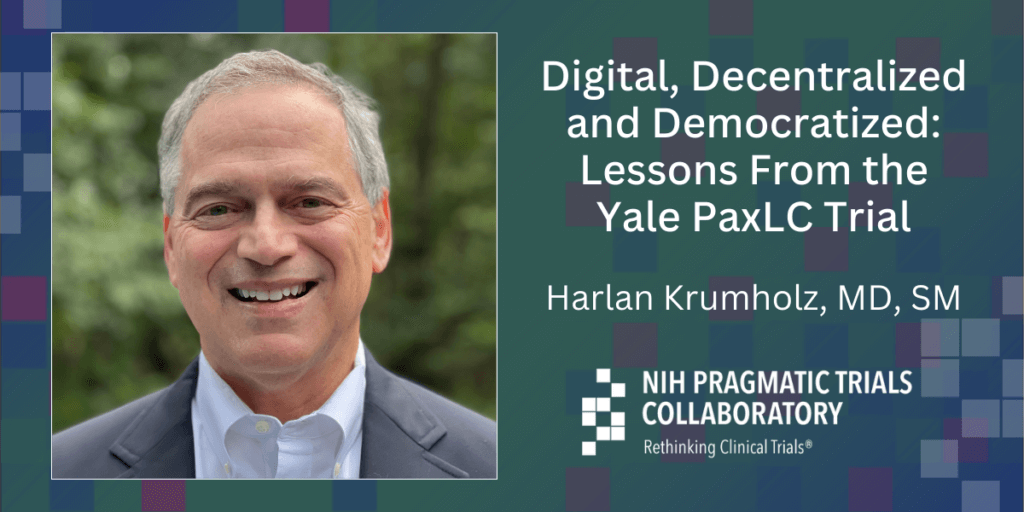
Banner showing a headshot of Dr. Harlan Krumholz and the title of his upcoming PCT Grand Rounds Session, "Digital, Decentralized and Democratized: Lessons From The Yale PaxLC Trial."In this Friday’s PCT Grand Rounds, Harlan Krumholz of Yale University will present “Digital, Decentralized and Democratized: Lessons From the Yale PaxLC Trial.”

The Grand Rounds session will be held on Friday, October 27, 2023, at 1:00 pm eastern.

The PaxLC Trial is a decentralized study of Paxlovid in adult participants with long COVID. Krumholz, the principal investigator for the trial, is the Harold H. Hines, Jr Professor of Medicine at Yale University and the director of the Yale-New Haven Hospital Center for Outcomes Research and Evaluation.

Join the online meeting.

Grand Rounds June 30, 2023: Decentralized Trials – From Guidance to Reality & What’s Left (Adrian Hernandez, MD, MHS; Pamela Tenaerts, MD, MPH; Craig Lipset, MPH)

Speakers:

Adrian Hernandez, MD, MHS
Director, Duke Clinical Research Institute

Pamela Tenaerts, MD, MPH
Chief Scientific Officer, Medable

Craig Lipset, MPH
Co-Chair, Decentralized Trials & Research Alliance

Topic: Decentralized Trials – From Guidance to Reality & What’s Left

Date: Friday, June 30, 2023, 1:00-2:00 p.m. ET

To join the online meeting:

Click the Zoom Meeting link below:

https://duke.zoom.us/j/96153659804?pwd=VmNJVDE5VmtFbUFHY0lZeTM1K0Y5QT09

Meeting ID: 961 5365 9804
Passcode: 12345

One tap mobile

+16468769923,,96153659804#,,,,*12345# US (New York)
+16469313860,,96153659804#,,,,*12345# US
Find your local number: https://duke.zoom.us/u/abvw6X2hYV

Audio Dial in Options

US:  1-646-876-9923
International: https://duke.zoom.us/u/abvw6X2hYV

Meeting ID: 961 5365 9804
Passcode: 12345

Grand Rounds September 30, 2022: CTTI’s Digital Health Trials Hub Recommendations and Resources to Run Your Digital Health Trial (Marianne Chase, MGH, CTTI Team Lead, Jörg Goldhahn, ETH Zurich, CTTI Team Lead)

Speakers

Marianne Chase
Senior Director Clinical Trial Operations
Neurological Clinical Research Institute
Massachusetts General Hospital


Jörg Goldhahn, MD
Medical Director
Director of Institute for Translational Medicine
ETH Zurich


Keywords

Clinical Trial Transformation Initiative (CTTI); Decentralized Clinical Trials (DCTs); Digital endpoints; Developing novel endpoints


Key Points

  • The Clinical Trial Transformation Initiative (CTTI) envisions an evidence generating system with trials that are patient-centered, integrated into health processes, quality, leverage all available data, and improve population health.
  • Digital Health Trials can help research obtain better and more reliable information, conduct more patient-centric research, and move at higher speed and efficiency. We need to work together to find ways to evaluate the potential benefits and share lessons learned broadly.
  • CTTI’s Decentralized Clinical Trials Project was a 1 year accelerated project to deliver updated recommendations and best practices for Decentralized Clinical Trials (DCTs).
  • DCTs range from near-traditional to hybrid to fully remote trials that conduct study visits away from the central study site using strategies such as tele-visits or home delivery of investigational products.
  • Decentralized trials require novel technology and digital endpoints. CTTI wants to increase meaningful novel digital endpoints that are clinically relevant and fit-for-purpose.
  • CTTI has developed 35 tools to help study teams develop meaningful measures, map individual medical product development, navigate regulatory requirements, and help implement other CTTI recommendations.

Discussion Themes

– One of the key challenges in the field of decentralized trials and digital measures is sharing tools and collaboration between companies. There’s a growing understanding that we have to collaborate on the endpoints and digital technology to advance the field.

– A feasibility study is a good way to gain insight into possible snags when participants may not be tech savvy. Tech support at the site level is important to addressing problems in a study.


Read more about the Clinical Trial Transformation Initiative and CTTI’s vision for clinical trials in 2030. Find CTTI’s recommendations and resources.


Tags

#pctGR, @Collaboratory1