Patient Perspectives on Data Sharing

Data Sharing and Embedded Research


Section 4


Patient Perspectives on Data Sharing

While understanding of patient perspectives about participating in research is growing, particularly with regard to consent, disclosure, and non-disclosure of research activities, little is known about trial participant’ views on data sharing. Although pressure is increasing from journal editors, research sponsors, and patient groups for more sharing of participant-level data, concerns about privacy and informed consent are often invoked as reasons to limit the amount of sharing (Godlee and Groves 2012; Institute of Medicine (U.S.) and Institute of Medicine (U.S.) 2015; Krumholz et al. 2016; Taichman et al. 2016).

One recent study surveyed clinical trial participants at 3 major institutions about their perspectives regarding the risks and benefits of sharing participant-level data (Mello et al. 2018). Most participants believed the benefits of data sharing outweighed the potential negatives and were willing to share their data regardless of the intended use (i.e., for research by drug companies and/or academic institutions) with the exception of use for litigation purposes.

It is worth noting that this study surveyed patients in explanatory clinical trials who had consented to participate and who were recruited by their physician. For an ePCT that involves a waiver of consent, participant views on data sharing might be very different. As expressed earlier in this chapter, healthcare system leaders have strong opinions about sharing data from ePCTs, and individual participants might also.  Additionally, the findings of the study by Mello et al are in contrast to a previous report on participant views regarding sharing EHR data. In this case, participants cared most about the potential uses of the shared information and were substantially less willing to share with for-profit pharmaceutical and device companies than with academic researchers (Grande et al. 2013). As another example of how participant views might vary depending on study type, in a survey of patients regarding participating in quality improvement initiatives, approximately half felt comfortable with data sharing as long as they were not able to be individually identified (Kaplan et al. 2016).

More work is needed to understand participant views on data sharing from ePCTs. Even though we do not have a full understanding of patient perspectives, the demand for data sharing continues to accelerate.

SECTIONS

CHAPTER SECTIONS

REFERENCES

back to top

Godlee F, Groves T. 2012. The New BMJ Policy on Sharing Data from Drug and Device Trials. BMJ 345: e7888–e7888. https://doi.org/10.1136/bmj.e7888. PMID: 23169872.

Grande D, Mitra N, Shah A, et al. 2013. Public Preferences about Secondary Uses of Electronic Health Information. JAMA Intern Med. 173: 1798–1806. https://doi.org/10.1001/jamainternmed.2013.9166. PMID: 23958803.

Institute of Medicine (U.S.), and Institute of Medicine (U.S.), eds. 2015. Sharing Clinical Trial Data: Maximizing Benefits, Minimizing Risk. Washington, D.C: National Academies Press. DOI: 10.17226/18998. PMID: 25590113.

Kaplan SH, Gombosev A, Fireman S, et al. 2016. The patient’s perspective on the need for informed consent for minimal risk studies: Development of a survey-based measure. AJOB Empirical Bioethics. 7:116–124. doi:10.1080/23294515.2016.1161672.

Krumholz HM, Terry SF, Waldstreicher J. 2016. Data Acquisition, Curation, and Use for a Continuously Learning Health System. JAMA. 316: 1669–70. https://doi.org/10.1001/jama.2016.12537.P MID: 27668668.

Mello MM, Lieou V, Goodman SN. 2018. Clinical Trial Participants’ Views of the Risks and Benefits of Data Sharing. NEJM. 378: 2202–11. https://doi.org/10.1056/NEJMsa1713258. PMID: 29874542 .

NIH Data Sharing Policy and Implementation Guidance March 5, 2003 Version. n.d. Accessed February 10, 2015. http://grants.nih.gov/grants/policy/data_sharing/data_sharing_guidance.htm.

Taichman DB, Backus J, Baethge C, et al. 2016. Sharing Clinical Trial Data: A Proposal From the International Committee of Medical Journal Editors. Ann Intern Med. 164: 505. https://doi.org/10.7326/M15-2928. PMID: 26792258.

Version History

Published December 16, 2018.

FAQ- ARCHIVED


Version History

Published December 17, 2018

FAQ

Building Partnerships and Teams to ensure a successful trial


Section 9


FAQ

Frequently Asked Questions

Question

Answer

What if the health system leadership is resistant to your proposed intervention? What do you do when the providers don’t think the issue you want to study is important? When engaging health system partners, frame your research question to show how knowing the answer will benefit their priorities. Align your ideas with their mission, promote cost-saving and enhancement of patients’ needs. It’s all about head, heart, and heat. If you can get to the place where the system leaders own it, then they will want to see the results. Set the expectation for partners to take pride in doing research, understand what they don’t know, and be a part of the team.
What do you do when there is a real conflict in priorities? How do you wrestle divergence of opinions with different priorities? Partner with a local champion. There are multiple ways to find a champion for your research. It could be frontline clinicians and staff or health system leadership.
Nobody wants to volunteer or give up anything for free, and it takes resources to generate a pilot that will produce evidence to get the grant. How do I get past these roadblocks? Fully understand what the possible wins are, and frame the project around what the health system will gain. The rewards could be reductions in costs, increased patient satisfaction, or alignment with organizational goals and the mission of the health system.

SECTIONS

CHAPTER SECTIONS


Version History

Published December 15, 2018

Additional Resources

Developing a Compelling Grant Application


Section 8

Additional Resources

NIH Application Guide Provides guidance on preparing to apply and on writing and submitting applications for clinical trials to NIH.
Simplified Review Framework for NIH Research Project Grant Applications Describes a new framework to better focus peer reviewers on the key questions needed to assess the scientific and technical merit of proposed research projects.
New Review Criteria for Research Project Applications Involving Clinical Trials Describes NIH review criteria for clinical trial applications.
Research Methods Resources Website Provides resources for investigators considering group- or cluster-randomized designs, including lists of NIH webinars, key references, and statements to help investigators prepare sound applications and avoid methodological pitfalls.
PCORI’s Research Funding Process Details each step of the PCORI funding process.
Value of Engagement in Research Defines engagement in research and introduces PCORI’s Foundational Expectations for Partnerships in Research.

SECTIONS

CHAPTER SECTIONS

DISCLAIMER

back to top

The views expressed in this chapter should not be interpreted as representing the official views of the US Department of Health and Human Services, the National Institutes of Health, the National Institute on Aging, the National Center for Complementary and Integrative Health or PCORI, except where noted.

ACKNOWLEDGEMENT

back to top

The authors thank Dr. Tracy Wang, the chief officer for Comparative Clinical Effectiveness Research (CER) at the Patient-Centered Outcomes Research Institute (PCORI), for her review of the content related to PCORI.


Version History

October 18, 2024: Added information about PCORI as a funder (changes made by K. Staman).

March 29, 2024: Added resource (changes made by K. Staman).

July 2, 2020: Minor corrections to layout and formatting (changes made by D. Seils).

Published December 13, 2018

Award Status

Developing a Compelling Grant Application


Section 7

Award Status

For NIH-Funded Studies

If an NIH grant is awarded, the investigator receives a notice of award, which is a legally binding document that contains award details, grant payment information, terms, and conditions. When you receive a notice of award, it is important to carefully review the document to determine if there are any restrictions or requirements that must be resolved before starting enrollment. Note that some aspects of the application may change during the grant approval process, such as updating milestones and meeting IC-specific requirements for safety monitoring.

If a project is not funded, the program official is available to explain the scoring and to help investigators decide whether they should revise and resubmit the application.

For PCORI-Funded Studies

Applicants for PCORI funding are notified through email informing them whether their proposals are approved. It is important to note that PCORI does not fund grants, but rather contracts. A project is not officially funded until PCORI conducts their final review, and the applicant’s institution enters into a contract with them. The contract is formed collaboratively, with milestones that create the basis on the contract. There is an expectation that these milestones will be reported to PCORI.

SECTIONS

CHAPTER SECTIONS

DISCLAIMER

back to top

The views expressed in this chapter should not be interpreted as representing the official views of the US Department of Health and Human Services, the National Institutes of Health, the National Institute on Aging, the National Center for Complementary and Integrative Health or PCORI, except where noted.

ACKNOWLEDGEMENT

back to top

The views expressed in this chapter should not be interpreted as representing the official views of the US Department of Health and Human Services, the National Institutes of Health, the National Institute on Aging, the National Center for Complementary and Integrative Health or PCORI, except where noted.


Version History

October 18, 2024: Added information about PCORI as a funder (changes made by K. Staman).

July 2, 2020: Minor corrections to layout and formatting (changes made by D. Seils).

Published December 13, 2018

Review Criteria

Developing a Compelling Grant Application


Section 6

Review Criteria

For NIH-Funded Studies

Research applications are reviewed and scored by a group of scientific experts from the extramural community in a process called peer review based on significance, investigators, innovation, approach, and environment. RFAs and PARs often include additional nonstandard review criteria. In addition, all applications that include an NIH-defined clinical trial have specific review criteria, including study timeline; milestones; resources and data sharing plan; protection of human subjects; inclusion of women, minorities, and individuals across the lifespan; and addressing potential biohazards. For applications that include distinct phases, such as the UG3/UH3 mechanism used by the NIH Collaboratory Trials, reviewers assess the clarity and appropriateness of proposed milestones that must be met for the transition from the first phase to the second.

In response to concerns regarding the complexity of the peer review process for research project grants and reputational bias impacting peer review outcomes, the NIH is implementing a new, simplified review framework starting January 25, 2025. The new review criteria are intended to help reviewers hone in on the most important questions to determine the merit of research projects. The new criteria reviewers will consider are as follows:

  1. Importance of the Research (Covers Significance and Innovation), scored 1-9
  2. Rigor and Feasibility (Covers Approach), scored 1-9
  3. Expertise and Resources (Covers Investigator and Environment), scored sufficient or insufficient

Reorganizing the review criteria into broader factors simplifies the process and minimizes the potential for reputational bias. Before this change, peer reviewers were responsible for assessing policy compliance of research, which could distract them from determining the actual merit of research. The new framework is expected to have minimal impact on how applications are written.

For PCORI-Funded Studies

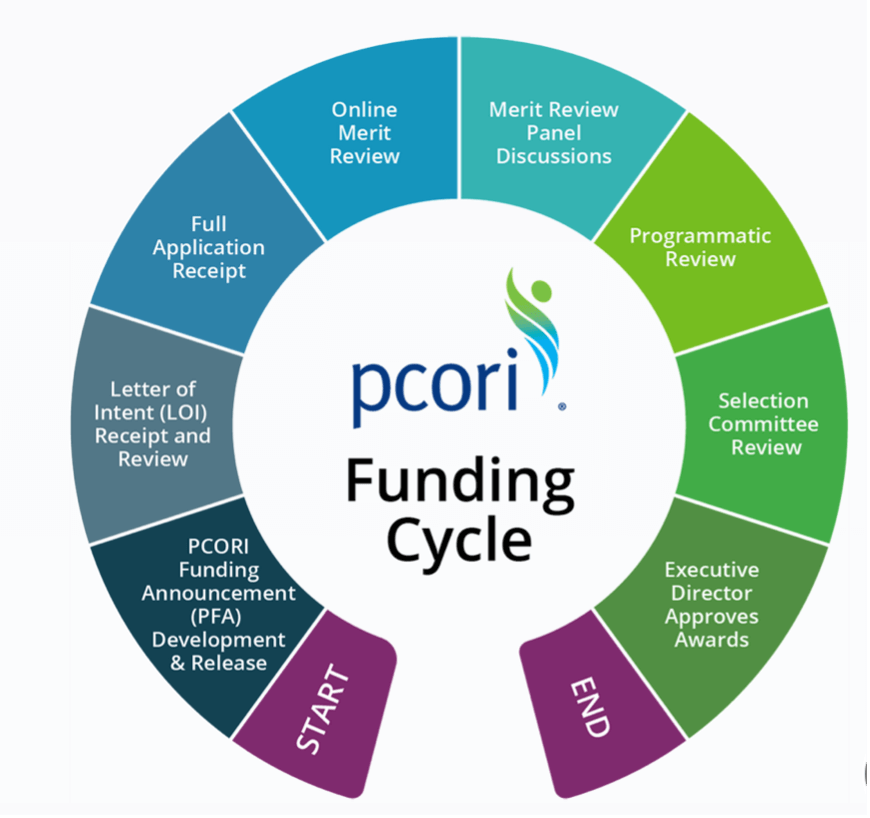
PCORI evaluates LOIs for administrative compliance and programmatic responsiveness and subsequently notifies applicants of a decision to advance their projects to the full application stage (Figure). If the full application is reviewed and approved to proceed to the next step, it moves into the merit review process. Merit review consists of a panel of external experts including patients, clinicians, and researchers who evaluate applications to determine adherence to PCORI’s Methodology Standards, appropriate human subjects protections, and the merit of the study. The proposals also go through selection committee review (a sub-set of the board of governors) to ensure the proposals meet the mission of PCORI and that the results of the study can penetrate into practice. Following review, the panel holds discussion and scores the application. The slate of applications is reviewed by the Standing Selection Committee, then advanced to the Executive Director for approval. All applicants receive detailed feedback from merit review that supports resubmission for those who did not receive funding.

Figure. PCORI Funding Cycle

Funding Announcements are offered in 3 cycles across the year with standard due dates, although extensions for cause of up to 24 hours may be requested.

Inclusion of patients/stakeholders in the entire research process, including early and ongoing engagement, is necessary for PCORI funding. These crucial partnerships can fill knowledge gaps, improve scientific merit, and most importantly, enhance ability for results to be implemented in clinical settings.

Common Pitfalls Seen in Applications

  • Overly ambitious—proposes research beyond the length of the application
  • Missing or inappropriate comparison groups (for more information, see the chapter on Experimental Designs and Randomization Schemes)
  • Lack of sufficient expertise or skilled collaborators needed to complete the studies
  • Lack of diverse sites to ensure generalizability of findings
  • Insufficient publications in the area of proposed studies
  • Studies that lack appropriate statistical power to address the primary hypothesis
  • Lack of documentation and experience needed to recruit the population for the study

SECTIONS

CHAPTER SECTIONS

DISCLAIMER

back to top

The views expressed in this chapter should not be interpreted as representing the official views of the US Department of Health and Human Services, the National Institutes of Health, the National Institute on Aging, the National Center for Complementary and Integrative Health or PCORI, except where noted.

ACKNOWLEDGEMENT

back to top

The authors thank Dr. Tracy Wang, the chief officer for Comparative Clinical Effectiveness Research (CER) at the Patient-Centered Outcomes Research Institute (PCORI), for her review of the content related to PCORI.


Version History

October 18, 2024: Added information about PCORI as a funder (changes made by K. Staman).

March 29, 2024: Minor updates to text (Changes made by K. Staman).

July 2, 2020: Minor corrections to layout and formatting (changes made by D. Seils).

Published December 13, 2018

Write a Strong Proposal That Addresses Review Criteria

Developing a Compelling Grant Application


Section 4

Write a Strong Proposal That Addresses Review Criteria

If responding to an NIH or PCORI funding opportunity announcement, tailor the application to address all of the specific instructions and review criteria. Investigators should read and reread the funding opportunity to be sure they address all requirements.

When writing the grant application, investigators should simply and clearly explain the pragmatic trial and justify why this design will be best for testing the research hypothesis. The application should clearly describe what elements of the study design are pragmatic (or not) and justify the design choices to balance the important issues of generalizability and rigor of the pragmatic trial. Remember that the goal of the application is to convince the reviewers that the trial is worth doing and feasible. Include a logical plan for how the planning and implementation of the trial will be conducted.

Before submitting the grant application, it is highly recommended that you obtain feedback about the proposed study from partners, including health system partners, statisticians, patients, and other collaborators.

For NIH-Funded Studies

Within a NOFO, there are portions describing the general purpose and type of research that the NOFO will support, instructions for developing the application, and review criteria that will be used to evaluate the application. For NOFOs that use phased award mechanisms (eg, UH2/UH3, UG3/UH3, R61/R33), the activities that will be conducted in each phase should be clearly described. The application should highlight strengths and identify weaknesses and strategies to overcome them.

If the proposed study meets NIH’s definition of a clinical trial, investigators will be required to include the NIH Human Subjects and Clinical Trials Information Form for the application to describe all of the elements of the study design. Investigators can use eRA Commons to submit the application and track the status of the application through review.

For PCORI-Funded Studies

All PCORI studies must adhere to rigorous PCORI Methodology Standards. To respond to an opportunity, applicants are required to submit of a Letter of Intent (LOI) that includes all requirements outlined in the announcement (See the LOI cheat sheet and tips for creating a responsive LOI).

PCORI offers engagement awards to assist in convening patient stakeholders and community partners as a way to prepare for applications, allowing investigators to convene an in-person meeting or have a series of meetings that help shape study design.

PCORI created the Foundational Expectations for Partnerships in Research to help investigators consider how to meaningfully engage with patients and partners. The document outlines the following features of a successful partnership:

  • Diversity & Representation
  • Early & Ongoing Engagement
  • Dedicated Funds for Engagement & Partner Compensation
  • Build Capacity to Work as a Team
  • Meaningful Inclusion of Partners in Decision Making
  • Ongoing Review & Assessment of Engagement


Dos and Don'ts of a Compelling Research Application

Do

Don't

  • Justify the research
  • Skip any steps (such as the literature review)
  • Include pilot data
  • Use a dense or confusing writing style
  • Address potential overlaps
  • Use appendix inappropriately
  • Reduce complexity
  • Include untestable aims
  • Ensure aims are capable of advancing the field
  • Include non-relevant aims or fishing expeditions
  • Choose appropriately expert personnel for a multidisciplinary team
  • Assume that prior collaboration is irrelevant
  • Link data collection and analysis to aims
  • Justify the use of multiple sites and sample size

NIH Data Sharing Policy

NIH released the final NIH Policy for Data Management and Sharing with the aim of fostering the management and sharing of scientific data procured from NIH-funded or conducted research. This policy details the requirements of submission of Data Management and Sharing Plans in compliance with NIH Institute, Center, or Office-approved Plans.

The final policy requires the submission of a plan for extramural grants at application. While this allows for the ability to fund data sharing through grants and to include data sharing in the budget, the intention is to promote data sharing as a crucial part of research, rather than a clerical task. Lastly, this policy outlines the balance between data sharing and maintaining the confidentiality of patient data.

PCORI’s Policy for Data Management and Data Sharing state the expectations that applicants for PCORI funding demonstrate a willingness to support open science, including the sharing of data from their PCORI-funded research. A data management and sharing plan is not required at the applications stage, but awardees must submit such a plan as part of the Full Protocol. For awardees depositing into a PCORI-designated data repository, PCORI will cover reasonable costs associated with the effort needed to prepare, deposit, and maintain data in the repository for a period of at least 7 years after acceptance of the Final Research Report.

SECTIONS

CHAPTER SECTIONS

Resources

Building Partnerships to Ensure a Successful Trial
This chapter of the Living Textbook describes partner engagement throughout the ePCT life cycle, including grant development. Healthcare system leaders can provide valuable advice regarding topics and grants for ePCTs.

Patient Engagement
This chapter of the Living Textbook describes how patients are key partners in ePCTs and can lend unique perspectives throughout the research process.

DISCLAIMER

back to top

The views expressed in this chapter should not be interpreted as representing the official views of the US Department of Health and Human Services, the National Institutes of Health, the National Institute on Aging, the National Center for Complementary and Integrative Health or PCORI, except where noted.

ACKNOWLEDGEMENT

back to top

The authors thank Dr. Tracy Wang, the chief officer for Comparative Clinical Effectiveness Research (CER) at the Patient-Centered Outcomes Research Institute (PCORI), for her review of the content related to PCORI.


Version History

October 18, 2024: Added information about PCORI as a funder (changes made by K. Staman).

March 29, 2024: Minor updates to text; added data sharing policy (changes made by K. Staman).

July 2, 2020: Minor corrections to layout and formatting (changes made by D. Seils).

February 11, 2020: Added resource: Building Partnerships to Ensure a Successful Trial (changes made by K. Staman).

Published December 13, 2018

Find the Notice of Funding Opportunity

Developing a Compelling Grant Application


Section 3

Find the Notice of Funding Opportunity

Watch the video module: Finding the Right NIH Funding Opportunity

The program official may recommend specific notice of funding opportunities (NOFOs) for the proposed application. Each IC uses different types of Funding Opportunity Announcements for clinical trial applications, so it is important to confirm that the IC you want to receive your application is participating in the NOFO that you use for your submission. Part 1 of the NOFO will list all of the participating organizations and the components of that organization that are participating. NIH advertises availability and grant support through Funding Opportunity Announcements in the NIH Guide for Grants and Contracts or Grants.gov.

There are 2 main types of NOFOs commonly used by NIH for clinical trial applications:

  • Request for Applications (RFA)
    • This type of NOFO is used when there are specific areas of science where more research is needed, and applications are encouraged for investigator-initiated research in this specific area of science. RFAs have specific funds designated for the area of science described in the NOFO and typically have a one-time specific deadline.
  • Program Announcements (PA, PAS, PAR)
    • This type of NOFO is used when there is an area of scientific interest for one or more ICs where investigator-initiated research is needed. These NOFOs are generally less specific than RFAs and often have multiple receipt dates.
    • Parent Announcements are a type of program announcement that are more generic and allow investigators to submit research in any area of science to any of the participating ICs. Typically, many, but not all, NIH ICs participate in these parent NOFOs. If there is not a focused RFA, PA, PAR, or PAS for your area of research, then applying via a parent announcement NOFO is an acceptable option, as long as the IC you want to receive your application participates in the parent NOFO.

PCORI Funding Opportunities

PCORI funding opportunities focus on patient-centered comparative clinical effectiveness research (CER), that is research that compares the benefits and potential harms of different health care options to provide evidence that patients and other health care decision makers need to make informed choices. Funded projects must be designed, conducted in partnership with patients and other healthcare stakeholders.

PCORI offers 2 main types of CER funding opportunities:

Broad Funding Announcements: This type of funding invites investigator initiated research in any health topic area. Applicants must relate their research to at least 1 of the following PCORI National Priorities for Health.

  • Increase Evidence for Existing Interventions and Emerging Innovations in Health
  • Enhance Infrastructure to Accelerate Patient-Centered Outcomes Research
  • Advance the Science of Dissemination, Implementation, and Health Communication
  • Achieve Health Equity
  • Accelerate Progress Toward an Integrated Learning Health System.

Focused Funding Announcements: This type of funding seeks applications on specific, high-impact topics selected through patient/stakeholder input.

PCORI also funds projects that support CER, such as methodology studies, as well as projects that support engagement in research and dissemination and implementation of PCORI-funded research findings.

SECTIONS

CHAPTER SECTIONS

DISCLAIMER

back to top

The views expressed in this chapter should not be interpreted as representing the official views of the US Department of Health and Human Services, the National Institutes of Health, the National Institute on Aging, the National Center for Complementary and Integrative Health or PCORI, except where noted.

ACKNOWLEDGEMENT

back to top

The authors thank Dr. Tracy Wang, the chief officer for Comparative Clinical Effectiveness Research (CER) at the Patient-Centered Outcomes Research Institute (PCORI), for her review of the content related to PCORI.


Version History

October 18, 2024: Added information about PCORI as a funder (changes made by K. Staman).

March 29, 2024: Minor updates to text (changes made by K. Staman).

January 22, 2021: Added embedded video (change made by G. Uhlenbrauck).

July 2, 2020: Minor corrections to layout and formatting (changes made by D. Seils).

Published December 13, 2018

Find the Right Program Official and Study Section

Developing a Compelling Grant Application


Section 2

Find the Right Program Official and Study Section

The NIH is a major funder of health research and comprises 27 institutes and centers (ICs), each with its own mission, budget, scientific priority, funding strategy, and staff (including those who work with applicants, such as program officials, scientific review officers, and grants management officers).

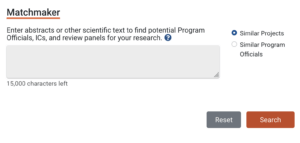
Early in the planning of developing any application, including those for a pragmatic trial, NIH recommends contacting a program official at one of the ICs whose mission most closely matches the trial. The purpose of this contact is to talk to a program official who can gauge an IC's potential enthusiasm for a research idea, recommend which notice of funding opportunity (NOFO) to use for the application, and provide guidance to the investigator both pre-submission and post-review. Because finding the right program official is a critical first step in developing a successful grant application, the NIH Research Portfolio Online Reporting Tools (RePORTER) website has a matchmaker function. Through the site, prospective grant applicants can enter up to 15,000 words, such as the proposed application’s project aims, abstracts, or other scientific text, and search for a "similar project" and a "similar program official."

Matchmaker tool


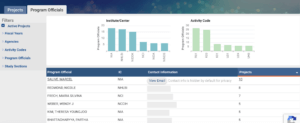
Searching for a program official produces a list of people and their affiliated IC, email addresses, and number of projects. For example, the search “pragmatic clinical trial” produced a list of 191 program officials.


After researching the program officials and ICs, prospective investigators can select one with projects most closely matching the proposed application and then email the program official with

  1. A 1- to 2-page draft of specific aims for the proposed application
  2. A request to discuss the proposed application and whether it is a fit with the IC's mission and priorities
  3. A request to provide the name of another colleague or IC if the proposed application is not a fit with their portfolio.

The program official will be in touch to review the specific aims. If the program official is not a right fit for a project, they may recommend someone who might be more suitable or recommend that the investigator contact a program official at another IC. In some cases, more than one program official is potentially appropriate, such as when a project would fit within a disease-specific and non–disease-specific IC. If so, investigators may contact both program officials.

Applications at NIH are reviewed by groups of scientists from the research community that are called study sections. The NOFO will indicate how the application will be reviewed. If the NOFO states that the application will be evaluated for scientific and technical merit by an appropriate Scientific Review Group convened by a specific IC, then the application will be reviewed by that specific IC. Many NOFOs do not specify an IC to conduct the review, and in those cases, the application will be assigned to a standing study section in the Center for Scientific Review (CSR). Applicants can request their application be assigned to a specific study section at the CSR. To help investigators find the study section with the most appropriate scientific expertise for reviewing their grant, the NIH has developed the Assisted Referral Tool.

The Assisted Referral Tool (ART) was developed by the CSR to recommend potentially appropriate study sections, based on the scientific content of a user’s grant application. The information you provide to the tool is only used to recommend study sections and is not stored. ART results should be discussed with the program official, if possible, to help narrow down which study section to request when submitting the application.

How to Use the ART

  1. Select your mode of operation based on your search goals.
  2. Enter application text and/or title into the appropriate text boxes. Concepts from the Research, Condition, and Disease Categorization Thesaurus are extracted and weighted against relative frequency of concepts within the text. Concepts found within the title receive an additional influence on the search results.
  3. The search results are ranked based upon relevancy, and the number of results within each relevancy category is determined by multiple criteria. Within each relevancy category, the results are ordered alphabetically based on Scientific Review Group abbreviation.

Examples of Using the ART

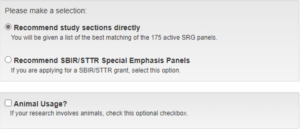
  1. Using the NIH Collaboratory Trial BackInAction as an example, we first select “Recommend study sections directly.” Next, input the title and summary in the appropriate text boxes, as shown below.
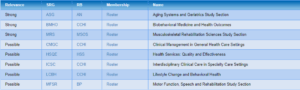
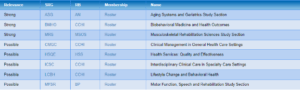
  2. Search results will appear. In this example, the top 3 strongest results are ASG, BMHO, and MRS. These represent the most relevant sections based on concepts found in the search input.

SECTIONS

CHAPTER SECTIONS

DISCLAIMER

back to top

The views expressed in this chapter should not be interpreted as representing the official views of the US Department of Health and Human Services, the National Institutes of Health, the National Institute on Aging, the National Center for Complementary and Integrative Health or PCORI, except where noted.

ACKNOWLEDGEMENT

back to top

The authors thank Dr. Tracy Wang, the chief officer for Comparative Clinical Effectiveness Research (CER) at the Patient-Centered Outcomes Research Institute (PCORI), for her review of the content related to PCORI.


Version History

October 18, 2024: Added information about PCORI as a funder (changes made by K. Staman).

March 29, 2024: Minor updates to text and refresh of figures; added ART tool (Changes made by K. Staman).

July 2, 2020: Minor corrections to layout and formatting (changes made by D. Seils).

Published December 13, 2018

Introduction

Developing a Compelling Grant Application


Section 1

Introduction

Watch the video module: Writing a Successful Grant Application

In this video, Dr. Wendy Weber, the program officer for the NIH Collaboratory Coordinating Center, provides some expert advice for investigators who are considering submitting an application for a pragmatic clinical trial to the NIH.

Don’t assume that the study panel is going to understand what pragmatic means. They may have their own completely different definition than you, and it’s important that you get on the same page early on in your application. — Wendy J. Weber, PhD, National Center for Complementary and Integrative Health

The National Institutes of Health and the Patient-Centered Outcomes Research Institute (PCORI) are both funders of embedded pragmatic clinical trials (ePCTs). While both organizations share common goals to advance public health, PCORI-funded research requires investigator and patient/community partnership throughout the entirety of the research process from design through results dissemination and implementation. For investigators who are considering submitting an application for an ePCT to the NIH or PCORI, there are several important aspects to consider. First and foremost, develop and clearly define a clinical research question with a testable hypothesis and then select an experimental design best suited to answering the research question.

The study question drives the research design

For example, efficacy questions (e.g., Does the intervention work under ideal settings?) are probably best suited to explanatory designs, and questions involving real-world populations (e.g., Does the intervention work when implemented in clinical care?) are probably best suited to embedded pragmatic designs.

Watch the video module: Is a Pragmatic Trial Right for Your Research Question?

It is important to keep in mind that many reviewers will have little experience with ePCTs and much more experience with traditional explanatory designs. Thus, investigators should clearly describe the study design details and justify the use of a pragmatic trial as opposed to an explanatory trial. In addition, the investigators should define how the trial is "pragmatic," and clearly describe and justify which elements are (and are not) pragmatic and why making these elements more or less pragmatic improves the ability to test the research hypothesis.

SECTIONS

CHAPTER SECTIONS

DISCLAIMER

back to top

The authors thank Dr. Tracy Wang, the chief officer for Comparative Clinical Effectiveness Research (CER) at the Patient-Centered Outcomes Research Institute (PCORI), for her review of the content related to PCORI.

ACKNOWLEDGEMENT

back to top

The views expressed in this chapter should not be interpreted as representing the official views of the US Department of Health and Human Services, the National Institutes of Health, the National Institute on Aging, the National Center for Complementary and Integrative Health or PCORI, except where noted.


Version History

September 3, 2025: Updated links (changes made by K. Staman).

October 18, 2024: Added information about PCORI as a funder (changes made by K. Staman).

March 29, 2024: Minor updates to text (changes made by K. Staman).

January 22, 2021: Updated video and added embedded video (change made by G. Uhlenbrauck).

July 1, 2020: Minor corrections to layout and formatting (changes made by D. Seils).

Published December 13, 2018