


Building Partnerships and Teams to ensure a successful trial
Section 6
Embedded ePCT Team Composition
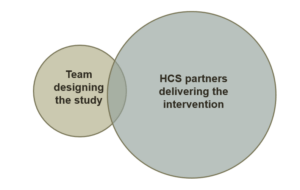
Although a research team typically designs a pragmatic study, it is the healthcare system partners who actually deliver the intervention. Many different people are involved in the conduct of an ePCT, and when designing a trial, an investigator will need to carefully consider the roles of potential team members, including which roles are essential, and who will fill the roles. Because ePCTs are embedded in health systems, team members from both the research team and the health system must understand and respect each other’s workflow, culture, priorities, and responsibilities (Johnson et al. 2014). Communication is essential, and having a team member with both research and health system expertise can help ensure the success of a PCT (Johnson et al. 2014).
GRACE Case Study
In some cases, it may be necessary for study team members to perform certain functions to reduce patient and clinician burden and to streamline operations. The GRACE Trial tests the effectiveness of guided relaxation and acupuncture for chronic sickle cell disease pain at University of Illinois Chicago (UIC), Duke University, and University of Florida. The GRACE Trial is a hybrid 1 effectiveness-implementation trial, which means we are first and foremost testing effectiveness of the two interventions and are beginning to identify facilitators and barriers to implementing the interventions. At all 3 study sites, the individual teams developed customized processes for scheduling and tracking treatments at the different sites where acupuncture is delivered. UIC does not have an integrative medicine clinic, therefore acupuncture treatments are being administered at the complementary integrative health research lab at the College of Nursing. The study acupuncturist schedules all acupuncture treatments. At Duke, acupuncture treatments are being provided at a well-established integrative medicine clinic and at private acupuncture clinics. The participants are permitted to schedule appointments directly through the clinics to provide optimal flexibility. However, study staff have established processes to work with clinic staff and participants to send reminders for upcoming acupuncture treatments and document participant attendance, address problems the clinic may have reaching the participant, and are available to answer questions related to the research protocol. At the University of Florida, the acupuncture is provided by community acupuncturists in private practice. The study staff collaborates with the acupuncturists and the patient to schedule the first acupuncture study visit. Thereafter, the acupuncturist and the patient work with their schedules to schedule the rest of the study visits. The patient contacts the acupuncturist directly to reschedule or cancel an appointment. The acupuncturists contact the study staff for any matters or difficulties they encounter in working with the patients to complete the acupuncture study visit. The acupuncturists document all patient encounters in REDCap per GRACE trial protocol.
Assessing Clinicians’ Views on Participating in Pragmatic Clinical Trials
A 2020 qualitative study was conducted to better understand the views of clinicians—including physicians, nurses, and other care providers—about their potential role in research conducted in the context of healthcare delivery. A goal of the study was to develop guidance for how study teams can best engage front-line clinicians to participate in ePCTs. Among the study’s findings is the importance of involving clinicians early in planning the study, including helping select the research topic. Key reasons for early engagement include that front-line care providers can provide insights to researchers on issues of clinical relevance, specific populations, and gaining trust in research. Also, because every clinic has its own workflow, clinicians are aware of constraints and potential disruptions that a trial might bring to clinic operations. Last, clinicians need to believe in the importance of the study so they can translate that to patients and staff.
The authors describe three levels of PCT engagement with clinicians, characterizing the trials as being “low touch, medium touch, or high touch”:
- A low-touch PCT would be one that involves direct recruitment and enrollment of eligible patients by members of the study team with no need for clinician involvement in delivering the study intervention or conducting follow-up.
- A medium-touch PCT would be one where there are sufficient numbers of patients at all study sites, a functional EHR system, site-level study champions, and adequate space to accommodate research activities without impeding workflow.
- A high-touch PCT would be one in which a clinician plays an active role in patient identification, recruitment, delivery of the intervention, data collection, and patient follow up.
While it has been reported that clinicians hold generally favorable views of research, there are barriers to participation such as lack of time and competing priorities. Study authors also noted that there are clinicians who are interested in research but do not know how to get involved. Expanded opportunities for clinicians and researchers to collaborate via multiple platforms and modalities should be encouraged.
“With increasingly high demands on clinician time and the fact that their first priority is, as it should be, providing the best possible patient care, research teams should take on as much of the burden of trial implementation as possible.” –Tambor et al. 2020
Watch the video module: Engaging With Stakeholders in Pragmatic Clinical Trials
Potential ePCT team members can include:
- Principal investigator and co-investigator
- Health system leader or executive
- Biostatistician
- Lead clinician (e.g., epidemiologist, behavioral specialist, radiologist, pharmacist, physical therapist)
- Clinical staff (e.g., nurse, operations manager, business manager)
- IT specialist for EHR data extraction or clinical decision support tool design
- Professional society leader
- Site champion/liaison
- Practice facilitator
- Research assistant
- Project coordinator
- Communications specialist
- Research participant, patient, or patient advocate
These team members will fulfill different roles throughout the course of the trial, and could assist with trial design, budgeting, site and participant recruitment, communications with patients, trial conduct, and dissemination and implementation of results (Dolor et al. 2014). Early engagement of the team will help identify workflow issues, ensure the budget is feasible, and help with recruitment of sites and clinicians.
Roles and Expertise
The expertise necessary for a trial will depend on the specific study aims and how the intervention will be embedded in the healthcare system workflow. A simplified example of the roles the team members could fulfill is shown in the table.
| Role | Priority | Study question refinement | Protocol development | Conduct |
| Researcher | Improve public heath by answering research questions | Develops and procures funding for research question | Drafts protocol | Ensures sustainability; communicates with team; helps solve issues as they arise |
| Patient | Improve individual health or the health of others with a similar condition | Provides feedback | Provides feedback | May participate in study |
| HCS Leader | Improve patient outcomes, reduce costs, and increase efficiency | Ensures question aligns with priorities and mission | Provides feedback, promotes and supports study | Promotes and supports study |
| IT Staff | EHR features that support patient care and billing | May need to adapt EHR for data collection. Can advise on feasibility | Responsible for data collection and/or data pulls. Will help mitigate problems with data quality (consistency, anomalies, errors, etc) | |
| Frontline and Operational Staff | Patient care | Consult on protocol so it fits into workflow with a little burden as possible. Advise on feasibility | Responsible for data collection and/or implementing interventions | |
| Clinic Champion | Improving patient outcomes | Refines question with researchers and HCS leaders | Serves a liaison and helps integrate protocol into workflow | Ensures sustainability; helps to solve issues as they arise |
Finding the Right Biostatistician for the ePCT Team
A biostatistician will be an essential member of the ePCT study team, and ideally would be engaged from the earliest phase of developing the research question and proposal through the study design, statistical analysis, and final results dissemination. It will be useful for this team member to have experience with pragmatic trial interventions as well as familiarity with the PRECIS-2 tool, used to evaluate the degree of pragmatism along 9 domains. An understanding of the PICOT (population, intervention, comparison, outcome, time) framework is helpful in developing the research question, as the question will drive the design, and the design will drive the analysis. Other skills for the biostatistician include relevant experience in the design and analysis of randomized clinical trials (RCTs) with clustering, such as cluster-randomized trials (CRTs), stepped-wedge design, and individually-randomized group treatment trials. Familiarity with the Consolidated Standards of Reporting Trials (CONSORT) statements, including extensions for cluster trials and pragmatic trials, will be helpful knowledge for the team as they prepare to report their findings.
Other Considerations
Clinical and healthcare system staff and team members tend to have high turnover rates, which creates challenges for ePCTs. Developing good documentation and training practices for new team members helps ensure sustainability in case of turnover. Perhaps more importantly, NIH Collaboratory PIs have found that engaging staff throughout the trial and developing clear methods for multidirectional communication can help identify and mitigate potential issues before they become acute. For example, the STOP CRC trial implemented a well-validated quality improvement approach called Plan-Do-Study-Act, or PDSA. The use of PDSA helped to identify implementation issues and unintended consequences and empowered clinics to actively address local conditions.
A directory of team members is advisable; for example, the Health Care Services Research Network (a network of healthcare systems that participate in research) provides a directory on their website with key administrative contacts by site.
At the end of the trial, team members, including participating sites, physicians, and clinics, should have the opportunity to receive, interpret, and implement findings from the trial. Likewise, where applicable, findings should also be communicated to patients or patient advocacy groups.
To determine what skills are needed, consider the following key questions in the planning phase:
-
-
-
- What clinical specialties will be needed to carry out the intervention?
- What roles will support clinic operations?
- Who will be the liaison between healthcare system departments for interventions that are multidisciplinary?
- What aspects of the trial will require IT staff expertise?
- Will the trial need training videos, online materials, or toolkits?
-
-
SECTIONS
sections
- Introduction
- Engagement Across Settings and Populations
- Deciding Who to Engage
- Partner Engagement Throughout the PCT Life Cycle
- Advice From Healthcare System Leadership
- Embedded ePCT Team Composition
- Learning Health Systems and Embedded Clinical Trials
- Framework for Health Systems to Assess PCT Participation
- FAQ
Resources
Considerations for Training Front-Line Staff and Clinicians on Pragmatic Clinical Trial Procedures
This working document helps ePCT teams plan training for study procedures that involve frontline clinicians and staff.
A guide to research partnerships for pragmatic clinical trials (Johnson KE et al. 2014)
Publication describing how to build strong research partnerships between health researchers and healthcare systems.
REFERENCES
Dolor RJ, Schmit KM, Graham DG, Fox CH, Baldwin LM. 2014. Guidance for Researchers Developing and Conducting Clinical Trials in Practice-based Research Networks (PBRNs). J Am Board Fam Med. 27(6):750–758. doi:10.3122/jabfm.2014.06.140166. PMID: 25381071
Johnson KE, Tachibana C, Coronado GD, Dember LM, Glasgow RE, Huang SS, Martin PJ, Richards J, Rosenthal G, Septimus E, et al. 2014. A guide to research partnerships for pragmatic clinical trials. BMJ. 349(dec01 7):g6826–g6826. doi:10.1136/bmj.g6826. PMID: 25446054
current section : Embedded ePCT Team Composition
- Introduction
- Engagement Across Settings and Populations
- Deciding Who to Engage
- Partner Engagement Throughout the PCT Life Cycle
- Advice From Healthcare System Leadership
- Embedded ePCT Team Composition
- Learning Health Systems and Embedded Clinical Trials
- Framework for Health Systems to Assess PCT Participation
- FAQ