Podcast June 26, 2019: Good Clinical Practice Guidance and Pragmatic Trials: Balancing the Best of Both Worlds in the Learning Health System (Robert Mentz, MD)

In this episode of the NIH Collaboratory Grand Rounds podcast, Dr. Adrian Hernandez sits down with Dr. Rob Mentz to discuss balancing Good Clinical Practice Guidance and Pragmatic Trials in the Learning Health System. In the discussion, Dr. Mentz covers key challenges with good clinical practice (GCP), input from Dr. Rob Califf and others, and suggestions on how the scientific community should address the evolution of GCP versus the evolution of clinical trials.

Click on the recording below to listen to the podcast.

Want to hear more? View the full Grand Rounds presentation.

For alerts about new episodes, subscribe free on Apple Podcasts or SoundCloud.

Read the transcript.

Rate this podcast

June 14, 2019: Good Clinical Practice Guidance and Pragmatic Trials: Balancing the Best of Both Worlds in the Learning Health System (Robert Mentz, MD)

Speaker

Robert J. Mentz, MD, FACC, FAHA, FHFSA
Associate Professor
Director, Duke Cooperative Cardiovascular Society
Associate Program Director, Duke Cardiovascular Disease Fellowship
Duke University Medical Center and Duke Clinical Research Institute

Topic

Good Clinical Practice Guidance and Pragmatic Trials: Balancing the Best of Both Worlds in the Learning Health System

Keywords

International Council for Harmonization (ICH); Good clinical practice (GCP); Learning health system; Pragmatic clinical trials; Institutional review board (IRB); Research oversight; Regulatory issues; Quality by design (QbD)

Key Points

  • Good clinical practice (GCP) guidance details the responsibilities, procedures, and recording that are necessary for appropriate trial conduct; for example, conducting the trial in accordance with an IRB-approved protocol with appropriate adverse event monitoring and reporting.
  • There is an urgent need to streamline randomized trials. Key obstacles are lack of transparency, lack of representativeness, and lack of evidence of competence.
  • In the United States, clinical investigators must abide by guidance from FDA, HHS, and ICH-GCP. Yet it is hard for investigators to keep track and to know how GCP applies to their study.
  • GCP as an overall construct is useful, but it does not deal well with issues particular to pragmatic trials or trials outside the FDA-regulated world.

Discussion Themes

With embedded pragmatic trials, informed consent is more nuanced. New considerations and approaches for consent have arisen since ICH GCP first came into effect.

Establishing quality by design will take time, effort, and educating IRBs to understand how QbD can be used to avoid errors in a trial and collect data that is fit-for-purpose.

It’s crucial that trials address an important question, answer that question reliably, and keep participants safe.

Read more about Dr. Mentz’s study of GCP and pragmatic trials.

Tags

#pctGR, @Collaboratory1, @RobMentz

June 13, 2019: Experience With Pragmatic Clinical Trials Gains Momentum

At the NIH Collaboratory Steering Committee Meeting in May 2019, participants shared their perspectives on the evolving landscape of embedded pragmatic clinical trials (ePCTs). Three initiatives were presented: the Patient-Centered Outcomes Research Institute (PCORI), the NIH-DoD-VA Pain Management Collaboratory, and the HEAL (Helping to End Addiction Long-term) Initiative. Although many challenges remain, the conduct of ePCTs is gaining momentum, and the synergy between the initiatives, along with the fellowship they engender, will continue to help pave the way for more embedded pragmatic research in the future.

Dr. Ann Trontell, Associate Director of Clinical Effectiveness and Decision Science at PCORI, shared PCORI’s experience with pragmatic clinical studies. Since 2014, PCORI has awarded $494 million dollars for 43 pragmatic studies that range in size from 425 to 100,000 participants (median, approximately 1700). The studies include 2 observational, 27 individually randomized, and 14 cluster randomized trials in a wide range of therapeutic areas.
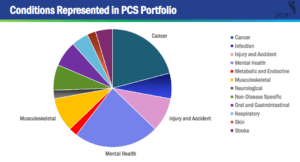
Dr. Trontell urged those developing proposals for pragmatic trials to make them fit for purpose, as opposed to emphasizing pragmatism, a theme echoed in the Developing a Compelling Grant Application chapter of the Living Textbook.


Dr. Robert Kerns, a director of the NIH-DoD-VA Pain Management Collaboratory, shared progress with pragmatic trials designed to evaluate whether evidence-based nonpharmacological approaches are effective for pain management among US military personnel and veterans.
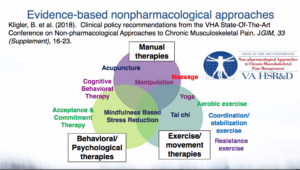
Modeled after the NIH Collaboratory, the Pain Management Collaboratory is supporting 11 projects through a 2-year planning phase and a 2- to 4-year implementation phase. Subject matter experts at the Pain Management Collaboratory Coordinating Center (PMC3) support the projects by sharing tools, best practices, and resources.


Dr. Wendy Weber, Program Officer for the NIH Collaboratory Coordinating Center, introduced the HEAL initiative, which is designed to enhance pain management and improve prevention and treatment strategies for opioid misuse and addiction. The goal of the initiative is to provide scientific solutions to the opioid crisis. It includes a set of large-scale pragmatic trials that will receive logistical and technical support from the NIH Collaboratory Coordinating Center.
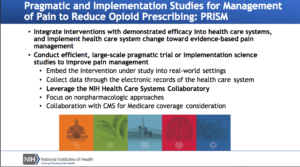
 

While experience with ePCTs is growing, many distinct challenges remain. As the conduct of ePCTs gains momentum, there is a rich opportunity to use collective experiences to refine best practices to real-world evidence generation and help solve urgent public health problems.

June 7, 2019: Meeting Materials from the 2019 NIH Collaboratory Steering Committee Meeting

The Collaboratory has made available all the presentations from their recent Steering Committee meeting held in Bethesda May 1-2, 2019.

Highlights of Day 1 included updates on the progress and sustainability of the NIH Collaboratory, perspectives on the landscape of embedded PCTs (ePCTs) and the need for real-world evidence, challenges and lessons learned from the UH3 NIH Collaboratory Trials, updates on progress and transition plans from the UG3 NIH Collaboratory Trials, and discussions on data sharing policy and planning. Day 2 featured an intensive workshop hosted by the NIH with the goal of starting discussions on statistical issues with ePCTs.

View or download the meeting materials on the website.

May 16, 2019: NIH Collaboratory Investigators Author Recommendations for Responding to Guideline or Policy Changes That Affect Ongoing Pragmatic Trials

A new perspective article by NIH Collaboratory investigators describes the unique, unexpected challenges researchers face when clinical practice guidelines and policies change during the conduct of a pragmatic clinical trial (PCT). The article was published online this week in Clinical Trials.

The NIH Collaboratory Trials are PCTs that test interventions to address urgent public health problems. They involve hundreds to thousands of participants and generally include usual care as a control arm. During the course of these years-long trials, clinical practice guidelines and policies changed due to new evidence from observational studies, small trials, and shifting expert opinion. Such changes can have profound effects on usual care and, therefore, threaten the ability of the PCTs to address the questions they were designed to answer. Investigators must strike a balance between the primary ethical obligation to protect patients by adhering to new best-practice guidelines and policy and the secondary, yet crucial, obligation to develop high-quality evidence to improve care.

“PCTs are an important means of producing high-quality evidence needed to better inform clinical practice. However, when guidelines or reimbursement policies change during the conduct of a PCT, the ethical obligation to gather information to develop evidence-based practices may conflict with the primary ethical obligation to participants.” — Curtis et al, Clinical Trials, 2019

Based on their aggregate experience with the NIH Collaboratory, the authors provide broad recommendations and strategies for overcoming these challenges, including protecting the well-being of patients; involving stakeholders, health system leaders, and the entity charged with data and safety monitoring; and actively monitoring changes and site-level responses to them. If changes to the standard of care are merited, investigators should provide equal opportunity and support for the recommended changes. Finally, during the design phase, investigators should communicate with the entities charged with creating guidelines to see what is needed and to anticipate possible future changes.

“The ability to appropriately address the tension between modifications to clinical guidelines and the need to generate quality evidence to support those guidelines is a crucial consideration for the fulfilment of a learning health system.” — Curtis et al, Clinical Trials, 2019

May 8, 2019: Dr. Greg Simon Receives National Suicide Prevention Award

At the Lifesavers Gala in New York last night, Dr. Greg Simon received the American Foundation for Suicide Prevention (AFSP’s) Research Award for his contributions to suicide prevention. Dr. Simon leads the Suicide Prevention Outreach Trial (SPOT), an NIH Collaboratory Trial that builds on previous work demonstrating that patients who answer “yes” to thoughts of self-harm on routinely administered PHQ-9 questionnaires at primary care visits are more likely to attempt suicide. For these high-risk patients, SPOT explores different modes of outreach (care management or online skills training versus usual care) to prevent suicide.

“There’s a conspiracy of silence around suicidal thoughts, because it’s awkward to discuss. So we’ve found that we have to incorporate talking about it into our standard care. Our suicide prevention work is a great example of how research and care keep influencing each other to improve our patients’ health. When research springs from clinicians’ and patients’ questions, ‘learning health systems’ can put results into practice much faster than the oft-cited 17-year lag.” — Dr. Greg Simon, from the Kaiser Permanente Washington Health Research Institute Press Release

Dr. Simon and his colleagues are also studying how machine-learning models can be used to predict risk of suicide. The models combine the PHQ-9 mental health questionnaire responses with information from electronic health records, including prior suicide attempts and mental health and substance use diagnoses. In a blog post regarding his research (and recent publication) on machine learning, Dr. Simon compares machine learning to warning lights on cars:

Our paper prompted many questions from clinicians and health system leaders about the practical utility of risk predictions:

“Are machine learning algorithms accurate enough to replace clinicians’ judgment?” our clinical partners asked.

“No,” I answered, “but they are accurate enough to direct clinicians’ attention.”

The AFSP also honored four others, including Anderson Cooper, a CNN and 60-minutes correspondent, and Kate Snow, an NBC news correspondent, for their work raising public awareness of suicide prevention.

Read more about what inspired Dr. Simon to study mental health.

April 18, 2019: New Commentary Highlights Value of Pragmatic Trials for Learning Health Systems

In an eGEMs commentary published this month, Leah Tuzzio and Dr. Eric Larson of the NIH Collaboratory’s Health Care Systems Interactions Core discuss the value and impact of embedded pragmatic clinical trials for learning health systems.

Pragmatic trials embedded in healthcare systems are designed to align with the care delivery goals of the health system to produce better health outcomes. The commentary highlights the NIH Collaboratory’s pragmatic trials as “the best-case examples to learn about the challenges of conducting research and of dissemination, implementation and sustainability of research results in real-world settings.”

Designing and implementing an embedded pragmatic clinical trial “requires a bidirectional flow of information and cooperative problem solving between investigator teams and clinical teams,” an important feature of learning health systems. In implementing the trial, the clinical and research teams not only generate useful data, but also demonstrate how the trial results can be incorporated into evidence-based clinical practice.

The commentary is part of a special collection of eGEMs articles commemorating 25 years of the Health Care Systems Research Network.

eGEMs is AcademyHealth’s peer-reviewed, open-access journal for electronic health data and methods. At AcademyHealth’s 2019 Annual Research Meeting in Washington, DC, the NIH Collaboratory will offer a full-day pre-conference seminar on the essentials of embedded pragmatic clinical trials. Registration for the seminar is open now.

April 12, 2019: Development of Harmonized Outcome Measures for Use in Research and Clinical Practice (Richard Gliklich, MD, Michelle Leavy, MPH, Elise Berliner, PhD)

Speakers

Richard Gliklich, MD
CEO, OM1, Inc.

Michelle B. Leavy, MPH
Head, Healthcare Research and Policy
OM1, Inc.

Elise Berliner, PhD
Director, Technology Assessment Program
Center for Evidence and Practice Improvement (CEPI)
Agency for Healthcare Research and Quality (AHRQ)

Topic

Development of Harmonized Outcome Measures for Use in Research and Clinical Practice

Keywords

Health outcomes; Patient-centered outcomes; Agency for Healthcare Research and Quality; Patient registries; Clinical data; Patient-reported outcomes; Value-based care; Electronic health records; Learning health system; Conceptual framework

Key Points

  • The goal of the Outcome Measures Framework is to create a common conceptual model for classifying the range of outcomes that are relevant to patients and providers across most conditions.
  • Harmonization of outcome measures is essential to comparing and aggregating results between and among registries, clinical research, and quality reporting, and to facilitating performance and value-based measurement.
  • A minimum measure set is the minimum set of harmonized measures that can be captured consistently in research and clinical practice.
  • Developing the framework used a stakeholder-driven process that categorized outcomes as clinical responses, patient-reported, survival, resource utilization, and events of interest for a sample set of 5 clinical areas.

Discussion Themes

The benefits of developing a core set of measures include reduced clinician burden and improved patient care.

How is this work informing the HL7 work group that is defining standards for registries?

Next steps include implementation of the minimum measure sets in EHRs, registries, and other research efforts; demonstrating the value of a minimum measure set; and encouraging adoption of the measures.

Learn more about AHRQ’s Outcome Measures Framework.

Tags

#pctGR, @Collaboratory1, @AHRQNews

Podcast January 29, 2019: A Learning Health System Story: Perinatal Outcomes Associated with a Major Change in Gestational Diabetes Screening

Listen to the episode here:

At least once a month, we will release interviews with Grand Rounds speakers that delve into their topic of interest and give listeners bonus time with these featured experts.

Please let us know what you think by providing your feedback through the podcast page. We also encourage you to listen and share the recordings with your colleagues!

January 22, 2019: New Self-Paced ePCT Training Course Available

The NIH Collaboratory is pleased to announce the availability of a new self-paced, 10-module introductory course on how to design, conduct, and disseminate embedded PCTs (ePCTs). This course presents condensed material from the inaugural ePCT Training Workshop held in 2018 and provides users with important things to know and do when designing an ePCT, along with helpful links to additional learning resources within the Living Textbook.

Also available in the Living Textbook are links to videocast workshops hosted by the NIH on a range of ePCT topics including:

  • Embedded PCTs of therapeutic A versus B interventions
  • Unique opportunities for disseminating, implementing, and sustaining evidence-based practices into clinical care
  • Ethical and regulatory issues of PCTs

For these and other ePCT resources, visit the Training Resources webpage.