February 8, 2022: Patient-Centered Outcomes Core Highlights Lessons From the NIH Collaboratory Trials

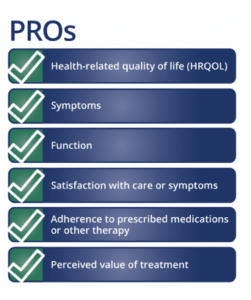
PRO figure

In new additions to the Living Textbook, the Patient-Centered Outcomes Core of the NIH Pragmatic Trials Collaboratory explores lessons learned from the NIH Collaboratory Trials and provides information about including patient-reported outcomes (PROs) in pragmatic clinical trials.

The new content includes:

  • A Case Study from Guiding Good Choices for Health in which the principal investigators provide their most critical advice and tips for study teams
  • A new section about the Food and Drug Administration’s Patient-Focused Drug Development series. This 4-part series provides guidance about how to collect and submit patient experience data in clinical research.
  • New content on Cultural Adaptation and Linguistic Translation from the NIH HEAL Initiative’s PRISM program—Pragmatic and Implementation Studies for the Management of Pain to Reduce Opioid Prescribing. The PRISM NIH Collaboratory Trials are designed to assess the effectiveness of non-opioid interventions for pain management. Cultural and linguistic adaptation of PRO measures enables inclusion of a broader study population and enhanced generalizability of results.
  • New content on acceptability and burden in the chapter on Incorporating PRO Data into the Electronic Health Record (EHR).

Read the Patient-Reported Outcomes chapter.

The PRISM program is a part of the Helping to End Addiction Long-Term Initiative℠, or NIH HEAL Initiative℠. The NIH Pragmatic Trials Collaboratory Coordinating Center serves as the PRISM Resource Coordinating Center.


April 12, 2019: Development of Harmonized Outcome Measures for Use in Research and Clinical Practice (Richard Gliklich, MD, Michelle Leavy, MPH, Elise Berliner, PhD)

Speakers

Richard Gliklich, MD
CEO, OM1, Inc.

Michelle B. Leavy, MPH
Head, Healthcare Research and Policy
OM1, Inc.

Elise Berliner, PhD
Director, Technology Assessment Program
Center for Evidence and Practice Improvement (CEPI)
Agency for Healthcare Research and Quality (AHRQ)

Topic

Development of Harmonized Outcome Measures for Use in Research and Clinical Practice

Keywords

Health outcomes; Patient-centered outcomes; Agency for Healthcare Research and Quality; Patient registries; Clinical data; Patient-reported outcomes; Value-based care; Electronic health records; Learning health system; Conceptual framework

Key Points

  • The goal of the Outcome Measures Framework is to create a common conceptual model for classifying the range of outcomes that are relevant to patients and providers across most conditions.
  • Harmonization of outcome measures is essential to comparing and aggregating results between and among registries, clinical research, and quality reporting, and to facilitating performance and value-based measurement.
  • A minimum measure set is the minimum set of harmonized measures that can be captured consistently in research and clinical practice.
  • Developing the framework used a stakeholder-driven process that categorized outcomes as clinical responses, patient-reported, survival, resource utilization, and events of interest for a sample set of 5 clinical areas.

Discussion Themes

The benefits of developing a core set of measures include reduced clinician burden and improved patient care.

How is this work informing the HL7 work group that is defining standards for registries?

Next steps include implementation of the minimum measure sets in EHRs, registries, and other research efforts; demonstrating the value of a minimum measure set; and encouraging adoption of the measures.

Learn more about AHRQ’s Outcome Measures Framework.

Tags

#pctGR, @Collaboratory1, @AHRQNews