


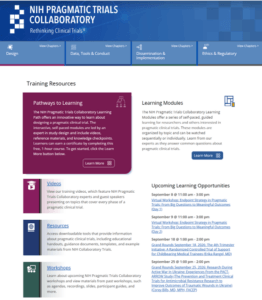
 The NIH Collaboratory Living Textbook offers a variety of training resources intended for researchers, research team members, clinicians, healthcare system leaders and staff, and others involved in pragmatic clinical trial (PCT) research. These resources cover foundational information preparing learners to engage meaningfully with PCT research.
A Learning Modules section provides a series of self-paced videos featuring NIH Collaboratory experts covering PCT study funding, design, endpoint selection, and randomization strategies. Pathways to Learning provides comprehensive information on PCT study design while offering Continuing Education Units through the Duke University Health System’s Department of Clinical Education and Professional Development.
A wide range of videos, resources, and workshops provide learners with information, downloadable tools, guidance documents, templates, and relevant example materials from NIH Collaboratory Trials. Training resources are categorized by topic allowing research teams to easily find materials relevant to their interests.
All training resources can be accessed through the Living Textbook’s Training Resources page. New topics and materials are added frequently.
 The NIH Collaboratory is pleased to announce the availability of a new self-paced, 10-module