December 3, 2021: Primary Care-Based Behavioral Treatment for Long Term Opioid Users with Chronic Pain: Primary Results and Lessons Learned from the PPACT Pragmatic Trial (Lynn DeBar, PhD MPH)

Speaker

Lynn DeBar, PhD MPH
Senior Scientist
Kaiser Permanente Washington Health Research Institute
Seattle, WA

Keywords

PPACT, Chronic pain, Opioid use, Patient reported outcome data, Patient-centered research, Cognitive behavioral therapy

Key Points

  • Chronic Pain is responsible for far more years lived with disability than a large number of other diseases and injuries, such as COPD, diabetes, dementia, stroke and others, combined.
  • PPACT was a cluster randomized study aimed at integrating interdisciplinary pain management methods into primary care to improve care for patients with chronic pain.
  • Participants had been prescribed long-term opioids for mixed chronic pain conditions.
  • Study intervention lasted 12 weeks and included cognitive behavioral therapy, yoga-based exercises, physical therapy, a medication review, and support from a primary care provider.
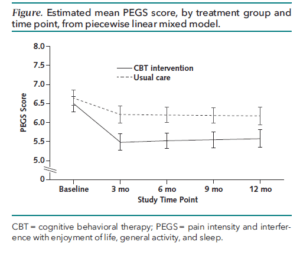
  • Participants in the treatment group of the PPACT study showed a modest reduction of pain that was sustained over a 12 month period.
  • The PPACT intervention was cost effective versus usual treatment methods.

Discussion Themes

An in-person enhanced enrollment session was conducted to give potential subjects a comprehensive overview of the study procedures. This enrollment session led to fewer people enrolling in the study, but of those that did, more completed the study.

The key to successful CBT is an interactive patient-centered approach.


Read more about the PPACT study.


Tags

#pctGR, @Collaboratory1

Grand Rounds December 3: Primary Care-Based Behavioral Treatment for Long Term Opioid Users with Chronic Pain: Primary Results and Lessons Learned from the PPACT Pragmatic Trial

Speaker:
Lynn DeBar, PhD MPH
Senior Scientist
Kaiser Permanente Washington Health Research Institute
Seattle, WA

Topic: Primary Care-Based Behavioral Treatment for Long Term Opioid Users with Chronic Pain: Primary Results and Lessons Learned from the PPACT Pragmatic Trial

Date: Friday, December 3, 2021, 1:00-2:00 p.m. ET

Meeting Info: To check whether you have the appropriate players installed for UCF (Universal Communications Format) rich media files, go to https://dukemed.webex.com/dukemed/systemdiagnosis.php.

To join the online meeting:
Go to https://dukemed.webex.com/dukemed/j.php?MTID=m4c6e3e4827442a92338a5649cee613e6

Click ‘Connect to Audio”
Choose ‘Computer Audio’ or ‘I will call in’.
If using the ‘call in option’, follow the information from the dialog box that appears.
Be certain to use the Access Code AND the Attendee ID.

Troubleshooting:
If the URL above does not work, go to dukemed.webex.com and enter:
Meeting Number: 2622 682 0537
Meeting Password: 12345

For Audio ONLY:
Call-in toll number (US/Canada): 1-650-479-3207
Access code: 2622 682 0537

NOTE: For Toll-free users, the call-back (call me) services are also available.

November 9, 2021: PPACT Study Finds Benefits of Cognitive Behavioral Therapy in Reducing Chronic Pain and Pain-Related Disability

Photo of Dr. Lynn DeBar
Dr. Lynn DeBar, principal investigator of PPACT

Patients who participated in a cognitive behavioral therapy (CBT) intervention as part of their regular care for chronic pain showed improved function and reduced pain compared to standard treatment, according to the results of the Pain Program for Active Coping and Training (PPACT) study. Although CBT did not reduce opioid use, patients who participated in a 12-week course on pain self-management led by primary care providers showed modest but sustained benefits that persisted for 12 months after the intervention.

Study results were published this month in the Annals of Internal Medicine.

The PPACT study, an NIH Collaboratory Trial, was a pragmatic, cluster randomized trial that enrolled 850 patients receiving long-term opioid therapy for chronic pain. Patients in the intervention group participated in 12 weekly, 90-minute group sessions that taught skills of muscle relaxation, guided imagery, cognitive restructuring, and yoga-based adapted movement. Patients in the usual care group continued to receive pharmacologic and nonpharmacologic treatment.

Figure from PPACT main outcomes paper
Source: Annals of Internal Medicine 2021 Nov 2. doi: 10.7326/M21-1436

Patients were followed for 12 months with primary outcome measures of pain impact on enjoyment of life, activity levels, and sleep. Researchers also assessed secondary outcome measures of pain-related disability and opioid use.

Compared to usual care, the CBT intervention reduced self-reported pain and pain-related disability and increased satisfaction with primary healthcare providers. Opioid use and dose remained the same in both the intervention group and the usual care group.

PPACT was supported within the NIH Collaboratory by the NIH Common Fund, the National Center for Complementary and Integrative Health (NCCIH), and the National Institute of Neurological Disorders and Stroke (NINDS). Learn more about the NIH Collaboratory Trials.

October 29, 2021: Embedding Pragmatic Trials into Emergency and Critical Care (Matthew W. Semler, MD, MSc; Jonathan D. Casey, MD, MSc)

Speakers

Matthew W. Semler, MD, MSc
Assistant Professor
Vanderbilt University Medical Center

Jonathan D. Casey, MD, MSc
Assistant Professor
Vanderbilt University Medical Center

Topic

Embedding Pragmatic Trials into Emergency and Critical Care

Keywords

Pragmatic clinical trials; Study design; Comparative effectiveness trials; Treatment effect; SMART trial; PreVent trial; Exception from Informed Consent (EFIC)

Key Points

  • Emergency medical clinicians are faced with common decisions in everyday practice with little to no data from randomized clinical trials to help inform their decisions.
  • Four barriers to comparative effectiveness trials in a critical care setting are a brief therapeutic window, patients with multiple co-morbidities, the inability of the patient to consent to research, and analyzing average treatment effect rather than individual treatment effect.
  • The PreVent Trial studied the use of bag-mask ventilation to prevent hypoxemia for patients who had been administered anesthesia in preparation for intubation.
  • Efficient, pragmatic trial procedures that don’t delay treatment enable comparative effectiveness randomized clinical trials to be conducted effectively.
  • After 50 years of debate about bag-mask ventilation during this interval period, the PreVent Trial found that bag-mask ventilation cut the rate of hypoxemia by 50% without affecting aspiration.
  • The SMART Trial was a cluster-randomized, multiple-crossover trial of fluid management that studied patient outcomes when Balanced Crystalloids were used versus Saline solution.
  • The large sample size of over 15,000 patients provided the SMART trial with the power to detect that a balanced crystalloid fluid prevented Major Adverse Kidney Events in 1% of patients compared to Saline solution. /li>
  • Exception from Informed Consent (EFIC), implemented in 1996 allows trials in emergency situations of the condition is life-threatening, existing treatments are unproven or unsatisfactory, and research involves no more than minimal risk.
  • Analyzing Individual Treatment Effects will allow clinical providers to tailor their decisions to their individual patient.

Discussion Themes

Clinical equipoise poses a challenge for comparative effectiveness trials.

Key to getting buy-in from clinician stakeholders is explaining the importance of the research to the patient.


Read more about PreVent trial and the SMART trial.

Tags

#pctGR, @Collaboratory1

October 8, 2021: Lessons Learned and Patient Partnership in ADAPTABLE (Schuyler Jones, MD; Madelaine Faulkner Modrow, MPH)

Speakers

Schuyler Jones, MD
Associate Professor of Medicine
Duke University School of Medicine

Madelaine Faulkner Modrow, MPH
Program Director
Department of Epidemiology and Biostatistics
University of California, San Francisco

Topic

Lessons Learned and Patient Partnership in ADAPTABLE

Keywords

Patient engagement; Pragmatic clinical trial; Aspirin; ADAPTABLE; Study design; Stakeholder engagement; Recruitment

Key Points

  • ADAPTABLE is a pragmatic clinical study of 15,000 patients to examine a simple, everyday decision, whether to take 81mg or 325mg of aspirin daily, to identify if that decision could prevent heart attacks.
  • ADAPTABLE used both pragmatic and personalized approaches to participant recruitment.
  • Pragmatic recruitment involves broad-based email and social media outreach to a large pool of potential subjects. This method of recruitment was lower cost, less time intensive, and faster paced than personalized recruitment.
  • Personalized recruitment involves traditional in-clinic or phone call personal outreach to potential participants. This method of recruitment was higher cost, time intensive, and slower paced than personalized recruitment.
  • ADAPTABLE learned a critical lesson in patient engagement: in-clinic enrollment was much higher at 81% of those approached versus e-communication enrollment at 35% of those contacted.
  • Key principles of patient engagement include trust and partnership, respect and listening, empowering patients to find solutions, and value and design the trial for the patient experience.

Discussion Themes

We are moving from a traditional model of research to a relational model with participants coming together with researchers and forming a kind of social contract where a participant’s voice is valued in the research process.

We have lessons left to learn in order to fully utilize technology for patient engagement including how to use broad outreach methods to increase enrollment of diverse populations.

Patients continue to look to their clinician or doctor for advice on whether to participate in a clinical trial. Trusted contacts will continue to play an important role in the recruitment process.


Read more about the ADAPTABLE trial.

Tags

#pctGR, @Collaboratory1

October 5, 2021: New Article Identifies Challenges and Prerequisites for Using Electronic Health Record Systems for Pragmatic Research

JAMIA Cover

In a new NIH Collaboratory study, 20 NIH Collaboratory Trials responded to a survey about challenges encountered when using the electronic health record (EHR) for pragmatic clinical research. The goal of the study was to elucidate challenges and develop solutions—or prerequisites for pragmatic research—to enable healthcare system leaders, policy makers, and EHR designers to improve the national capacity for generating real-world evidence.

The article was published in the Journal of American Medical Informatics Association (JAMIA).

The challenges identified by the projects fell into 6 broad themes, including inadequate collection of patient-centered data, lack of functionality for structured data collection, lack of standardization, lack of resources to support customization, difficulties aggregating data from multiple sites, and difficult and inefficient access to EHR data.

Researchers from the NIH Collaboratory’s EHR Core and colleagues from the Patient-Centered Outcomes and the Health Care Systems Interactions Core Working Groups discussed the issues and iterated possible solutions. The authors developed the following prerequisites for the conduct of pragmatic research:

  • Integrate collection of patient-centered data into EHR systems
  • Facilitate structured research data collection by leveraging standard EHR functions, usable interfaces, and standard workflows
  • Support creation of high-quality research data by using standards
  • Ensure adequate IT staff to support embedded research
  • Create aggregate, multidata type resources for multisite trials
  • Create reusable and automated queries

The authors argue for the ability to tailor EHR systems to enable the collection of patient-centered outcomes and the extraction of high-quality, standardized data. Although the primary uses of the data are for clinical care and billing, high-quality data from the EHR also have the potential to improve clinical care and population health by providing reliable evidence and to support pragmatic research and learning within and across healthcare systems.

Read the full article.

This work was supported within the National Institutes of Health (NIH) Health Care Systems Research Collaboratory by the NIH Common Fund through cooperative agreement U24AT009676 from the Office of Strategic Coordination within the Office of the NIH Director. This work was also supported by the NIH through the NIH HEAL Initiative under award number U24AT010961.


Grand Rounds October 29: Embedding Pragmatic Trials into Emergency and Critical Care

Speakers:
Matthew W. Semler, MD, MSc
Assistant Professor
Vanderbilt University Medical Center

Jonathan D. Casey, MD, MSc
Assistant Professor
Vanderbilt University Medical Center

Topic: Embedding Pragmatic Trials into Emergency and Critical Care

Date: Friday, October 29, 2021, 1:00-2:00 p.m. ET

Meeting Info: To check whether you have the appropriate players installed for UCF (Universal Communications Format) rich media files, go to https://dukemed.webex.com/dukemed/systemdiagnosis.php.

To join the online meeting:
Go to https://dukemed.webex.com/dukemed/j.php?MTID=m4c6e3e4827442a92338a5649cee613e6

Click ‘Connect to Audio”
Choose ‘Computer Audio’ or ‘I will call in’.
If using the ‘call in option’, follow the information from the dialog box that appears.
Be certain to use the Access Code AND the Attendee ID.

Troubleshooting:
If the URL above does not work, go to dukemed.webex.com and enter:
Meeting Number: 2622 682 0537
Meeting Password: 12345

For Audio ONLY:
Call-in toll number (US/Canada): 1-650-479-3207
Access code: 2622 682 0537

NOTE: For Toll-free users, the call-back (call me) services are also available.

September 17, 2021: Population-based Outreach to Prevent Suicidal Behavior: A Pragmatic Randomized Trial (Gregory Simon, MD, MPH; Susan M Shortreed, PhD)

Speaker

Gregory Simon, MD, MPH
Senior Investigator
Kaiser Permanente Washington Health Research Institute

Susan M Shortreed, PhD
Senior Investigator, Biostatistics Unit
Kaiser Permanente Washington Health Research Institute
Affiliate Professor, Department of Biostatistics
University of Washington

Keywords

Care Management; Dialectical Behavior Therapy; Patient engagement; Suicide prevention

Key Points

  • The SPOT trial was a pragmatic randomized clinical trial comparing care management and dialectical behavioral therapy skills training to usual care in adults at risk of self-harm or suicidal behavior.
  • Dialectical Behavior Therapy skills training (DBT) was delivered online and supported by coaching.
  • A care management intervention was intended to facilitate and maintain engagement in effective outpatient care.
  • Adult outpatients who reported suicidal ideation on a mental health questionnaire were randomized to one of 3 study groups: continued usual care, offer of Care Management program, offer of DBT skills Training program.
  • Patients were sent a message expressing care and concern through an online system and invited to participate in the study.
  • Patients were followed for 18 months and fatal or non-fatal self-harm events were recorded as the primary outcome measure.
  • Interim analysis detected a signal of possible serious outcome in April/May 2019, but upon analysis rerun, the signal dropped below threshold and the DSMB recommended the trial continue.
  • Patients offered care management had no reduction in Risk of self-harm behavior compared to usual care. Patients offered DBT had significantly increased risk of self-harm compared to usual care.

Discussion Themes

Real-time feedback from potential subjects is important to ascertain if recruitment efforts or intervention is affecting patients negatively.

The inclusion of the usual care group allowed us to determine more than just care management works better than DBT.


Read more about the SPOT trial and study results.


Tags

#pctGR, @Collaboratory1

Grand Rounds October 22: The STAMP Trial: Increasing Engagement in Advance Care Planning and Lessons Learned from Partnering with Community Ambulatory Practices

Speaker:
Terri R. Fried, MD
Section Chief, Geriatrics
Professor of Medicine
Yale School of Medicine
Attending Physician
VA Connecticut Healthcare System

Topic: The STAMP Trial: Increasing Engagement in Advance Care Planning and Lessons Learned from Partnering with Community Ambulatory Practices

Date: Friday, October 22, 2021, 1:00-2:00 p.m. ET

Meeting Info: To check whether you have the appropriate players installed for UCF (Universal Communications Format) rich media files, go to https://dukemed.webex.com/dukemed/systemdiagnosis.php.

To join the online meeting:
Go to https://dukemed.webex.com/dukemed/j.php?MTID=m4c6e3e4827442a92338a5649cee613e6

Click ‘Connect to Audio”
Choose ‘Computer Audio’ or ‘I will call in’.
If using the ‘call in option’, follow the information from the dialog box that appears.
Be certain to use the Access Code AND the Attendee ID.

Troubleshooting:
If the URL above does not work, go to dukemed.webex.com and enter:
Meeting Number: 2622 682 0537
Meeting Password: 12345

For Audio ONLY:
Call-in toll number (US/Canada): 1-650-479-3207
Access code: 2622 682 0537

NOTE: For Toll-free users, the call-back (call me) services are also available.

Grand Rounds September 17: Population-based Outreach to Prevent Suicidal Behavior: A Pragmatic Randomized Trial

Speakers:
Gregory Simon, MD, MPH
Senior Investigator
Kaiser Permanente Washington Health Research Institute

Susan M Shortreed, PhD
Senior Investigator, Biostatistics Unit
Kaiser Permanente Washington Health Research Institute
Affiliate Professor, Department of Biostatistics
University of Washington

Topic: Population-based Outreach to Prevent Suicidal Behavior: A Pragmatic Randomized Trial
Date: Friday, September 17, 2021, 1:00-2:00 p.m. ET

Meeting Info: To check whether you have the appropriate players installed for UCF (Universal Communications Format) rich media files, go to https://dukemed.webex.com/dukemed/systemdiagnosis.php.

To join the online meeting:
Go to https://dukemed.webex.com/dukemed/j.php?MTID=m4c6e3e4827442a92338a5649cee613e6

Click ‘Connect to Audio”
Choose ‘Computer Audio’ or ‘I will call in’.
If using the ‘call in option’, follow the information from the dialog box that appears.
Be certain to use the Access Code AND the Attendee ID.

Troubleshooting:
If the URL above does not work, go to dukemed.webex.com and enter:
Meeting Number: 2622 682 0537
Meeting Password: 12345

For Audio ONLY:
Call-in toll number (US/Canada): 1-650-479-3207
Access code: 2622 682 0537

NOTE: For Toll-free users, the call-back (call me) services are also available.