February 11, 2022: Great Power and Great Responsibility: Machine Learning in Clinical Research (E. Hope Weissler, MD, MHS; Erich Huang, MD, PhD)

Speakers

E. Hope Weissler, MD, MHS
Resident, Vascular and Endovascular Surgery
Duke University School of Medicine

Erich Huang, MD, PhD
Chief Science and Innovation Officer, Onduo

Topic

Great Power and Great Responsibility: Machine Learning in Clinical Research

Keywords

Machine Learning; Artificial Intelligence; Data Liquidity; Data Storage; HL7FHIR

Key Points

  • Machine learning may address issues that have reduced the efficiency and effectiveness of clinical research and help clinical research projects reach their full potential.
  • Machine learning may improve the pragmatism of research, decreasing costs and time it takes to conduct a research study.
  • Machine learning can be used to canvas the literature, hypothesize drug-target interactions, propose new therapeutics, and analyze highly dimensional research output.
  • Effects of machine learning are up to us and could potentially reduce the pragmatism of research if applied indiscriminately. Machine learning could produce overly selected study participant groups, too closely managing adherence, and using ultra-high-touch follow-up methods.
  • Data Liquidity refers to the ease with which data can be transferred or exchanged. This depends largely on the manner in which the data is stored.
  • Some forms of data are liquid than others due to privacy, security, and ethical concerns.

Discussion Themes

A lot of emphasis is currently being placed on the mobile/wearable device area, but an equally important area to develop in machine learning is patient identification and recruitment.

Is data ever really de-identified? Should data be owned by the patient? Why is health data treated differently than consumer data? Privacy regulation is difficult and needs to be addressed further by Congress in the future.


Read more about Dr. Weissler and Dr. Huang’s machine learning in clinical research.


Tags

#pctGR, @Collaboratory1

February 4, 2022: SPIRRIT-HFpEF: Opportunities and Challenges in a Large Registry-Based Randomized Clinical Trial(Adam DeVore, MD, MHS; Lars Lund, MD, PhD)

Speakers

Adam DeVore, MD, MHS
Associate Professor of Medicine
Duke University Medical Center
Duke Clinical Research Institute

Lars Lund, MD, PhD
Professor of Cardiology
Karolinska Institutet
Karolinska University Hospital

Topic

SPIRRIT-HFpEF: Opportunities and Challenges in a Large Registry-based Randomized Clinical Trial

Keywords

Heart Failure; SPIRRIT-HFpEF; Randomized clinical trial; Spironolactone; Eplerenone; Swedish Heart Failure Registry (SwedeHF)

Key Points

  • The SPIRRIT-HFpEF trial, conducted Sweden and the US, was a randomized pragmatic clinical trial of spironolactone or eplerenone in heart failure.
  • Death from heart disease is decreasing while death from Heart Failure is increasing.
  • The SPIRRIT-HFpEF trial focused on improving the trajectory for the growing heart failure population.
  • Patients treated with Spironolactone had a modest but not statistically significant improvement over placebo, but total hospitalizations were less.
  • Patients with a lower ejection fraction were more likely to benefit than patients with a higher ejection fraction.
  • The Swedish Heart Failure Registry (SwedeHF) has been collecting data from HF patients since 2000.’

Discussion Themes

The hardest aspect of a clinical trial is recruitment and enrollment. Patients are spread out over the health care system. The challenge is getting staff and personnel to do the work of screening and prescreening.

In the SPIRRIT-HFpEF, the drawbacks of not blinding were small and the costs of blinding would have been huge.


Learn more about the SPIRRIT-HFpEF trial and the Swedish Heart Failure Registry.  Read about the SPIRRIT-HFpEF trial results.


Tags

#pctGR, @Collaboratory1

January 27, 2022: Grand Rounds Podcast Now Available, Featuring Dr. Chris Lindsell on Selecting Outcomes for Outpatient Trials

Headshot of Dr. Christopher John LindsellIn the latest episode of the NIH Collaboratory Grand Rounds podcast, Dr. Christopher Lindsell and Dr. Adrian Hernandez continue the discussion about research outcomes and the importance of understanding stakeholder perspectives in choosing the correct outcomes for outpatient trials.

The full January 14 Grand Rounds webinar with Dr. Lindsell is also available.

Podcast January 19, 2022: Searching for a Unicorn: Understanding Stakeholder Perspectives When Selecting Outcomes for Outpatient Trials (Christopher Lindsell, PhD)

This podcast continues the discussion with Dr. Christopher Lindsell as he discusses research outcomes and the importance of choosing the correct outcome.

Click on the recording below to listen to the podcast.

Want to hear more? View the full Grand Rounds presentation.

For alerts about new episodes, subscribe free on Apple Podcasts or SoundCloud.

Read the transcript.

January 21, 2022: Primary Palliative Care for Emergency Medicine (Corita R. Grudzen, MD, MSHS, FACEP)

Speaker

Corita R. Grudzen, MD, MSHS, FACEP
Professor, Emergency Medicine and Population Health
Associate Dean, Clinical Sciences
Deputy Director, Clinical and Translational Science Institute
Vice Chair for Research, Emergency Medicine
Ronald O. Perelman Department of Emergency Medicine
NYU Grossman School of Medicine

Keywords

Palliative Care; Stepped-Wedge study design; Emergency Department (ED); Gagne Index; PRIM-ER


Key Points

  • The Emergency Department is increasingly seeing older adults with serious illness rather than patients with acute trauma.
  • Primary Palliative Care for Emergency Medicine (PRIM-ER) is a stepped-wedge study partnership of 18 health systems in 33 EDs designed to change the culture and norms of emergency care to promote palliative care at home or hospice rather than admittance to the hospital.
  • The study used the Gagne Index greater than 6 to identify patients at high risk of short-term mortality. Patients with dementia did not need to meet the Gagne Index criteria to be included in the study.
  • A baseline survey, training of 2,470 emergency providers, and study intervention has been completed at all 33 sites.
  • Only .2% of ED patients in the study were admitted to hospice after their ED visit.  At 12 months post ED visit, 30% of dementia patients had died whereas 15.6% of the non-dementia chronic disease patients had died. Data analysis is ongoing.

Discussion Themes

Stepped-wedge studies present timing issues and COVID-19 increased these problems. A cluster randomized design may have been easier to implement.


The PRIM-ER study was considered quality improvement by the IRB, so no human subjects approval from the IRB was required.


The PRIM-ER next step will be developing tools for patients with dementia regarding palliative care in the ED.


Learn more about the PRIM-ER study.


Tags

#pctGR, @Collaboratory1

January 7, 2022: D-PRESCRIBE-AD: A Pragmatic Trial to Educate and Sensitize Caregivers and Healthcare Providers to Reduce Inappropriate Prescription Burden in Persons Living with Dementia (Jerry H. Gurwitz, MD; Richard Platt, MD, MSc)

Speaker

Jerry H. Gurwitz, MD
Chief, Division of Geriatric Medicine
University of Massachusetts Medical School and UMass Memorial Medical Center
Executive Director, Meyers Health Care Institute
A joint endeavor of University of Massachusetts Medical School, Fallon Health, and Reliant Medical Group

Richard Platt, M.D., M.Sc.
President, Harvard Pilgrim Health Care Institute

Topic

D-PRESCRIBE-AD: A Pragmatic Trial to Educate and Sensitize Caregivers and Healthcare Providers to Reduce Inappropriate Prescription Burden in Persons Living with Dementia

Keywords

Distributed Research Network; Dementia; Alzheimer’s Disease; Deprescribing

Key Points

  • The Distributed Research Network, with 45 million members currently accruing new data, facilitates the conduct of multi-center research requiring access to full text medical records and the collection of patient-generated data.
  • Inappropriate prescribing can increase the likelihood of adverse drug events and may have a heightened impact for Alzheimer’s patients.
  • D-PRESCRIBE-AD study is a randomized educational intervention to improve medication safety among Alzheimer patients by discontinuing potentially inappropriate prescriptions.
  • The D-PRESCRIBE-AD study found incidents of prescribing cascades to be less common than expected in the AD population, but prescription of high-risk medications were relatively high.
  • The challenges of the D-PRESCRIBE-AD study are deciding who should receive the provider letter and who is the appropriate caregiver of the patient.

Discussion Themes

One challenge of a study of this nature is getting buy-in from primary care providers.

Randomization was attempted at the level of Metropolitan Statistical Areas, but challenges with this idea proved too great. Randomization was instead done at an individual level.

Multiple arms of the study were necessary to answer questions about primary care doctor buy-in for this type of study.


Learn more about partnering with the DRN.  Read more about. Read more about the D-PRESCRIBE-AD study.


Tags

#pctGR, @Collaboratory1

December 16, 2021: NIH Collaboratory Publishes COVID-19 Checklist for Statistical Analysis Plans in Pragmatic Trials

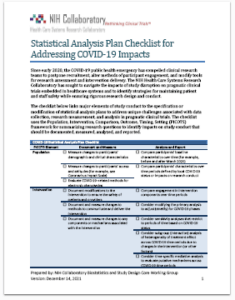
Thumbnail image of the COVID-19 checklistA new tool from the NIH Collaboratory assists investigators in identifying impacts of the COVID-19 public health emergency on ongoing pragmatic clinical trials. The Statistical Analysis Plan Checklist for Addressing COVID-19 Impacts summarizes impacts on trial conduct that study teams should document, measure, analyze, and report.

The new checklist was developed by the NIH Collaboratory’s Biostatistics and Study Design Core Working Group. Since the beginning of the COVID-19 pandemic, many of the NIH Collaboratory Trials have had to postpone recruitment, alter methods of participant engagement, and modify tools for research assessment and intervention delivery.

The leaders of the Biostatistics Core, Dr. Patrick Heagerty and Dr. Liz Turner, spoke in a recent interview about the impacts of the pandemic on the NIH Collaboratory Trials. Early next year, the Coordinating Center will report the results of a survey of the study teams about their experiences with these impacts.

Download the Statistical Analysis Plan Checklist for Addressing COVID-19 Impacts.

December 10, 2021: Decentralized Trials: Naughty or Nice? (Adrian F. Hernandez, MD, MHS)

Speaker

Adrian F. Hernandez, MD, MHS
Executive Director, Duke Clinical Research Institute
Vice Dean, Duke University School of Medicine

Topic

Decentralized Trials: Naughty or Nice?

Keywords

Decentralized trials; Study design; Implementation; Patient engagement; Patient-reported data

Key Points

  • Decentralized trials have been occurring since the start of the internet and mobile devices to reach people where they are and collect data in places we were not able to in the past.
  • One key problem decentralized trials can help solve is the gap between those who wish to participate in research and those who actually do participate. Clinical trial deserts and lack of broadband widen the gap between those who wish to participate and those who are able.
  • Decentralized trials attempt to capture data remotely instead of at a site and virtually(patient-reported) rather than recorded by study personnel.
  • COVID-19 flipped the model for clinical trial visits from that of site-based visits and care to home based, virtual visits and care.
  • Enrollment can be a challenge for decentralized trials and requires engagement campaigns at various timepoints in the study to achieve desired enrollment numbers.
  • Decentralized trials can help ensure inclusion of diverse communities in your study population.
  • The HeartLine study, CHIEF-HF study, HERO-Together study, and ACTIV-6 study are taking advantage of various technologies to decentralize study design.

Discussion Themes

Decentralized methods may improve recruitment, but may not improve retention. We may need a hybrid model to keep a patient engaged.

Decentralized methods may require decisions about what data we should collect and what we could collect, but don’t need.


Read more about decentralized study design in Use of Mobile Devices to Measure Outcomes in Clinical Research, 2010-2016: A Systematic Literature Review and Digitizing Clinical Trials.


Tags

#pctGR, @Collaboratory1

November 19, 2021: Exploring Approaches in Using Digital and Mobile Health in Patient-oriented Research: Pearls and Pitfalls (Anish K. Agarwal MD, MPH MS)

Speaker

Anish K. Agarwal MD, MPH MS
Assistant Professor of Emergency Medicine
Clinical Innovation Manager, Penn Medicine Center for Health Care Innovation
University of Pennsylvania, Perelman School of Medicine

Topic

Exploring Approaches in Using Digital and Mobile Health in Patient-oriented Research: Pearls and Pitfalls

Keywords

Mobile health; Digital health; Patient-oriented research; Study design

Key Points

  • Digital and mobile health is a rapidly evolving field that integrates with the electronic health records in both low and high tech ways.
  • Dr. Agarwal conducted a randomized control trial of overweight veterans who had daily access to a smartphone or tablet. These participants were sent a wearable device to collect step count data.
  • An important consideration for studies using mobile health technology is participant access to a smart or mobile device. 85% of Americans have access to a Smartphone where 97% have access to a mobile device that can receive texts. 20% use a smartwatch.
  • Mobile methods are just tools to support overall study design.
  • Dr. Agrawal conducted a study on post-operative opioid prescribing and use. Data was gathered from participants via text messaging systems.
  • Simple text messages that are more conversational in nature are received better by the participant. Links in text messages should be limited. It’s important for participants to understand the privacy and security of their communications and data. Nudge a participant with a text at the right time to avoid being overbearing.

Discussion Themes

Let patients know that SMS is not secure, and frame questions to avoid patients sending HIPAA covered data via text.

A good relationship with your institutions Privacy and Safety office is fundamental to navigating IRB regulations for research with digital and mobile devices.


Read more about Dr. Agarwal’s studies using mobile health devices: Effect of Gamification With and Without Financial Incentives to Increase Physical Activity Among Veterans Classified as Having Obesity or Overweight: A Randomized Clinical Trial and Patient-Reported Opioid Consumption and Pain Intensity After Common Orthopedic and Urologic Surgical Procedures With Use of an Automated Text Messaging System.


Tags

#pctGR, @Collaboratory1

October 29, 2021: Embedding Pragmatic Trials into Emergency and Critical Care (Matthew W. Semler, MD, MSc; Jonathan D. Casey, MD, MSc)

Speakers

Matthew W. Semler, MD, MSc
Assistant Professor
Vanderbilt University Medical Center

Jonathan D. Casey, MD, MSc
Assistant Professor
Vanderbilt University Medical Center

Topic

Embedding Pragmatic Trials into Emergency and Critical Care

Keywords

Pragmatic clinical trials; Study design; Comparative effectiveness trials; Treatment effect; SMART trial; PreVent trial; Exception from Informed Consent (EFIC)

Key Points

  • Emergency medical clinicians are faced with common decisions in everyday practice with little to no data from randomized clinical trials to help inform their decisions.
  • Four barriers to comparative effectiveness trials in a critical care setting are a brief therapeutic window, patients with multiple co-morbidities, the inability of the patient to consent to research, and analyzing average treatment effect rather than individual treatment effect.
  • The PreVent Trial studied the use of bag-mask ventilation to prevent hypoxemia for patients who had been administered anesthesia in preparation for intubation.
  • Efficient, pragmatic trial procedures that don’t delay treatment enable comparative effectiveness randomized clinical trials to be conducted effectively.
  • After 50 years of debate about bag-mask ventilation during this interval period, the PreVent Trial found that bag-mask ventilation cut the rate of hypoxemia by 50% without affecting aspiration.
  • The SMART Trial was a cluster-randomized, multiple-crossover trial of fluid management that studied patient outcomes when Balanced Crystalloids were used versus Saline solution.
  • The large sample size of over 15,000 patients provided the SMART trial with the power to detect that a balanced crystalloid fluid prevented Major Adverse Kidney Events in 1% of patients compared to Saline solution. /li>
  • Exception from Informed Consent (EFIC), implemented in 1996 allows trials in emergency situations of the condition is life-threatening, existing treatments are unproven or unsatisfactory, and research involves no more than minimal risk.
  • Analyzing Individual Treatment Effects will allow clinical providers to tailor their decisions to their individual patient.

Discussion Themes

Clinical equipoise poses a challenge for comparative effectiveness trials.

Key to getting buy-in from clinician stakeholders is explaining the importance of the research to the patient.


Read more about PreVent trial and the SMART trial.

Tags

#pctGR, @Collaboratory1