The US Food and Drug Administration (FDA) will host a webinar on September 9 for industry, patient groups, and other interested stakeholders to discuss and answer questions about the draft guidance, Patient-Focused Drug Development: Selecting, Developing, or Modifying Fit-for-Purpose Clinical Outcome Assessments.
The draft guidance, known as “Guidance 3,” is the third of 4 methodological guidance documents for patient-focused drug development that describe how patients, caregivers, researchers, medical product developers, and others can collect and submit patient experience data and other relevant information to be used for medical product development and regulatory decision making. Guidance 3 discusses approaches to selecting, modifying, developing, and validating clinical outcome assessments to measure outcomes of importance to patients in clinical trials.
In connection with the NIH Pragmatic Trials Collaboratory’s annual Steering Committee meeting and 10th anniversary celebration, we interviewed Dr. Christy Zigler and Dr. Emily O’Brien, asking them to reflect on the role of the Patient-Centered Outcomes Core in helping the NIH Collaboratory Trial teams plan and implement their trials, and to discuss their focus for the Core’s future contributions to pragmatic clinical trials.
Based on your experience working with the NIH Collaboratory Trials, what are some of the common challenges of patient-centered outcomes?
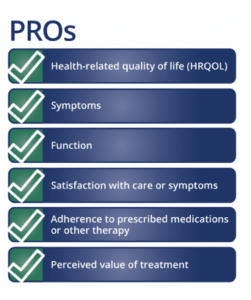
Based on our experience, the challenges that NIH Collaboratory Trials face with patient-centered outcomes can occur across several project periods. In the planning phase, we see a number of basic questions about patient-reported outcomes (PROs), including “What outcomes should be measured?” and “What measures should be used to capture these outcomes?”
Once appropriate measures have been identified, there are often challenges related to implementation of these measures and resources. For example, project teams are usually interested in understanding the availability of existing PROs within the electronic health records that study sites could leverage, as well as which measures have appropriate translations or cross-cultural validation versions that are already established.
We also have come across some interesting Core-crossing challenges, including ethical considerations for collecting PROs (Who is responsible for monitoring patient responses?) and data collection methods (Should PROs be integrated within the EHR systems or in a separate repository?). Finally, sites are sensitive to patient and system burden of PRO collection, how to reduce the likelihood of missing data, and how patient-centered outcomes fit into the overall statistical analysis plan.
Dr. Christy Zigler
What strategies have NIH Collaboratory Trials used to overcome these barriers?
So far, the NIH Collaboratory Trials have been able to share resources and test out some direct strategies to overcome these challenges. For example, some projects have created outcome-specific data silos and also tested different administration methods. The Cores have also been able to provide insight into best practices for making these decisions, such as when to use particular formats for PRO administration (eg, in clinic, via telephone, via text, via electronic capture).
How are the NIH Collaboratory Trials’ experiences with patient-centered outcomes helping the field ofpragmatic research?
We’ve really be able to pull together the lessons learned around patient-centered outcomes in pragmatic research to help inform the field. In particular, even for NIH Collaboratory Trials that have not conferred directly with our Core, we have been able to interview them about their work. For example, we highlighted critical advice from the Guiding Good Choices for Health (GGC4H) NIH Collaboratory Trial on the Living Textbook. Their real-world experience with determining and utilizing patient-centered outcomes provide a road map for other investigators.
What do you think the Core can contribute over the next decade?
Our wish list for future contributions includes:
More cross-core collaboration—specifically, conferring with the Biostatistics and Study Design Core on quantitative measurement questions around topics like meaningful change and longitudinal responsiveness within the context of pragmatic trials.
More focus on lessons learned from NIH Collaboratory Trial teams who have worked through their enrollment periods and have successful response rates. This real-world knowledge is very valuable to the field.
More focus on how to create equity within patient-centered outcomes in pragmatic trials.
In new additions to the Living Textbook, the Patient-Centered Outcomes Core of the NIH Pragmatic Trials Collaboratory explores lessons learned from the NIH Collaboratory Trials and provides information about including patient-reported outcomes (PROs) in pragmatic clinical trials.
A new section about the Food and Drug Administration’s Patient-Focused Drug Development series. This 4-part series provides guidance about how to collect and submit patient experience data in clinical research.
New content on Cultural Adaptation and Linguistic Translation from the NIH HEAL Initiative’s PRISM program—Pragmatic and Implementation Studies for the Management of Pain to Reduce Opioid Prescribing. The PRISM NIH Collaboratory Trials are designed to assess the effectiveness of non-opioid interventions for pain management. Cultural and linguistic adaptation of PRO measures enables inclusion of a broader study population and enhanced generalizability of results.
New content on acceptability and burden in the chapter on Incorporating PRO Data into the Electronic Health Record (EHR).
The PRISM program is a part of the Helping to End Addiction Long-Term Initiative℠, or NIH HEAL Initiative℠. The NIH Pragmatic Trials Collaboratory Coordinating Center serves as the PRISM Resource Coordinating Center.
The FDA is creating 4 methodological Patient-Focused Drug Development (PFDD) guidance documents to describe how to collect and submit patient experience data in clinical research. The guidance series is responsive to the mandates of the 21st Century Cures Act and other efforts to include patient experience data in support of regulatory decision-making and medical product development. Patient experience data include information about patients’ symptoms, the effects the disease has on patients over time, and patients’ experience with and views about treatments. It also includes information about patients’ views about the disease, treatment, and outcomes, and the relationship amongst those things. It includes information about the impact of the disease and treatment on the patient, patients’ thoughts about potential and current treatments, and the patients’ enhanced understanding of the progression, severity, and chronicity of the disease.
The guidance series consists of 4 documents:
Guidance 1: Collecting Comprehensive and Representative Input
Guidance 1 was released in June 2020 and is designed for those planning a study and deciding on sampling methods for the collection of patient input. Approaches for patient selection and input collection depend on the research question, and FDA recommends examining previous studies and relevant literature and consulting subject matter experts regarding decisions on methodology and study materials.
Guidance 1 describes the steps in the process of collecting input, which include defining a research question, describing the target population and who will be providing the data (patients, caregivers, or clinicians), choosing a data collection methodology, and collecting, storing and managing the data. Of note, when choosing data collection methodology and setting, ensure the data collected are representative of the population and consider the inclusion of diverse sites to better enable a representative sample.
Guidance 2: Methods to Identify What Is Important to Patients
This draft guidance describes what to ask patients and why. It describes qualitative, quantitative, and mixed methods approaches and provides best practices for eliciting information that is important to patients, including special populations (children, the cognitively impaired, and those with rare diseases) and diverse populations.
Guidance 3: Selecting, Developing, or Modifying Fit-for-Purpose Clinical Outcomes
This guidance is intended to help investigators decide what to measure and how to select or develop clinical outcome assessments (COAs) that are fit for the purpose of assessing outcomes that are important to patients. It “describes how stakeholders (patients, caregivers, researchers, medical product developers, and others) can collect and submit patient experience data and other relevant information from patients and caregivers to be used for medical product development and regulatory decision-making.”
Guidance 4: Incorporating Clinical Outcome Assessments Into Endpoints for Regulatory Decision-Making
This guidance is forthcoming and will describe how to incorporate a given clinical outcome assessment tool or a set of measures into a clinical research study. The guidance will include information about defining meaningful change, and the collection, analysis, interpretation, and submission of data.
In the latest episode of the NIH Collaboratory Grand Rounds podcast, Dr. Christopher Lindsell and Dr. Adrian Hernandez continue the discussion about research outcomes and the importance of understanding stakeholder perspectives in choosing the correct outcomes for outpatient trials.
This podcast continues the discussion with Dr. Christopher Lindsell as he discusses research outcomes and the importance of choosing the correct outcome.
Click on the recording below to listen to the podcast.
Christopher Lindsell, PhD
Professor of Biostatistics and Biomedical Informatics
Director, Vanderbilt Institute for Clinical and Translational Research (VICTR) Methods Program
Codirector, Vanderbilt Health Data Science (HEADS) Center
Topic
Searching for a Unicorn: Understanding Stakeholder Perspectives When Selecting Outcomes for Outpatient Trials
Keywords
Research outcome; Outpatient clinical trials; Patient-reported outcomes; Researcher-observed outcomes; Pragmatic trials; ACTIV-6; Days of benefit; Mean time unwell
Key Points
A research outcome is the main piece of data used to decide if the research intervention has failed or succeeded.
If the incorrect outcome is chosen, the question of whether the intervention has succeeded can’t be answered accurately. Finding the correct outcome requires asking the question ‘What matters?’
In studies that are designed to help you feel better faster, we may need to prioritize symptoms and signs (patient reported outcomes) over objective measures (researcher observed outcomes).
Outcomes should be chosen based on the purpose of the study.
Researchers need to balance sensitivity and specificity when choosing an outcome measure.
The ACTIV-6 study uses an overall symptom outcome scale to determine if patients ‘feel better faster.’
ACTIV-6 uses Days of Benefit and Time to Recovery/hospitalization and death as an outcome to determine if the intervention is successful.
Discussion Themes
It’s important to strive to complete the most powerful and efficient studies that we can do.
Having multiple medicines available that balance risk and benefit differently gives patients options for their treatment. Individual patients have differing levels of risk tolerance and different ideas about what is the most beneficial outcome.
Adrian F. Hernandez, MD, MHS
Executive Director, Duke Clinical Research Institute
Vice Dean, Duke University School of Medicine
Topic
Decentralized Trials: Naughty or Nice?
Keywords
Decentralized trials; Study design; Implementation; Patient engagement; Patient-reported data
Key Points
Decentralized trials have been occurring since the start of the internet and mobile devices to reach people where they are and collect data in places we were not able to in the past.
One key problem decentralized trials can help solve is the gap between those who wish to participate in research and those who actually do participate. Clinical trial deserts and lack of broadband widen the gap between those who wish to participate and those who are able.
Decentralized trials attempt to capture data remotely instead of at a site and virtually(patient-reported) rather than recorded by study personnel.
COVID-19 flipped the model for clinical trial visits from that of site-based visits and care to home based, virtual visits and care.
Enrollment can be a challenge for decentralized trials and requires engagement campaigns at various timepoints in the study to achieve desired enrollment numbers.
Decentralized trials can help ensure inclusion of diverse communities in your study population.
The HeartLine study, CHIEF-HF study, HERO-Together study, and ACTIV-6 study are taking advantage of various technologies to decentralize study design.
Discussion Themes
Decentralized methods may improve recruitment, but may not improve retention. We may need a hybrid model to keep a patient engaged.
Decentralized methods may require decisions about what data we should collect and what we could collect, but don’t need.
Chronic Pain is responsible for far more years lived with disability than a large number of other diseases and injuries, such as COPD, diabetes, dementia, stroke and others, combined.
PPACT was a cluster randomized study aimed at integrating interdisciplinary pain management methods into primary care to improve care for patients with chronic pain.
Participants had been prescribed long-term opioids for mixed chronic pain conditions.
Study intervention lasted 12 weeks and included cognitive behavioral therapy, yoga-based exercises, physical therapy, a medication review, and support from a primary care provider.
Participants in the treatment group of the PPACT study showed a modest reduction of pain that was sustained over a 12 month period.
The PPACT intervention was cost effective versus usual treatment methods.
Discussion Themes
An in-person enhanced enrollment session was conducted to give potential subjects a comprehensive overview of the study procedures. This enrollment session led to fewer people enrolling in the study, but of those that did, more completed the study.
The key to successful CBT is an interactive patient-centered approach.
Anish K. Agarwal MD, MPH MS
Assistant Professor of Emergency Medicine
Clinical Innovation Manager, Penn Medicine Center for Health Care Innovation
University of Pennsylvania, Perelman School of Medicine
Topic
Exploring Approaches in Using Digital and Mobile Health in Patient-oriented Research: Pearls and Pitfalls
Keywords
Mobile health; Digital health; Patient-oriented research; Study design
Key Points
Digital and mobile health is a rapidly evolving field that integrates with the electronic health records in both low and high tech ways.
Dr. Agarwal conducted a randomized control trial of overweight veterans who had daily access to a smartphone or tablet. These participants were sent a wearable device to collect step count data.
An important consideration for studies using mobile health technology is participant access to a smart or mobile device. 85% of Americans have access to a Smartphone where 97% have access to a mobile device that can receive texts. 20% use a smartwatch.
Mobile methods are just tools to support overall study design.
Dr. Agrawal conducted a study on post-operative opioid prescribing and use. Data was gathered from participants via text messaging systems.
Simple text messages that are more conversational in nature are received better by the participant. Links in text messages should be limited. It’s important for participants to understand the privacy and security of their communications and data. Nudge a participant with a text at the right time to avoid being overbearing.
Discussion Themes
Let patients know that SMS is not secure, and frame questions to avoid patients sending HIPAA covered data via text.
A good relationship with your institutions Privacy and Safety office is fundamental to navigating IRB regulations for research with digital and mobile devices.


 The US Food and Drug Administration (FDA) will host a webinar on September 9 for industry, patient groups, and other interested stakeholders to discuss and answer questions about the draft guidance, Patient-Focused Drug Development: Selecting, Developing, or Modifying Fit-for-Purpose Clinical Outcome Assessments.

 In the latest episode of the