April 22, 2020: New Article Details the Design of ADAPTABLE, PCORnet’s First Pragmatic Trial

A new article in JAMA Cardiology discusses the design of ADAPTABLE, a pragmatic clinical trial (PCT) which strives to answer a three-decade-old question with great potential significance for public health. ADAPTABLE is the first PCT to use many of the data-driven and patient-centric capabilities of the National Patient-Centered Clinical Research Network (PCORnet).

Researchers in ADAPTABLE pursued the unanswered question of whether a low dose or high dose of aspirin is optimal for secondary prevention of atherosclerotic cardiovascular disease. Complexities of running a randomized clinical trial and the expenses associated with it have previously prevented researchers from answering this question.

The capabilities of PCORnet have aided in this research. Though not all randomized clinical trials can be designed as PCTs, ADAPTABLE demonstrates the possibility of incorporating pragmatic elements into future studies with the goal of producing real-world evidence.

A key objective of involving PCORnet in ADAPTABLE was the ability for large-scale recruitment (15,000 participants) using electronic health records and electronic informed consent. The PCORnet component permitted complete electronic participation, from randomization to data collection. Patients reported their own data during scheduled electronic follow-ups, which replaced conventional follow-up visits.

NIH Collaboratory Coordinating Center co–principal investigator Dr. Adrian Hernandez also serves as co–principal investigator of ADAPTABLE and contributed to the article.

See the accompanying editorial describing lessons learned from the design features of ADAPTABLE.

November 15, 2019: PCORnet: Health Plan Research Network Data Linkage and Patient Engagement with Patient-Powered Research Networks (Kevin Haynes, PharmD, MSCE)

Speaker

Kevin Haynes, PharmD, MSCE
Principal Scientist
HealthCore

Topic

PCORnet: Health Plan Research Network Data Linkage and Patient Engagement with Patient-Powered Research Networks

Keywords

Data linkages; PCORnet; Patient-powered research networks; Health plan research networks; Computable phenotypes

Key Points

  • One of the biggest challenges facing healthcare today is reducing gaps in evidence necessary to improve health outcomes. Research collaborations between health plans and patient-powered research networks (PPRNs) can help close this gap.
  • PCORnet enables linkages with patient groups through PPRNs, which include participating organizations and leadership teams of patients, advocacy groups, clinicians, academic centers, and practice-based research networks.
  • From the health plan perspective, postal mail outreach to members was more effective than email outreach around engaging patients in research opportunities.

Discussion Themes

When engaging with different patient-powered research networks, are there differences around common conditions compared with rare or stigmatized conditions?

What are participants told about the commercialization of findings, whether in terms of new treatments that might be identified, or the ways in which findings might affect health plans’ willingness to continue to cover certain treatments?

An essential aspect of collaboration is building and maintaining the trust of members in the research networks.

Read more about collaborations between PPRNs and health plans in a recent JAMIA publication and the PCORnet website.

Tags
#pctGR, @Collaboratory1, @KHaynes001

September 13, 2019: ADAPTABLE Recruitment and Follow-up: Health Plan Research Network Engagement (Kevin Haynes, PharmD, MSCE)

Speaker

Kevin Haynes, PharmD, MSCE
Principal Scientist
HealthCore, Inc.

Topic

ADAPTABLE Recruitment and Follow-up: Health Plan Research Network Engagement

Keywords

Real-world evidence; Real-world data; Study design; Claims data; ADAPTABLE; Patient recruitment; Pragmatic clinical trial; Electronic health record; Informed consent; Learning health system

Key Points

  • We need integrated EHR data and claims data in order to close evidence gaps in observational pharmacoepidemiology studies and comparative effectiveness trials.
  • The health plan claims data environment can be leveraged to support real-world evidence studies.
  • An integrated health plan network database can be a resource for data about eligibility, lab test results, and pharmacy claims. In a pragmatic clinical trial, using health plan data can provide a longitudinal electronic approach to endpoint ascertainment.

Discussion Themes

Have you had a chance to do any cost analysis of this high-volume, low-touch method of recruitment?

In the ADAPTABLE enrollment portal, it seems the biggest chunk of time (reading about the study) came before the screening questions. Do you think swapping the order might have improved enrollment?

Read more about the ADAPTABLE pragmatic trial.

Tags

#pctGR, @Collaboratory1, @HealthCoreRWE

June 13, 2019: Experience With Pragmatic Clinical Trials Gains Momentum

At the NIH Collaboratory Steering Committee Meeting in May 2019, participants shared their perspectives on the evolving landscape of embedded pragmatic clinical trials (ePCTs). Three initiatives were presented: the Patient-Centered Outcomes Research Institute (PCORI), the NIH-DoD-VA Pain Management Collaboratory, and the HEAL (Helping to End Addiction Long-term) Initiative. Although many challenges remain, the conduct of ePCTs is gaining momentum, and the synergy between the initiatives, along with the fellowship they engender, will continue to help pave the way for more embedded pragmatic research in the future.

Dr. Ann Trontell, Associate Director of Clinical Effectiveness and Decision Science at PCORI, shared PCORI’s experience with pragmatic clinical studies. Since 2014, PCORI has awarded $494 million dollars for 43 pragmatic studies that range in size from 425 to 100,000 participants (median, approximately 1700). The studies include 2 observational, 27 individually randomized, and 14 cluster randomized trials in a wide range of therapeutic areas.

Dr. Trontell urged those developing proposals for pragmatic trials to make them fit for purpose, as opposed to emphasizing pragmatism, a theme echoed in the Developing a Compelling Grant Application chapter of the Living Textbook.


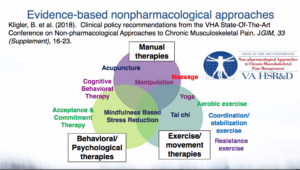
Dr. Robert Kerns, a director of the NIH-DoD-VA Pain Management Collaboratory, shared progress with pragmatic trials designed to evaluate whether evidence-based nonpharmacological approaches are effective for pain management among US military personnel and veterans.

Modeled after the NIH Collaboratory, the Pain Management Collaboratory is supporting 11 projects through a 2-year planning phase and a 2- to 4-year implementation phase. Subject matter experts at the Pain Management Collaboratory Coordinating Center (PMC3) support the projects by sharing tools, best practices, and resources.


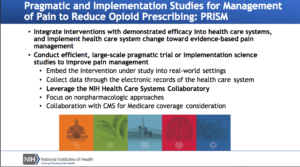
Dr. Wendy Weber, Program Officer for the NIH Collaboratory Coordinating Center, introduced the HEAL initiative, which is designed to enhance pain management and improve prevention and treatment strategies for opioid misuse and addiction. The goal of the initiative is to provide scientific solutions to the opioid crisis. It includes a set of large-scale pragmatic trials that will receive logistical and technical support from the NIH Collaboratory Coordinating Center.


While experience with ePCTs is growing, many distinct challenges remain. As the conduct of ePCTs gains momentum, there is a rich opportunity to use collective experiences to refine best practices to real-world evidence generation and help solve urgent public health problems.

August 28, 2018: ADAPTABLE Patient-Reported Health Data Codes Now Available

The ADAPTABLE pragmatic trial relies on patients to report key information at baseline and throughout follow-up. To capture these data, ADAPTABLE investigators developed a LOINC (Logical Observation Identifiers Names and Codes) patient-reported item set, which is now publicly available.

The development of the item set is part of the ADAPTABLE Supplement, an initiative funded by the Office of the Assistant Secretary for Planning and Evaluation to develop best practices for capturing patient-reported outcome data and optimal analytic approaches for using the data in a pragmatic clinical trial. Additional reference material can be found in the ADAPTABLE Supplement Roundtable Meeting summary, in a report describing the results of a literature review of data standards and metadata standards for variables of interest, and on GitHub. The project is expected to inform future efforts to integrate patient-reported data in the electronic health record and provide opportunities to streamline data for use in pragmatic trials. Information from the project is being added to the Living Textbook as it accumulates; learn more in the chapters on Using Electronic Health Record Data and Choosing and Specifying End Points and Outcomes.

ADAPTABLE (Aspirin Dosing: A Patient-Centric Trial Assessing Benefits and Long-Term Effectiveness) aims to identify the optimal dose of aspirin therapy for secondary prevention in atherosclerotic cardiovascular disease and is the first major randomized comparative effectiveness trial to be conducted by the National Patient-Centered Clinical Research Network (PCORnet).

PCORnet Posts Aspirin Study Protocol for Public Review and Comment


PCORnetThe National Patient-Centered Clinical Research Network (PCORnet) has recently made a draft protocol for its first randomized clinical trial available for stakeholder review. Researchers, clinicians, patients and the public are all invited to read the current draft of the study protocol and provide comments and feedback.

The ADAPTABLE Study (PDF), which will investigate whether lower- or higher-dose aspirin is better for preventing heart attack and stroke in patients at risk for heart disease, is PCORnet’s first randomized pragmatic clinical trial. Designed to leverage PCORnet’s Clinical Data Research Networks (CDRNs) and Patient-Powered Research Networks (PPRNs), the trial will serve as twofold purpose: answering a clinical question of direct importance for patients, families, and healthcare providers, and serving as a demonstration of PCORnet’s capabilities in conducting clinical research on a national scale.

Links to the proposed study protocol, a survey tool for capturing feedback, and other information about ADAPTABLE Study, including press releases, fact sheets, and infographics, are available at the link below:

ADAPTABLE: The Aspirin Study

Follow PCORnet on Twitter @PCORnetwork for updates on the ADAPTABLE #ClinicalTrial


In the News: Increase in Use of Personal Health Data


An explosion in the collection of personal data is fostering concerns about the extent to which health information is accessed—and about the privacy and confidentiality of this information. Two recent National Public Radio stories highlight a few of the burgeoning uses of these abundant data.

In the first, an insurer uses personal data to predict who will get sick so it can identify patients at highest risk for hospital admission, or readmission, and then provide them with personal health coaches. The coordinated care given to patients by the coaches (for example, arranging a visiting nurse or streamlining appointments) has been shown to improve hospitalization rates. The insurer says it follows federal health privacy guidelines for anonymity and uses the information to better serve its members.

The second story explains that results of online health searches aren’t always confidential, and data brokers are tracking information and selling it to interested parties. The author notes that data gathered on the Web are, for the most part, unregulated. Both stories raise questions about privacy and confidentiality of health information and how to best protect it.

Pragmatic clinical trials also seek to use personal health data to answer important questions on the risks, benefits, and burdens of therapeutic interventions. In a blog post in Health Affairs, Joe Selby, executive director of the Patient-Centered Outcomes Research Institute (PCORI), underscores the need for trust, support, and active engagement of patients when involving them in health data research, even with privacy protections in place. PCORI has launched the National Patient-Centered Clinical Research Network (PCORnet) as a means of harnessing large clinical data sets to study the comparative effectiveness of treatments, and a central tenet of the network is that patients, clinicians, and healthcare systems should be actively involved in the governance of the use of health information.


Read the full articles

From NPR: Insurer Uses Personal Data To Predict Who Will Get Sick
From NPR: Online Health Searches Aren't Always Confidential
From Health Affairs: Advancing the Use of Health Data in Research With PCORnet


PCORI Announces First PCORnet NIH Collaboratory Trial: The ADAPTABLE Aspirin Study


The Patient-Centered Outcomes Research Institute (PCORI) has approved the first pragmatic clinical trial to be performed through the National Patient-Centered Clinical Research Network (PCORnet)—the ADAPTABLE study (Aspirin Dosing: A Patient-centric Trial Assessing Benefits and Long-term Effectiveness).

Over the course of the trial, 20,000 study participants with cardiovascular disease will be randomly assigned to receive one of two commonly used doses of aspirin—a low dose of 81 mg per day versus a higher dose of 325 mg per day—in order to determine which provides the optimal balance between protecting patients with cardiovascular disease from heart attack and stroke, and minimizing bleeding events associated with aspirin therapy. The trial will also employ a number of innovative methods, including electronic health record (EHR)-based data collection and a patient-centered, web-based enrollment model in partnership with the Health eHeart Alliance Patient-Powered Research Network (PPRN).

The ADAPTABLE trial, which includes six of PCORnet’s Clinical Data Research Networks (CDRNs), will be led and coordinated through the Duke Clinical Research Institute (DCRI).


Read more about the ADAPTABLE Aspirin Trial here:
Fact Sheet (PDF)
Infographic (PDF)
DCRI Coordinating Center Announcement

Study Examines Public Attitudes Toward Data-Sharing Networks


A new study examining public attitudes about the sharing of personal medical data through health information exchanges and distributed research networks finds a mixture of receptiveness and concerns about privacy and security. The study, conducted by researchers from the University of California, Davis and University of California, San Diego and published online in the Journal of the American Medical Informatics Association (JAMIA), reports results from a telephone survey of 800 California residents. Participants were asked for their opinions about the importance of sharing personal health data for research purposes and their feelings about related issues of security and privacy, as well as the importance of notification and permission for such sharing.

The authors found that a majority of respondents felt that sharing health data would “greatly improve” the quality of medical care and research. Further, many either somewhat or strongly agreed that the potential benefits of sharing data for research and care improvement outweighed privacy considerations (50.8%) or the right to control the use of their personal information (69.8%), although study participants also indicated that transparency regarding the purpose of any data sharing and controlling access to data remained important considerations.

However, the study’s investigators also found evidence of widespread concern over privacy and security issues, with substantial proportions of respondents reporting a belief that data sharing would have negative effects on the security (42.5%) and privacy (40.3%) of their health data. The study also explored attitudes about the need to obtain permission for sharing health data, as well as whether attitudes toward sharing data differed according to the purpose (e.g., for research vs. care) and the groups or individuals among which the data were being shared.

The authors note that while data-sharing networks are increasingly viewed as a crucial tool for enabling research and improving care on a national scale, they ultimately rely upon trust and acceptance from patients. As such, the long-term success of efforts aimed at building effective data-sharing networks may depend on accurately understanding the views of patients and accommodating their concerns.


Read the full article here: 

Kim KK, Joseph JG, Ohno-Machado L. Comparison of consumers' views on electronic data sharing for healthcare and research. J Am Med Inform Assoc. 2015 Mar 30. pii: ocv014. doi: 10.1093/jamia/ocv014. [Epub ahead of print]

Report from NIH Collaboratory Workshop Examines Ethical and Regulatory Challenges for Pragmatic Cluster Randomized Trials

A new article by researchers from the NIH Collaboratory, published online this week in the journal Clinical Trials, explores some of the challenges facing physicians, scientists, and patient groups who are working to develop innovative methods for performing clinical trials. In the article, authors Monique Anderson, MD, Robert Califf, MD, and Jeremy Sugarman, MD, MPH, MA, describe and summarize discussions from a Collaboratory workshop on ethical and regulatory issues relating to pragmatic cluster-randomized trials.


Pragmatic Cluster-Randomized Trials

Many of the clinical trials that evaluate the safety and effectiveness of new therapies do so by assigning individual volunteers to receive either an experimental treatment or a comparator, such as an existing alternative treatment, or a placebo. However, this process can be complex, expensive, and slow to yield results. Further, because these studies often take place in specialized research settings and involve patients who have been carefully screened, there are  concerns that the results gathered from such trials may not be fully applicable to “real-world” patient populations.

For these reasons, some researchers, patients, and patient advocacy groups are interested in exploring different methods for conducting clinical trials, including designs known as pragmatic cluster-randomized trials, or CRTs. In a pragmatic CRT, groups of individuals (such as a clinic, hospital, or even an entire health system) are randomly assigned to receive one of two or more interventions being compared, with a focus on answering questions about therapies in the setting of actual clinical practice—the “pragmatic” part of “pragmatic CRT.”

Pragmatic CRTs have the potential to answer important questions quickly and less expensively, especially in an era in which patient data can be accessed directly from electronic health records. Just as importantly, that knowledge can then be fed back to support a “learning healthcare system” that is constantly improving in its approach to patient care.  However, while cluster-randomized trials are not themselves new, their widespread use in patient-care settings raises a number of potential challenges.

For example: in a typical individually randomized clinical trial, patients are enrolled in a study only after first providing written informed consent. However, in a CRT, the entire hospital may be assigned to provide a given therapy. In such a situation, how should informed consent be handled? How should patients be notified that research is taking place, and that they may be part of it? Will they be able to “opt out” of the research? What will happen to the data collected during their treatment? And what do federal regulations governing clinical trials have to say about this? These are just a few of the questions raised by the use of pragmatic CRTs in patient-care settings.


The NIH Collaboratory Workshop on Pragmatic Cluster-Randomized Trials

The NIH Collaboratory Workshop of Pragmatic CRTs, held in Bethesda, Maryland in July of 2103, convened a panel of experts in clinical trials, research ethics, and regulatory issues to outline the challenges associated with conducting  pragmatic CRTs and to explore ways for better understanding and overcoming them. Over the course of the intensive 1-day workshop, conference participants identified key areas for focused attention. These included issues relating to informed consent, patient privacy, oversight of research activities, insuring the integrity of data gathered during pragmatic CRTs, and special protections for vulnerable patient populations. The article by Anderson and colleagues provides a distillation of discussions that took place at the workshop, as well as noting possible directions for further work.

In the coming months and years, the NIH Collaboratory and its partners, including the National Patient-Centered Clinical Research Network (PCORnet), plan to build on this workshop experience. Together, they hope to explore these issues in greater detail and propose practical steps for moving forward with innovative clinical research methods, while at the same time maintaining robust protections for patients’ rights and well-being.


Jonathan McCall, MS, and Karen Staman, MS, contributed to this post.


Read the full text of the article here:

Anderson ML, Califf RM, Sugarman J. Ethical and regulatory issues of pragmatic cluster randomized trials in contemporary health systems. Clin Trials 2015 [e-Pub ahead of press].
doi:10.1177/1740774515571140 
For further reading:

Tunis SR, Stryer DB, Clancy CM. Practical clinical trials: Increasing the value of clinical research decision making in clinical and health policy. JAMA 2003;290(12):1624-32. PMID:14506122; doi:10.1001/jama.290.12.1624.

The Ottawa Hospital Research Institute Ethical Issues in Cluster Randomized Trials Wiki.

Special Report: Ethical Oversight of Learning Health Systems. Hastings Center Report 2013;43(s1):S2–S44, Si–Sii.

Sugarman J, Califf RM. Ethics and regulatory complexities for pragmatic clinical trials. JAMA 2014;311(23):2381-2. PMID: 24810723; doi: 10.1001/jama.2014.4164.