December 8, 2021: NIH Collaboratory and IMPACT Collaboratory Offer Workshop on Dissemination and Implementation Research and Pragmatic Trials

Logo for AcademyHealthThe NIH Collaboratory is partnering with the IMPACT Collaboratory to offer a pre-conference workshop on December 13 at AcademyHealth’s 14th Annual Conference on the Science of Dissemination and Implementation in Health.

The workshop, Convergence of Dissemination & Implementation Research Methods and Embedded Pragmatic Trials, will provide an introduction to investigative opportunities for pragmatic clinical trials embedded in healthcare systems, along with strategies for conducting clinical trials that provide real-world evidence necessary to inform both practice and policy.

The workshop is being offered free to conference attendees but requires a separate registration. The workshop will provide strategies for integrating implementation research methods in the design and conduct of ePCTs. Speakers will share firsthand experiences and case studies from the NIH Collaboratory and the IMPACT Collaboratory.

The learning objectives of the workshop include:

  • To identify key areas of synergy between ePCTs and implementation research
  • To introduce attendees to the unique characteristics and challenges of designing, conducting, and implementing ePCTs within diverse healthcare systems, and to describe opportunities for integrating implementation research methods into ePCTs
  • To increase the capacity of health services researchers to address important clinical questions with ePCTs and implementation research methods

CONFERENCE DETAILS AND REGISTRATION
14th Annual Conference on the Science of Dissemination and Implementation in Health: Broadening Horizons for Impact: Incorporating Multisectoral Approaches into D&I Science
December 13, 2021

June 28, 2021: AcademyHealth Announces Abstract Deadline for Dissemination and Implementation Science Conference

Logo for AcademyHealthAcademyHealth is accepting abstracts for the 14th Annual Conference on the Science of Dissemination and Implementation in Health until July 27, 2021. This year’s meeting will be held virtually from December 14 to 16.

Read the complete call for abstracts.

The theme of this year’s virtual online meeting is “Broadening Horizons for Impact: Incorporating Multisectoral Approaches into D&I Science.” The annual conference is cohosted by the NIH and AcademyHealth with the goal of realizing “the full potential of evidence to optimize health and health care by bridging the gap between research, practice, and policy.”

March 11, 2021: TSOS Study Intervention Reduces PTSD Symptoms in Injured Patients at Level I Trauma Centers

Photo of Dr. Doug Zatzick
Dr. Doug Zatzick

A collaborative care intervention for injured patients at trauma centers can reduce symptoms of posttraumatic stress disorder (PTSD), according to the results of the Trauma Survivors Outcomes and Support (TSOS) study. The results were published online this week in JAMA Surgery.

The TSOS study, an NIH Collaboratory Demonstration Project, was a stepped-wedge, cluster randomized pragmatic clinical trial testing the delivery of a stepped collaborative care intervention vs usual care for 635 injured patients with PTSD symptoms and comorbid conditions at 25 level I trauma centers in the United States.

Patients in the control group received usual care plus nurse notification about the patient’s high level of distress. Patients in the intervention group received collaborative care consisting of evidence-based medication, cognitive behavioral therapy, and case management. Patients in the intervention group whose PTSD symptoms persisted after initial treatment received stepped-up care, such as medication adjustments or additional psychotherapeutic elements.

After 6 months, the intervention group experienced a significant reduction in PTSD symptoms as compared with the control group. The treatment effect was greater for patients with higher baseline PTSD risk.

“Our study shows that a brief, approximately 2-hour collaborative care intervention delivered by frontline trauma center providers can significantly reduce PTSD symptoms in diverse injury survivors, including survivors of firearm injuries,” said Dr. Doug Zatzick of the University of Washington School of Medicine, the TSOS study’s principal investigator. “Collaborative care may therefore be an optimal treatment approach for trauma-exposed patients treated in acute care medical settings,” he said.

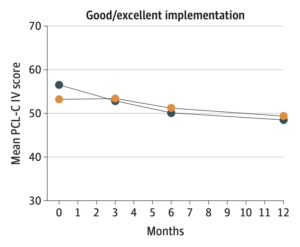
Figure from the TSOS main outcomes paper
Source: JAMA Surg. 2021 Mar 10. doi: 10.1001/jamasurg.2021.0131.

The study also included an implementation process assessment to allow the investigators to examine how the quality of each site’s implementation of the protocol affected study outcomes. The effect of the intervention on PTSD symptoms was greater at trauma centers with good or excellent protocol implementation.

“The upfront integration of an implementation process assessment into the TSOS pragmatic trial design allowed us to identify sites with good/excellent versus fair/poor protocol implementation, a key characteristic in discriminating patient-level PTSD treatment effects,” Zatzick said.

Overall, reduction in PTSD symptoms did not differ significantly between the study arms at 3 and 12 months, and there was no effect on secondary outcomes. However, the subgroup of patients who had firearm injuries and who were treated at sites with good or excellent implementation had among the largest 6-month treatment effects and demonstrated significant treatment effects at 12 months.

TSOS was supported within the NIH Collaboratory by a cooperative agreement from the National Institute of Mental Health and by the NIH Common Fund through a cooperative agreement from the Office of Strategic Coordination within the Office of the NIH Director. Learn more about the NIH Collaboratory Demonstration Projects.

November 2, 2020: PRIM-ER Pilot Study Identifies Keys to Implementation Success

Cover image of JGIMIn a qualitative analysis of the PRIM-ER pilot study, receiving the support of institutional leadership and leveraging existing institutional processes emerged as keys to successfully implementing the study intervention.

The results of the analysis were published last week in the Journal of General Internal Medicine.

PRIM-ER, an NIH Collaboratory Trial, is a stepped-wedge cluster randomized clinical trial that will test a multidisciplinary primary palliative care intervention consisting of education, clinical decision support, and other elements in a diverse mix of emergency departments in the United States. The intervention is intended to improve the delivery of goal-directed emergency care of older adults.

In the pilot study, the research team launched the intervention in 2 emergency departments. The purpose of the qualitative analysis was to measure and evaluate the reach and effectiveness of the intervention. Both sites in the pilot study achieved a high level of reach, or intervention completeness. The intervention’s effectiveness—in terms the success of its implementation—was enhanced by support from institutional leadership and use of the sites’ existing processes for quality improvement. The findings will guide the research team as they implement the intervention at additional study sites.

PRIM-ER is supported within the NIH Collaboratory by a cooperative agreement from the National Institute on Aging. Read more about PRIM-ER.

October 21, 2020: PCT Grand Rounds to Feature Implementation Framework for Outpatient Clinical Decision Support

The NIH Collaboratory’s PCT Grand Rounds will highlight an implementation framework for outpatient clinical decision support.

In this week’s session, Drs. Patrick O’Connor and JoAnn Sperl-Hillen of HealthPartners Institute will present “Outpatient Clinical Decision Support – An Evidence-Based Implementation Framework.” The Grand Rounds session will be held on Friday, October 23, at 1:00 pm eastern. Join the online meeting.

Learn more about upcoming and recent Grand Rounds webinars.

August 6, 2020: New Living Textbook Section Describes Rapid Approach for Implementation Assessments

A new section of the Living Textbook’s Dissemination and Implementation chapter describes how the Trauma Survivors Outcomes & Support (TSOS) pragmatic trial research team developed a rapid approach to implementation process assessments: the Rapid Assessment Procedure Informed Clinical Ethnography (RAPICE). Implementation assessments are typically time consuming and expensive, and the new approach embeds these procedures as part of the trial to increase efficiency and decrease cost.

Since its development within the NIH Health Care Systems Research Collaboratory, the RAPICE method has been used to address the Washington State COVID-19 outbreak to help rapidly identify primary and secondary COVID-19 prevention strategies that could be delivered using the TSOS care management platform.

For more information, see the April 19, 2019 Grand Rounds: Trauma Survivors Outcomes & Support (TSOS) Pragmatic Trial: Revisiting Effectiveness & Implementation Aims (Doug Zatzick, MD)