
September 11, 2024: HARMONIE and a New Approach to Commercial Clinical Trials, in This Week’s PCT Grand Rounds

Headshot of Professor Saul Faust
Professor Saul Faust

In this Friday’s PCT Grand Rounds, Saul Faust of the University of Southampton will present “The HARMONIE Trial: Reimagining How to Design and Deliver Contract Commercial Clinical Trials.”

The Grand Rounds session will be held on Friday, September 13, 2024, at 1:00 pm eastern.

The HARMONIE trial was a pragmatic trial of the effect of nirsevimab on hospitalizations for respiratory syncytial virus–associated lower respiratory tract infection when administered in healthy infants in France, Germany, and the United Kingdom.

Faust is a professor of pediatric immunology and infectious diseases at the University of Southampton, the director of the National Institute for Health Research (NIHR) Southampton Clinical Research Facility, the clinical director of the Wessex Local Clinical Research Network, and a NIHR senior investigator.

Join the online meeting.

July 10, 2024: Asking Different Causal Questions in Randomized Trials, in This Week’s PCT Grand Rounds

Headshot of Dr. Miguel Hernán
Dr. Miguel Hernán

In this Friday’s PCT Grand Rounds, Miguel Hernán of Harvard University will present “Causal Estimands: Should We Ask Different Causal Questions in Randomized Trials and in the Observational Studies That Emulate Them?”

The Grand Rounds session will be held on Friday, July 12, 2024, at 1:00 pm eastern.

Hernán is the Kolokotrones Professor of Biostatistics and Epidemiology and the director of the CAUSALab at Harvard T.H. Chan School of Public Health. Researchers at the CAUSALab generate, analyze, and interpret data to support decision-makers in making better decisions about what works in medicine, public health, and policy.

Join the online meeting.

November 29, 2023: Special Biostatistics Series Continues With Guidelines for Stepped-Wedge Trials

In this Friday’s PCT Grand Rounds, Jim Hughes of the University of Washington will continue our special series, Advances in the Design and Analysis of Pragmatic Clinical Trials, with his presentation, “Guidelines for Design and Analysis of Stepped-Wedge Trials.” The session will be held on Friday, December 1, at 1:00 pm eastern.

Hughes is a professor emeritus of biostatistics at the University of Washington. This session’s moderator, Patrick Heagerty, is a professor of biostatistics at the University of Washington and a cochair of the NIH Pragmatic Trials Collaboratory’s Biostatistics and Study Design Core.

Join the online meeting.

This special Grand Rounds series will include additional moderated webinar discussions that bring together biostatisticians, clinical trials methodologists, and investigators to discuss challenges and share lessons learned in the design, implementation, and analysis of pragmatic trials. Download the series flyer and see the full schedule below.

All sessions are free and open to the public; no registration is required.

October 4, 2023: Special Biostatistics Grand Rounds Series Begins Friday With Rigorous Methods for Hybrid Studies

In this Friday’s PCT Grand Rounds, David Murray of the NIH Office of Disease Prevention will kick off our special series, Advances in the Design and Analysis of Pragmatic Clinical Trials, with his presentation, “Hybrid Studies Should Not Sacrifice Rigorous Methods.” The session will be held on Friday, October 6, at 1:00 pm eastern and will be moderated by Jonathan Moyer.
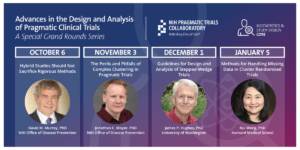
Murray is the NIH associate director for prevention and the director of the Office of Disease Prevention. He is a longtime member of the NIH Pragmatic Trials Collaboratory’s Biostatistics and Study Design Core. This session’s moderator, Jon Moyer, is a statistician in the Office of Disease Prevention.

Join the online meeting.

This special Grand Rounds series will include additional moderated webinar discussions that bring together biostatisticians, clinical trials methodologists, and investigators to discuss challenges and share lessons learned in the design, implementation, and analysis of pragmatic trials. Download the series flyer and see the full schedule below.

All sessions are free and open to the public; no registration is required.

September 5, 2023: NIH Pragmatic Trials Collaboratory Announces Grand Rounds Series on Design and Analysis of Pragmatic Clinical Trials

Promotional graphic showing details of the upcoming sessions of special Grand Rounds series, "Advances in the Design and Analysis of Pragmatic Clinical Trials"The NIH Pragmatic Trials Collaboratory is launching a special Grand Rounds series to share advances in the design and analysis of pragmatic clinical trials.

Join us on the first Friday of each month, October through January, to hear the latest best practices and explore emerging questions with experts from the program’s Biostatistics and Study Design Core.

Over the past decade, the Core has worked with investigators to fine-tune study designs, develop rigorous analysis plans, and offer guidance to the broader community of researchers who are planning pragmatic trials. With this new Grand Rounds series, the Core is bringing together biostatisticians, clinical trials methodologists, and investigators to discuss challenges and share lessons learned in the design, implementation, and analysis of pragmatic trials.

The webinar series, Advances in the Design and Analysis of Pragmatic Clinical Trials, will kick off on Friday, October 6, at 1:00 pm ET with a presentation on design and analysis considerations for implementation trials by David Murray, NIH associate director for disease prevention and director of the NIH Office of Disease Prevention.

The series will include 3 additional moderated webinar discussions. These sessions will focus on a range of topics, including complex clustering, best practices in the design and analysis of stepped-wedge trials, and handling missing data in cluster randomized trials.

Download the series flyer and see the full schedule below:

All sessions are free and open to the public; no registration is required. Recordings will be archived on the Rethinking Clinical Trials website.

Grand Rounds June 16, 2023: BeatPain Utah: Partnering With Community Health Centers Within a Socio-Technical Framework (Julie Fritz, PT, PhD, FAPTA; Guilherme Del Fiol, MD, PhD)

Speakers

Julie Fritz, PT, PhD, FAPTA
Distinguished Professor, Department of Physical Therapy & Athletic Training
Associate Dean for Research, College of Health
University of Utah

Guilherme Del Fiol, MD, PhD
Professor, Biomedical Informatics
University of Utah

Keywords

Community Health Centers; Low Back Pain; Physical Therapy Modalities; Primary Care; Telemedicine

Key Points

  • Clinical practice guidelines support nonpharmacologic care as first-line management of low back pain. However, persons in low-income and rural communities have significantly higher odds of receiving a prescription opioid for a new back pain diagnosis.
  • Use of nonpharmacologic pain treatments is lower in rural settings and for persons of Hispanic/Latino ethnicity. Many of these communities are served by federally qualified health centers that often lack options to provide accessible nonpharmacologic alternatives.
  • Clinical research can exacerbate disparities, because clinical trials typically are based in urban, academic medical centers, underrepresent diverse populations, and overlook community engagement strategies in trial planning and design.
  • BeatPain Utah, an NIH Pragmatic Trials Collaboratory Trial, is an embedded pragmatic clinical trial comparing the effectiveness of nonpharmacologic intervention strategies for patients with back pain seeking care in federally qualified health centers in Utah. The interventions include a telehealth strategy that provides a brief pain teleconsult along with phone-based physical therapy, and an adaptive strategy that provides the brief pain teleconsult first, followed by phone-based physical therapy among patients who are nonresponsive to treatment.
  • BeatPain Utah is using the Community-Engaged Dissemination and Implementation (CEDI) framework, which considers both social and technical factors in the implementation of health IT strategies, decentralizes the research methods and procedures, and grounds the implementation in a systematic, iterative mapping of how both clinic staff and patients interact with health IT.
  • Although there is evidence of a significant divide in the implementation of advanced health IT functions, low-resource settings can adopt advanced health IT with some assistance. Moreover, there is considerable opportunity to reduce inequities through increased adoption of telehealth strategies, given that 96% of people in low-resource communities have at least a text and voice phone.

Discussion Themes

  • Motivating patients to engage in self-management of health conditions is a challenge, irrespective of whether the intervention is delivered in person or remotely.
  • Designing interventions that can meet everyone’s needs can be a challenge in a study that involves rural/urban and racial/ethnic diversity. Implementation mapping at the beginning of the design process is key. This includes direct assessment of patients’ needs, such as by interviewing patients who seek care in the partnering clinics to understand their expectations and how they would think about a mode of care delivery, like telehealth, that is unfamiliar to them.
  • Another crucial element of the health equity–focused model is ensuring that the question at the heart of the research is of value to the clinics and their leadership. For every trial, one of the first important tasks is to reach out to the community health center leadership and see if they are interested. The clinic’s priorities should drive the design of the trial. “We have to be very accommodating to the needs of each [community health center] and respect their needs.”
  • How quickly can these types of studies proceed from trial completion to release of results? Especially in studies involving chronic conditions, having long-term follow-up data to answer the core effectiveness question in a hybrid trial means there could be a long wait for results. Researchers must also be prepared to consider the question of sustaining a service that many clinics in the study have come to rely on, even before the results are available.

Tags

#pctGR, @Collaboratory1

May 10, 2023: In This Week’s PCT Grand Rounds, a Pragmatic Trial of the COACH Blood Pressure Self-Management App

Headshot of Dr. Richelle KoopmanIn this Friday’s PCT Grand Rounds, Richelle Koopman of the University of Missouri will present “Design and Pragmatic Trial of COACH: A Patient Portal/EHR Information System for Home Blood Pressure Monitoring in Hypertension.” The Grand Rounds session will be held on Friday, May 12, 2023, at 1:00 pm eastern.
Dr. Koopman is professor and vice chair for research and faculty affairs in family and community medicine and the Jack M. and Winifred S. Colwill Endowed Professor at the University of Missouri. The Collaboration-Oriented Approach to Controlling High Blood Pressure (COACH) is a patient-facing clinical decision support app that assists patients in self-management of high blood pressure.

Join the online meeting.

April 27, 2023: New Chapter Describes Intervention Delivery and Complexity

The NIH Pragmatic Trials Collaboratory published a new chapter of its Living Textbook of Pragmatic Clinical Trials this week. The chapter, “Intervention Delivery and Complexity,” illustrates that—although an intervention may be simple—the actual delivery of the intervention may be complex due to factors such as new workflows, special training of frontline staff, and the number of components in the intervention. This chapter reviews what makes an intervention’s delivery complex and frameworks and guidance for studying complex interventions.

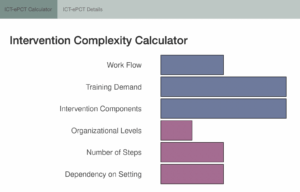
The chapter also highlights an online Intervention Complexity Calculator developed by the NIH Pragmatic Trials Collaboratory to evaluate the complexity of delivery of a trial intervention. To develop the tool, principal investigators of embedded pragmatic clinical trials shared critical drivers of complexity that affected their ability to implement an intervention and discern treatment effects. The tool consists of 6 domains comprised of internal and external factors that can impact complexity.

Intervention Complexity Calculator

An article describing the tool and its development was also published in Contemporary Clinical Trials.

April 10, 2023: Li Receives New PCORI Award to Develop Causal Inference Methods for Stepped-Wedge Cluster Randomized Trials

Headshot of Dr. Fan Li
Dr. Fan Li

Dr. Fan Li, a member of the NIH Pragmatic Trials Collaboratory’s Biostatistics and Study Design Core since 2013, has received approval of a 3-year funding award from the Patient-Centered Outcomes Research Institute (PCORI) to develop causal inference methods for stepped-wedge cluster randomized trials—a design that has been increasingly adopted in pragmatic trials. Li is an assistant professor of biostatistics at the Yale School of Public Health.

The new study, entitled “Toward Improved Design and Analysis of Stepped Wedge Trials: An Estimand-Aligned and Efficiency-Focused Framework,” will contribute new methods and software for planning and analyzing stepped-wedge cluster randomized trials that enable investigators to (a) target transparent causal estimands under the counterfactual outcomes framework and (b) to leverage baseline information for achieving higher statistical efficiency.

This is Li’s second PCORI award. Read a summary of his previous PCORI award.

An estimand is a precise description of the treatment effect reflecting the scientific question, and is ideally a model-free concept. The research team will contribute weighted average effect estimands to quantify treatment effect evidence by recognizing that unequal cluster sizes may contribute to variations of treatment effects in each cluster-period. In addition, pragmatic trials that adopt a stepped-wedge cluster randomized design frequently collect baseline data on the patient-centered outcomes and/or patient-level characteristics. The research team will study and operationalize estimand-aligned methods that effectively leverage such baseline variables through parametric regression and nonparametric machine learning methods.

Li has assembled a multidisciplinary team for this study, including Dr. Patrick Heagerty, professor of biostatistics at the University of Washington and a cochair of the NIH Collaboratory’s Biostatistics and Study Design Core. In addition, Drs. Jeffrey Jarvik, principal investigator of the NIH Collaboratory’s LIRE NIH Collaboratory Trial, and Douglas Zatzick, principal investigator of the TSOS NIH Collaboratory Trial, serve as stakeholders of the study. The stakeholder team also includes colleagues from the NIA IMPACT Collaboratory, Drs. Thomas Travison and Monica Taljaard.

February 14, 2023: IMPACT Collaboratory to Host Grand Rounds on Treatment Effect Heterogeneity in Cluster Randomized Trials

Headshot of Dr. Fan Li
Dr. Fan Li

Dr. Fan Li, a member of the NIH Pragmatic Trials Collaboratory’s Biostatistics and Study Design Core, will present “Methods for Designing Cluster Randomized Trials to Detect Treatment Effect Heterogeneity” during IMPACT Grand Rounds on Thursday, February 16, at 12:00 pm eastern. IMPACT Grand Rounds is hosted by the NIA IMPACT Collaboratory.

Fan Li, PhD, is an assistant professor in the Department of Biostatistics at Yale School of Public Health, and faculty member in the Center for Methods in Implementation and Prevention Science and the Yale Center for Analytical Sciences. He is the principal investigator of a Patient-Centered Outcomes Research Institute (PCORI)–funded methods award that investigates new study planning methods and software for testing treatment effect heterogeneity in cluster randomized trials.

Zoom Conferencing
Join from PC, Mac, iOS or Android: https://hebrewseniorlife.zoom.us/j/97344810673
Dial-In:  +1 312 626 6799 (US Toll) or  +1 470 250 9358 (US Toll)
Meeting ID:  973 4481 0673

Read more about this IMPACT Grand Rounds session.