
September 22, 2022: Registration Opens for Pragmatic Trials Workshop at AcademyHealth Dissemination & Implementation Conference

AcademyHealth and NIH logosThe NIH Pragmatic Trials Collaboratory will offer a full-day workshop at the 15th Annual Conference on the Science of Dissemination and Implementation in Health in Washington, DC. The workshop, “Dissemination & Implementation Research Methods and Embedded Pragmatic Trials: Strategies for Designing Studies That Inform Care for Diverse Populations,” will introduce concepts in the design, conduct, and implementation of pragmatic clinical trials embedded in healthcare systems.

The learning objectives of the workshop include:

  • To identify key areas of synergy between pragmatic trials and implementation research
  • To introduce attendees to the unique characteristics and challenges of designing, conducting, and implementing pragmatic clinical trials embedded within diverse health care systems, and to describe opportunities for integrating implementation research methods into pragmatic trials
  • To increase the capacity of health services researchers to address important clinical questions with pragmatic clinical trials and share lessons from implementation science for increasing engagement of diverse participants

The theme of this year’s D&I conference is “(Re)Building Better Systems: Being Proactive, Nimble, and Responsive.” The annual conference is cohosted by the NIH and AcademyHealth.

WORKSHOP DETAILS AND REGISTRATION
Sunday, December 11, 8:00 am-4:45 pm
Walter E. Washington Convention Center, Washington, DC
March 22, 2022: AHRQ Publishes Hospital Infection Prevention Toolkit Based on ABATE Infection Trial

ABATE Infection logoThe Agency for Healthcare Research and Quality (AHRQ) published a new Toolkit for Decolonization of Non-ICU Patients With Devices to help clinical teams implement a protocol to reduce bloodstream infections by approximately 30% in patients with specific medical devices.

The new toolkit is based on intervention materials successfully used in the ABATE Infection trial, one of the first NIH Collaboratory Trials of the NIH Pragmatic Trials Collaboratory. ABATE Infection was a large-scale pragmatic trial involving approximately 189,000 patients in the baseline period and 340,000 patients in the intervention period across 194 non–critical care units in 53 hospitals.

From the AHRQ announcement:

The free, customizable toolkit includes step-by-step instructions, handouts, and educational videos to show frontline teams how to apply a decolonization protocol for non-ICU patients who may be at greater risk of bloodstream infections because they have certain devices, such as central venous catheters. The decolonization protocol includes instructions on helping patients bathe with an antiseptic soap and applying a nasal antibiotic ointment to carriers of Methicillin-resistant Staphylococcus aureus (MRSA).

ABATE Infection was supported within the NIH Pragmatic Trials Collaboratory by a cooperative agreement from the National Institute of Allergy and Infectious Diseases and by the NIH Common Fund through a cooperative agreement from the Office of Strategic Coordination within the Office of the NIH Director. Learn more about ABATE Infection.

February 22, 2022: New Training Workshop on the Convergence of Dissemination & Implementation Research Methods and Embedded Pragmatic Trials Now Available

The NIH Pragmatic Trials Collaboratory is pleased to announce a new training workshop now available on the ePCT Training Workshop webpage.


Logo for the NIA IMPACT Collaboratory


On December 13, 2021 The NIH Pragmatic Trials Collaboratory and the NIA IMPACT Collaboratory co-hosted a Pre-Conference Workshop “Convergence of Dissemination & Implementation Research Methods and Embedded Pragmatic Trials” for Academy Health’s Annual Conference on the Science of Dissemination and Implementation in Health Conference (D&I).

This training workshop introduces concepts in the design, conduct, and implementation of embedded pragmatic clinical trials (ePCTs), with a particular focus on the intersection between ePCTs and implementation research methods. The workshop provides an introduction to the investigative opportunities for embedded health systems research, along with strategies for integrating implementation research methods in the design and conduct of ePCTs with the goal of providing real-world evidence necessary to inform both practice and policy. Firsthand ePCT experiences and case studies from the NIH Health Care Systems Research Collaboratory and the NIA IMPACT ADRD Collaboratory support and illustrate the topics presented.

View the workshop slides and recordings.

Visit the ePCT Training Resources webpage for more resources, including self-study guides, handouts, and video modules.

December 8, 2021: NIH Collaboratory and IMPACT Collaboratory Offer Workshop on Dissemination and Implementation Research and Pragmatic Trials

Logo for AcademyHealthThe NIH Collaboratory is partnering with the IMPACT Collaboratory to offer a pre-conference workshop on December 13 at AcademyHealth’s 14th Annual Conference on the Science of Dissemination and Implementation in Health.
The workshop, Convergence of Dissemination & Implementation Research Methods and Embedded Pragmatic Trials, will provide an introduction to investigative opportunities for pragmatic clinical trials embedded in healthcare systems, along with strategies for conducting clinical trials that provide real-world evidence necessary to inform both practice and policy.

The workshop is being offered free to conference attendees but requires a separate registration. The workshop will provide strategies for integrating implementation research methods in the design and conduct of ePCTs. Speakers will share firsthand experiences and case studies from the NIH Collaboratory and the IMPACT Collaboratory.

The learning objectives of the workshop include:

  • To identify key areas of synergy between ePCTs and implementation research
  • To introduce attendees to the unique characteristics and challenges of designing, conducting, and implementing ePCTs within diverse healthcare systems, and to describe opportunities for integrating implementation research methods into ePCTs
  • To increase the capacity of health services researchers to address important clinical questions with ePCTs and implementation research methods

CONFERENCE DETAILS AND REGISTRATION
14th Annual Conference on the Science of Dissemination and Implementation in Health: Broadening Horizons for Impact: Incorporating Multisectoral Approaches into D&I Science
December 13, 2021

July 6, 2021: New Quick Start Guide Offers Advice for Partnering With Healthcare System Leaders

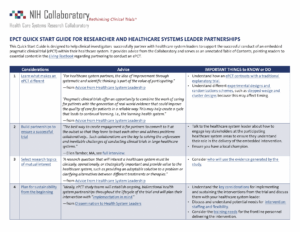
The NIH Collaboratory is pleased to share a new resource to help clinical investigators successfully partner with healthcare system leaders. The Quick Start Guide for Researcher and Healthcare Systems Leader Partnerships provides advice from NIH Collaboratory and healthcare system leadership and serves as an annotated table of contents for the Living Textbook, pointing readers to essential content.Quick Start Guide for Partnerships

The Quick Start Guide is part of a series of tools intended to support the successful conduct of ePCTs within healthcare systems. The first guide in the series, the Quick Start Guide for Investigators, is designed for clinical investigators interested in learning how to conduct an ePCT. The NIH Collaboratory Coordinating Center is developing more Quick Start Guides for different audiences and use cases.

June 28, 2021: AcademyHealth Announces Abstract Deadline for Dissemination and Implementation Science Conference

Logo for AcademyHealthAcademyHealth is accepting abstracts for the 14th Annual Conference on the Science of Dissemination and Implementation in Health until July 27, 2021. This year’s meeting will be held virtually from December 14 to 16.

Read the complete call for abstracts.

The theme of this year’s virtual online meeting is “Broadening Horizons for Impact: Incorporating Multisectoral Approaches into D&I Science.” The annual conference is cohosted by the NIH and AcademyHealth with the goal of realizing “the full potential of evidence to optimize health and health care by bridging the gap between research, practice, and policy.”

February 19, 2021: Beyond Politics: Promoting COVID Vaccination in the United States (Kevin A. Schulman, MD)

Speaker

Kevin A. Schulman, MD
Professor of Medicine and Economics
Stanford University

Topic

Beyond Politics: Promoting COVID Vaccination in the United States

Keywords

COVID-19; Vaccine hesitancy; Marketing strategies; Herd immunity; Vaccine adoption

Key Points

  • One key strategy is to promote the COVID-19 vaccine as a tool that will get us back to school and work again.
  • We need targeted COVID-19 marketing campaigns at each health system to achieve 100% vaccination of healthcare workers.
  • It is crucial that we tamp down vaccine misinformation. We must be vocal in telling the accurate stories of people’s experience with the vaccine, as these resonate with the public and can have an impact.

Discussion Themes

Many of these strategies could apply to clinical trials, for example, a scarcity, an honor for participation, a frontier. Could these tactics could be used to increase participation in clinical trials, especially COVID-19 trials?

Another strategy is to just open the floodgates for everyone to get the vaccine, and this will avoid having stock waste on the shelves. If high-risk groups are resistant to vaccination, perhaps highly motivated people can fill the gap.

How can private payers support COVID-19 vaccine marketing efforts?

Read more about Beyond Politics—Promoting Covid-19 Vaccination in the United States in the New England Journal of Medicine.

Tags

#pctGR, @Collaboratory1

February 11, 2021: New Living Textbook Section Highlights Practical Strategies for Sharing Study Results with Health System Leaders

A new section has been added to the Living Textbook chapter Dissemination Approaches for Different Stakeholders that offers practical strategies and tools for sharing study findings with healthcare system partners—beyond the usual journal publications and professional conferences. Suggestions include how to plan for impact at the outset, methods for communicating findings, and ideas for creating “leave-behind” materials. The section also includes case studies and links to available toolkits, templates, and other resources.

January 22, 2021: Is It Time to Embrace Preprints? A Conversation About the First 18 Months of medRxiv (Harlan Krumholz, MD, SM; Joseph Ross, MD, MHS)

Speakers

Harlan M. Krumholz, MD, SM
Harold H. Hines, Jr. Professor of Medicine and Public Health
Yale University

Joseph S. Ross, MD, MHS
Professor of Medicine and Public Health
Yale University

Topic

Is It Time to Embrace Preprints? A Conversation About the First 18 Months of medRxiv

Keywords

Preprints; Preprint server; medRxiv; Open science; Health science research; Research transparency; Preliminary research reports

Key Points

  • A preprint is a research manuscript yet to be certified by peer review and accepted for publication by a journal. A preprint server, like medRxiv, is an online platform dedicated to the distribution of preprints.

  • MedRxiv is publisher-neutral. It is operated by the Cold Spring Harbor Laboratory and managed in partnership with BMJ and Yale University.

  • Server submission requirements for authors help to mitigate concerns about preprints. These include clear posting criteria (ie, original research articles only), an established screening process, and a caution to users of preprints, including researchers, journalists, and the public, that states: “Preprints are preliminary reports of work that have not been peer-reviewed. They should not be relied on to guide clinical practice or health-related behaviors and should not be reported in news media as established information.”

  • Not allowed are commentaries, editorials, opinion pieces or essays, letters to editors, narrative reviews, medical-legal research, and case reports.

Discussion Themes

The concept of “living data” or “living analyses” has grown out of the pandemic crisis and could stay on as a feature of scientific communication.

How do you think the public conversation around a preprint may positively or negatively impact the peer review process itself?

How are academic institutions acknowledging preprints in the sense of “evidence of productivity” (as for academic promotion)?

Preprints can serve as a teaching opportunity not only for reminding scientists to be discerning readers of reported science, but also for reminding the media.

Learn more about medRxiv.

Tags

#pctGR, @Collaboratory1