
August 10, 2022: NIH Pragmatic Trials Collaboratory Announces Grand Rounds Series on Ethical and Regulatory Challenges in Pragmatic Trials

Steven Joffe, MD, MPH
Steven Joffe will give a keynote presentation on September 9.

The NIH Pragmatic Trials Collaboratory is launching a special Grand Rounds series to examine ethical and regulatory challenges in pragmatic clinical trials. Over the past decade, the program’s Ethics and Regulatory Core has worked with investigators to navigate ethical and regulatory complexities associated with research conducted within healthcare systems. With this new Grand Rounds series, the Core is bringing together bioethicists, investigators, and regulatory experts to share lessons learned, discuss empirical findings, and explore remaining uncertainties.

The webinar series, Ethical and Regulatory Dimensions of Pragmatic Clinical Trials, will kick off on Friday, September 9, at 1:00 pm ET with a keynote presentation by Dr. Steven Joffe, chair of the Department of Medical Ethics and Health Policy in the Perelman School of Medicine at the University of Pennsylvania.

The series will include an additional 5 moderated webinar discussions with panels of experts. The sessions will focus on a range of topics, including responding to signals of mental and behavioral health risk in pragmatic trials; the ethics of data sharing; ethical and regulatory considerations in the design and conduct of pragmatic trials; pragmatic research involving patients with dementia; and the use of waivers and alterations of consent.

Download the series flyer and see the full schedule below.

All session are free and open to the public; no registration is required. Recordings will be archived on the Grand Rounds website.
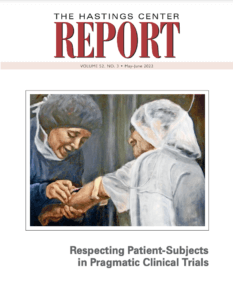
July 6, 2022: Article Offers Framework for Meeting Ethical Obligation of Respect for Persons in Pragmatic Trials

Cover the the Hastings Center ReportRespect for persons is a central obligation for the ethical conduct of research with human subjects. Traditionally, clinical trials have primarily relied on informed consent practices to fulfill this ethical obligation.

A new article in the Hastings Center Report proposes 8 dimensions for how researchers can meet the ethical obligation of respect for persons in pragmatic clinical trials. The authors, including members of the NIH Pragmatic Trials Collaboratory’s Ethics and Regulatory Core, developed the framework in recognition of the challenge many pragmatic trials face with traditional informed consent practices when embedding research into clinical care.

“What respect requires in the context of [pragmatic trials] will vary based on the nature of the [pragmatic trial] in question. In some circumstances, alterations of consent may be more ethically appropriate than traditional regulatory consent practices,” the authors wrote.

The dimensions of demonstrating respect for persons—including promoting transparency, minimizing burden, and protecting privacy and confidentiality, among others—serve as context-dependent goals that researchers and oversight committees can use in considering the ethical design, conduct, and oversight of pragmatic trials.

Lead author Stephanie Morain and coauthors Benjamin Wilfond, Andrew Garland, and Jeremy Sugarman are members of the NIH Collaboratory’s Ethics and Regulatory Core.

Read the full article.

June 23, 2022: Ethics and Regulatory Core Aims for Better Design and Improved Implementation

In an interview at the NIH Pragmatic Trials Collaboratory's annual Steering Committee meeting and 10th anniversary celebration, we asked Drs. Jeremy Sugarman and Pearl O'Rourke to discuss the role of the Ethics and Regulatory Core in helping the NIH Collaboratory Trial teams plan and implement their pragmatic trials, and the contributions the Core has made to the literature on ethics and regulatory challenges in pragmatic clinical research.

Headshot of Dr. Jeremy SugarmanBased on your experience working with the NIH Collaboratory Trials, what are some of the common challenges of the Core?


A common challenge the NIH Collaboratory Trial investigators face is determining their study’s level of risk, specifically whether the research is determined to be “minimal risk.” This issue is important, because it influences the permissibility of using alternatives to conventional written informed consent, such as waiving consent or waiving the requirement to document consent.

A recent focus of the Ethics and Regulatory Core is the challenge some studies face with “collateral findings.” These are findings, whether discovered intentionally or unintentionally, that don’t address the trial’s research questions, but may have implications for the health of patients in the trial. For example, when collecting data from electronic health records, researchers might detect the possible use of contraindicated medications in some patients. We recently completed a multimethod investigation of the ethical and regulatory implications of collateral findings in pragmatic clinical trials.

The Core has also offered advice and guidance on several other issues, including innovative study designs such as cluster randomization and stepped-wedge designs, data and privacy issues, collaborating and communicating with healthcare system representatives and clinicians, and challenges related to conducting research at multiple sites.

Headshot of Dr. Pearl O'Rourke

What strategies have NIH Collaboratory Trials used to overcome these barriers?

The Ethics and Regulatory Core hosts an initial consultation with each NIH Collaboratory Trial in the planning phase, and then a follow-up consultation when the project transitions to the implementation phase. We also invite the study teams to consult with us to help address any ethical challenges they’re facing. Sometimes these consultations result in changes in study design, partnerships with the Core to nest empirical ethics studies within the NIH Collaboratory Trials, and other approaches.

How are the NIH Collaboratory Trials’ experiences with the Core helping the field of pragmatic research?

The Core’s work with the NIH Collaboratory Trials has created a body of knowledge and guidance that we have made available to help those engaged in pragmatic research. In addition to a series of published articles in the peer-reviewed literature, we have included some related content in the Living Textbook of Pragmatic Clinical Trials.

Can you describe the impact the Core has had on pragmatic trials over the past decade?

The Core’s consultations during the development stage of these trials has improved investigators’ understanding, appreciation, and planning for the relevant ethical and regulatory issues. The result has hopefully been better research design and improved implementation. Likewise, routine conference calls with active studies have provided opportunities for investigators to hear about the challenges encountered and the solutions developed by other study teams. Sharing these experiences has been invaluable.

The Core is available for ad hoc consultation regarding the ethical and regulatory issues facing any of the projects. Such issue-specific consultations hopefully help study teams develop appropriate solutions.

Finally, Core members have generated a substantial amount of empirical and conceptual scholarship related to the ethical and regulatory issues encountered in the NIH Collaboratory. This work is helping to expand understanding of pragmatic clinical research for the broader research community.

What do you think the Core can contribute over the next decade?

The Core’s ongoing consultations during all phases of the NIH Collaboratory Trials will promote improvements to research protocols and offer real-time check-ins for unanticipated challenges. Our regular conference calls, contributions to the Living Textbook, and scholarly publications will continue to provide an important resource for investigators as well as IRBs.

June 6, 2022: Bioethics Supplement to Address Data Sharing and Pragmatic Clinical Trials

In an interview at the NIH Pragmatic Trials Collaboratory Steering Committee’s annual meeting in April, Dr. Stephanie Morain shared information about a bioethics supplement designed to explore the ethical issues that arise in the context of pragmatic clinical trials (PCTs) and data sharing.


“Our goal with the supplement is to identify the ways in which existing policies to promote data sharing do or do not align with the specific needs of pragmatic clinical trials.”

The activities of the bioethics supplement are to:

  • Conduct a systematic literature review to identify the specific features PCTs that may alter the risk-benefit calculus for data sharing as compared to explanatory trials & other settings with ethically relevant similarities
  • Through stakeholder interviews, explore data sharing in PCTs as understood by those responsible for the oversight, generation, dissemination, and future use of PCT data
  • Evaluate existing and proposed policies and guidance to promote data sharing.

Dr. Morain is a member of the Ethics and Regulatory Core of the NIH Pragmatic Trials Collaboratory, and this work is part of an overarching goal to develop approaches to the ethical design and conduct of pragmatic clinical trials.

Read Dr. Morain’s presentation on the Bioethics Supplement given at the Steering Committee Meeting in April.

Headshot of Dr. Stepanie Morain
Dr. Stepanie Morain

May 13, 2022: Ethics and Collateral Findings in Pragmatic Clinical Trials: Implications of a Multi-Method Exploration

Speaker

Jeremy Sugarman, MD, MPH, MA
Deputy Director for Medicine
Harvey M. Meyerhoff Professor of Bioethics and Medicine
Berman Institute of Bioethics
Johns Hopkins University

Stephanie Morain, PhD, MPH
Assistant Professor
Berman Institute of Bioethics
Johns Hopkins University

Juli Bollinger, MS
Research Scientist
Berman Institute of Bioethics
Johns Hopkins University

Kevin P. Weinfurt, PhD
Professor and Vice Chair of Research
Department of Population Health Sciences
Duke University School of Medicine


Keywords

PragmaticClinicalTrials; Ethics


Key Points

  • There are many ethical complexities for pragmatic clinical trials, including consent, gatekeepers/relationship to patients, privacy, scale and incidental and secondary findings that may have implications for health, but were not generated to address the PCT’s primary research questions.
  • MOTIFS: Management of Trial Incidental Findings study aimed to asses gaps in current guidance for managing incidental findings that are relevant to PCTs by holding stakeholder interviews and focus groups.
  • In interviews with health care provider stakeholders, MOTIFS investigators learned that PCT-CFs are not on peoples’ radar, but there is a shared belief anticipation/planning is critical. A lack of shared language and not having clear “ownership” further complicates communicating about PCT-CFs.
  • Focus groups were held with patient participants from cities in three different geographic areas of the U.S. Participants had mixed reactions to learning about possible incidental findings, preferences for who and how the findings were communicated varied, but the timeline for delivery of the finding was important. Communication should include clear action steps and not have unneeded details, and a multi-modal approach of communicating was preferred.
  • Policy recommendations include PCT-CFs should anticipate and plan for incidental findings before study implementation; clincians should be prepared to discuss PCT-CFs with patients and for subsequent management; multiple modes of communication with patients is preferred.

Discussion Themes

For at least some patients, the value of the information went beyond actionability–they wanted the information, even if not of immediate clinical relevance, as it could influence their future decisions about where/from whom to seek care.

– The study did not factor for race and ethnicity. Even with the large sample size, the experiment was a complex multifactorial design, and so adding new variables implies a multiplicative increase in study size.

– Incidental findings can be introduced as a possibility in the consent process of PCT-CFs when there is a full IC process.

Read more: 1) Ethics & Collateral Findings in Pragmatic Clinical Trials 2) Stakeholder perspectives regarding pragmatic clinical trial collateral findings 3) Patients’ Views About the Disclosure of Collateral Findings in Pragmatic Clinical Trials: a Focus Group Study 4) Patients’ Reactions to Letters Communicating Collateral Findings of Pragmatic Clinical Trials: a National Web-Based Survey.

Tags

#pctGR, @Collaboratory1

May 11, 2022: MOTIFS Investigation of Collateral Findings in Pragmatic Trials Will Be Featured in PCT Grand Rounds

Head shots of Dr. Jeremy Sugarman, Dr. Stephanie Morain, Juli Bollinger, and Dr. Kevin WeinfurtIn this Friday’s PCT Grand Rounds, Dr. Jeremy Sugarman, Dr. Stephanie Morain, and Juli Bollinger of Johns Hopkins University and Dr. Kevin Weinfurt of Duke University will present “Ethics and Collateral Findings in Pragmatic Clinical Trials: Implications of a Multi-Method Exploration.” The Grand Rounds session will be held on Friday, May 13, at 1:00 pm eastern.

The team will present lessons from MOTIFS, a recently completed multi-method investigation of the ethical and regulatory implications of “collateral findings” in pragmatic clinical trials.

Join the online meeting.

May 4, 2022: Ethics Core Members Pen Guest Editorial for AJOB Focus on Machine Learning in Healthcare

In a guest editorial in the American Journal of Bioethics, members of the NIH Pragmatic Trials Collaboratory’s Ethics and Regulatory Core introduced the issue’s target article and peer commentaries on artificial intelligence and machine learning in healthcare. Prof. Kayte Spector-Bagdady and Drs. Vasiliki Rahimzadeh and Kaitlyn Jaffe, who are Core members, were joined by coauthor Dr. Jonathan Moreno in writing the editorial.

The target article of the themed collection proposes a research ethics framework for the clinical translation of healthcare machine learning. In several peer commentaries accompanying the article, experts offer their perspectives on the proposed framework, including critiques of “the insufficiency of current ethics and regulatory solutions to adequately protect communities at higher risk for [machine learning] bias.”

Read the full editorial, “Promoting Ethical Deployment of Artificial Intelligence and Machine Learning in Healthcare.” Learn more about our Ethics and Regulatory Core.

March 31, 2022: GRACE Trial Has New Study Snapshot, Updated Ethics and Regulatory Documentation

GRACE Trial logoA downloadable study snapshot and updated ethics and regulatory documentation are now available for the GRACE trial, an NIH Pragmatic Trials Collaboratory Trial.

GRACE transitioned from the planning phase to the implementation phase in September. As part of the transition, the study team reviewed and updated the minutes of their initial consultation with the Ethics and Regulatory Core. The study is a hybrid effectiveness–implementation trial of guided relaxation and acupuncture for pain associated with chronic sickle cell disease in 3 large healthcare systems.

  • Read the updated ethics and regulatory documentation, including information about the study team’s approach to inclusion and exclusion criteria, informed consent, and collection of patient-reported outcome data.
  • Also available is a new study snapshot for GRACE. This downloadable handout summarizes the study’s aims, lessons from the planning phase, and links to other resources from this innovative pragmatic clinical trial.

GRACE is supported by the NIH through the NIH Heal Initiative under an award from the National Center for Complementary and Integrative Health. Learn more about the GRACE trial.

March 8, 2022: New Article Examines Ethical Considerations in Stepped-Wedge Cluster Randomized Trial Designs

Members of the NIH Pragmatic Trials Collaboratory Ethics and Regulatory Core published a new article in Contemporary Clinical Trials exploring the ethical and epistemic advantages and challenges specific to pragmatic stepped-wedge cluster randomized trial designs.

Contemporary Clinical TrialslsThe article titled “Ethical and Epistemic Issues in the Design and Conduct of Pragmatic Stepped-wedge Cluster Randomized Clinical Trials” was published online ahead of print in a special issue on pragmatic and virtual trials.

The authors draw on real-world examples from 5 NIH Collaboratory Trials: ACP PEACE, LIRE, NOHARM, PRIM-ER, and TSOS. The article examines practical, ethical, and epistemic issues faced by these NIH Collaboratory Trials.

In a traditional parallel cluster randomized trial, some clusters receive the intervention while other clusters do not, potentially depriving this control group of a beneficial intervention.  The stepped-wedge cluster randomized trial (SW-CRT) design takes steps toward minimizing this ethical dilemma by rolling out the intervention to all clusters over a predetermined time schedule.  This type of trial may have logistical and statistical advantages for researchers while allowing all study groups the opportunity to benefit from the intervention.

The unique design of SW-CRTs may also lead to regulatory challenges involving informed consent, bias due to contamination of the control clusters, or changing study conditions due to the extended length of time over which an intervention is rolled out.  The decision to conduct a pragmatic SW-CRT requires careful consideration of these challenges weighed against the possible advantages.

The NIH Pragmatic Trials Collaboratory is supported by the NIH Common Fund through a cooperative agreement from the Office of Strategic Coordination within the Office of the NIH Director, and through the NIH HEAL Initiative.

March 1, 2022: BeatPain Utah Has New Study Snapshot, Updated Ethics and Regulatory Documentation

BeatPain Utah logoA downloadable study snapshot and updated ethics and regulatory documentation are now available for BeatPain Utah, an NIH Pragmatic Trials Collaboratory Trial.

BeatPain Utah recently transitioned from the planning phase to the implementation phase. As part of the transition, the study team reviewed and updated the minutes of their initial ethics and regulatory consultation with the Ethics and Regulatory Core. The project is studying real-world implementation of a telehealth physical therapy strategy for patients with chronic back pain in primary care clinics of federally qualified health centers.

  • Also available is a new study snapshot for BeatPain Utah. This downloadable handout summarizes the study’s aims, lessons from the planning phase, and links to other resources from this innovative pragmatic clinical trial.

BeatPain Utah is supported by the NIH through the NIH Heal Initiative under an award from the National Institute of Nursing Research.