The NIH HEAL Initiative’s Common Data Elements (CDE) program this week announced the release of an online tool to calculate morphine milligram equivalents (MME), a standardized metric for reporting prescribed opioid use. In a webinar scheduled for Friday, March 7, speakers from the CDE program will explain the tool, demonstrate how researchers can use the tool to calculate MMEs for research purposes, and answer questions from researchers about the use of the tool for calculating and reporting MME data.
Standardizing approaches to data collection remains a critical challenge in pain research. The CDE program mandated collection of MME data in all NIH HEAL Initiative–funded research in 2023.
Ten of the NIH Collaboratory Trials are supported by funding from the NIH HEAL Initiative through the Pragmatic and Implementation Studies for the Management of Pain to Reduce Opioid Prescribing (PRISM) program. They explore a range of interventions to improve implementation of pain management strategies and reduce inappropriate prescribing of opioids.
New study snapshots and updated ethics and regulatory documentation are now available for the AIM-CP, ARBOR-Telehealth, and RAMP trials. The 3 NIH Collaboratory Trials, all supported through the NIH HEAL Initiative℠, or Helping to End Addiction Long-Term Initiative℠, reflect a special emphasis on developing strategies for the management of chronic pain in rural and remote populations. The trials have transitioned from the UG3 planning phase to the UH3 implementation phase.
“There are many known disparities between urban and rural populations,” said Karen Kehl, a program director at the National Institute of Nursing Research (NINR), in an interview at the NIH Pragmatic Trials Collaboratory’s 2024 Annual Steering Committee Meeting. “And when we talk about chronic pain, we know that there’s a higher incidence and a higher severity of pain in rural populations, and yet they don’t have access to many of the effective solutions that we have,” Kehl added.
AIM-CP
AIM-CP is testing the implementation of a care management program to address disparate access to nonpharmacological treatments for chronic pain in rural populations. The principal investigators are Sebastian Tong and Kushang Patel of the University of Washington. The study is supported by NINR.
ARBOR-Telehealth is evaluating the use of a telehealth physical therapy strategy for patients who present to primary care clinics with low back pain in rural communities. The principal investigators are Richard Skolasky and Kevin McLaughlin of Johns Hopkins University. The study is supported by the National Institute of Arthritis and Musculoskeletal and Skin Diseases.
RAMP is evaluating the use of a 12-week mind-body skills training program for rural veterans with pain within the VA’s Whole Health initiative, including a one-on-one session with a Whole Health coach followed by 11 weekly group sessions to include prerecorded expert-led education videos, mind-body skills training and practice, and group discussions. The principal investigators are Diana Burgess and Roni Evans of the University of Minnesota and Katherine Hadlandsmyth of the University of Iowa. The study is supported by NINR.
Jeffrey H. Samet, MD, MA, MPH
John Noble Professor in General Internal Medicine & Professor of Public Health
Boston University Chobanian and Avedisian School of Medicine and School of Public Health
Boston Medical Center
Over roughly 20 years, opioid overdose (OD) mortality in the U.S. increased tenfold: from a little over 8,000 in 1999 to over 80,000 in 2022. Health authorities urged medical professionals to address the crisis through stigma reduction, uptake of opioid use disorder (OUD) treatment, and other evidence-based practices (EBPs).
The goal of the HEALing Communities Study (HCS) was to reduce opioid OD through implementation of EBPs, including overdose education and naloxone distribution (OEND); access to medications for OUD (MOUD); and safer opioid prescribing and dispensing practices.
The research team conducted the cluster randomized trial in 67 communities across Ohio, Kentucky, New York, and Massachusetts – a total study population of about 10 million. HCS is the largest implementation science study funded by NIDA.
The primary objective of HCS was to compare the number of opioid OD deaths in adults during the comparison period (July 2021 – June 2022) between the intervention and control communities. Secondary outcomes included the rates of naloxone distribution; access to or utilization of MOUD; opioid + stimulant OD deaths; and non-fatal overdose events.
The intervention involved 3 pathways for implementing OUD EBPs: community engagement; the Opioid Reduction Continuum of Care Approach (ORCCA), consisting of a menu of strategies to support implementation of EBPs; and community-based health communications campaigns. Multi-level partnerships, Dr. Samet noted, are critical to the success of community-engaged research.
Between the intervention group and the control group, there was no difference in the number of opioid OD deaths. OD deaths involving opioids and psychostimulants (excluding cocaine) decreased by 37% in the intervention group, and there was a 15% reduction in nonfatal overdoses.
Factors that may have impacted results included the complex array of strategies; a limited period of time in which to achieve full benefits from the implementation of EBPs; COVID-19-related demands on coalition members and healthcare personnel; increasing rates of fentanyl in the drug supply with stimulant contamination; and statistical power.
Limitations included the fact that control communities could still access non-HCS funds to address the opioid epidemic and a variation in the affected population size within each community.
Discussion Themes
The research team had 18 months to get the intervention up and running; when the comparison period began, they were at 35% implementation – lower than their goal. This was partially a product of the stakes; the death toll of the opioid epidemic was high and the team was motivated to make quick progress. The COVID-19 pandemic also slowed things down.
Dr. Samet emphasized that the HCS team wasn’t testing whether MOUD and OEND worked; there is significant evidence demonstrating that these strategies are effective. Rather, the team was testing whether communities adopted them and if they had an effect on OD reduction.
When the team shared the results back with community partners, they heard anecdotal reports about the positive effects their partners had witnessed in their communities.
Engagement coalitions formed across communities. Ohio and Kentucky utilized existing coalitions while New York and Massachusetts built new ones. Dr. Samet noted that each of the four states performed well in different realms.
To build upon the progress of the Helping to End Addiction Long-term® Initiative, or NIH HEAL Initiative®, NIH is holding workshops to gather input to inform strategic research priorities and advance the mission of HEAL pain research.
The workshops will be held over the next few months (ET), as follows:
Non-Addictive Pain Therapeutics Development
November 15 @ 10:00 am – 2:00 pm
Co-led by John Markman and Ted Price
Research Workforce and Training
November 18 @ 1:00 – 5:00 pm
Co-led by Cheryl Stucky and Jennifer Haythornthwaite
Implementation and Health Services
November 19 @ 12:00 – 4:00 pm
Co-led by Lynn DeBar and Steve George
Optimizing Interventions to Improve Pain Management
The NIH Pragmatic Trials Collaboratory is pleased to welcome APA-SM (Personalized Auricular Point Acupressure for Chronic Pain Self-Management in Rural Populations) to its portfolio of innovative NIH Collaboratory Trials. The new project is supported by an award from the National Institute of Neurological Disorders and Stroke, with administrative oversight from the National Center for Complementary and Integrative Health.
The APA-SM study team will conduct a pragmatic, hybrid effectiveness-implementation trial of a 4-week auricular point acupressure intervention for self-management of chronic pain in rural communities in Texas and South Carolina. The primary outcomes include pain intensity, pain interference, and function. Key secondary outcomes are based on the HEAL Clinical Pain Core Common Data Elements. The study team will also evaluate implementation outcomes, cost-effectiveness, and predictive factors for treatment response.
Jennifer Kawi, Jane Bolin, and Hulin Wu will serve as the principal investigators for APA-SM. Kawi is a Lee and Joseph Jamail Distinguished Professor in the Cizik School of Nursing at the University of Texas Health Science Center at Houston (UTHealth Houston). Bolin is Regents Professor Emerita and a senior professor in the College of Nursing at Texas A&M University. Wu is the Betty Wheless Trotter Professor and Chair of the Department of Biostatistics and Data Science, professor of biomedical informatics, and director of the Center for Big Data in Health Sciences at UTHealth Houston.
Funding for APA-SM is provided through the Pragmatic and Implementation Studies for the Management of Pain to Reduce Opioid Prescribing (PRISM) program, a component of the Helping to End Addiction Long-Term Initiative℠, or NIH HEAL Initiative℠, to address the opioid crisis.
A new case study from the NIH Pragmatic Trials Collaboratory highlights an interim reassessment of sample size during an ongoing cluster randomized trial. The case study was published this week in the Living Textbook of Pragmatic Clinical Trials.
Researchers in cluster randomized trials must account for potential correlation between clusters in the design and analysis of their trial by estimating the intraclass correlation when calculating the target sample size. Often they use preliminary data from the planned enrollment sites to estimate the correlation. However, when preliminary data are unavailable at the time of study design, they may use interim data collected during the trial itself to reassess the trial’s sample size.
The contributors of the case study focus on FM-TIPS, an NIH Collaboratory Trial, to describe an approach to conducting an interim reassessment of sample size in an ongoing trial. Read the full case study.
FM-TIPS is examining whether the addition of transcutaneous electrical nerve stimulation to routine physical therapy improves movement-evoked pain compared with physical therapy alone among patients with fibromyalgia. The trial is supported by the National Institute of Arthritis and Musculoskeletal and Skin Diseases through the NIH HEAL Initiative. Learn more about FM-TIPS.
The contributors of the case study include members of the FM-TIPS study team and leaders of the NIH Collaboratory’s Biostatistics and Study Design Core. David-Erick Lafontant is a statistician, Bridget Zimmerman is a clinical professor of biostatistics, and Emine Bayman is an associate professor of biostatistics—all at the University of Iowa. Megan McCabe is an assistant professor of biostatistics at the University of Alabama at Birmingham. Patrick Heagerty is a professor of biostatistics at the University of Washington. Liz Turner is an associate professor of biostatistics and bioinformatics at Duke University.
The National Center for Complementary and Integrative Health (NCCIH), with support from the Helping to End Addiction Long-term® Initiative, or NIH HEAL Initiative®, published a notice of funding opportunity for pragmatic clinical trials within the infrastructure of the NIH-DOD-VA Pain Management Collaboratory (PMC).
The PMC was established in 2017 with an initial cohort of 11 pragmatic trials to develop and improve pain management approaches for veterans, military personnel, and their families. The PMC has established a coordinating center that provides national leadership and technical expertise for all aspects of research conducted within healthcare systems.
The new funding opportunity leverages the experience, expertise, and leadership of the PMC Coordinating Center to support the conduct of large-scale pragmatic clinical trials and implementation science demonstration projects to study nonopioid approaches to the management of pain and other comorbid conditions, including complementary and integrative approaches used alone and in combination with standard care. Supported projects will be conducted within healthcare systems serving veterans, military personnel, and their families.
Support the design and execution of additional high-impact demonstration projects that will conduct pragmatic clinical trials focusing on effectiveness research, implementation research, or hybrid effectiveness-implementation research on nonopioid approaches for the management of pain and comorbid conditions with patients in healthcare delivery systems that provide care to veterans, military personnel, and their families.
Make available data, tools, best practices, and resources that will facilitate a research partnership with healthcare delivery systems that provide care to veterans, military personnel, and/or their families.
The NIH Institutes participating in this funding opportunity include NCCIH, the National Institute on Aging (NIA), and the National Institute on Alcohol Abuse and Alcoholism (NIAAA).
The Chronic Pain and Fatigue Research Center at the University of Michigan is requesting applications for the HEAL National K12 Clinical Pain Career Development Award (HEAL K12).
The HEAL K12 is a mentored career development program designed to provide protected time for clinicians and scientists to focus on training in and conducting clinical pain research. The award is intended for scholars who may not be ready for a traditional K award or independent R award, come from institutional environments that cannot adequately support the scholar’s career and/or research objectives, and/or are unable to form a mentoring team that would make them competitive for a training or independent research award in clinical pain.
Additional program information can be found at https://heal-k12.med.umich.edu/. For questions regarding the letter of intent, submission process, or program requirements, or to request a presubmission consultation, email UM-HEALK12@umich.edu.
The NIH HEAL Initiative issued a request for information seeking feedback on the initiative’s future strategic research priorities to address opioid use disorder, overdose, and pain.
The NIH HEAL Initiative℠, or Helping to End Addiction Long-Term Initiative℠, invites you to submit feedback to shape strategic research priorities that will guide the initiative’s future efforts to find scientific solutions to the urgent public health challenges of opioid use disorder, overdose, and pain. HEAL welcomes feedback from all interest groups, including people with living/lived experience, caregivers, researchers, the private sector, community-based organizations, health care providers, professional societies, advocacy groups, patient communities, and other members of the public.
Nine of the NIH Collaboratory Trials are supported by funding from the NIH HEAL Initiative. They explore a range of interventions to improve implementation of pain management strategies and reduce inappropriate prescribing of opioids.
Respondents are asked to share their feedback by email by July 31, 2024, to HEALquestion@od.nih.gov with “HEAL RFI” in the subject line.
The NIH HEAL Initiative issued a request for information seeking feedback on the initiative’s future strategic research priorities to address opioid use disorder, overdose, and pain.
The NIH HEAL Initiative℠, or Helping to End Addiction Long-Term Initiative℠, invites you to submit feedback to shape strategic research priorities that will guide the initiative’s future efforts to find scientific solutions to the urgent public health challenges of opioid use disorder, overdose, and pain. HEAL welcomes feedback from all interest groups, including people with living/lived experience, caregivers, researchers, the private sector, community-based organizations, health care providers, professional societies, advocacy groups, patient communities, and other members of the public.
Nine of the NIH Collaboratory Trials are supported by funding from the NIH HEAL Initiative. They explore a range of interventions to improve implementation of pain management strategies and reduce inappropriate prescribing of opioids.
Respondents are asked to share their feedback by email by July 31, 2024, to HEALquestion@od.nih.gov with “HEAL RFI” in the subject line.


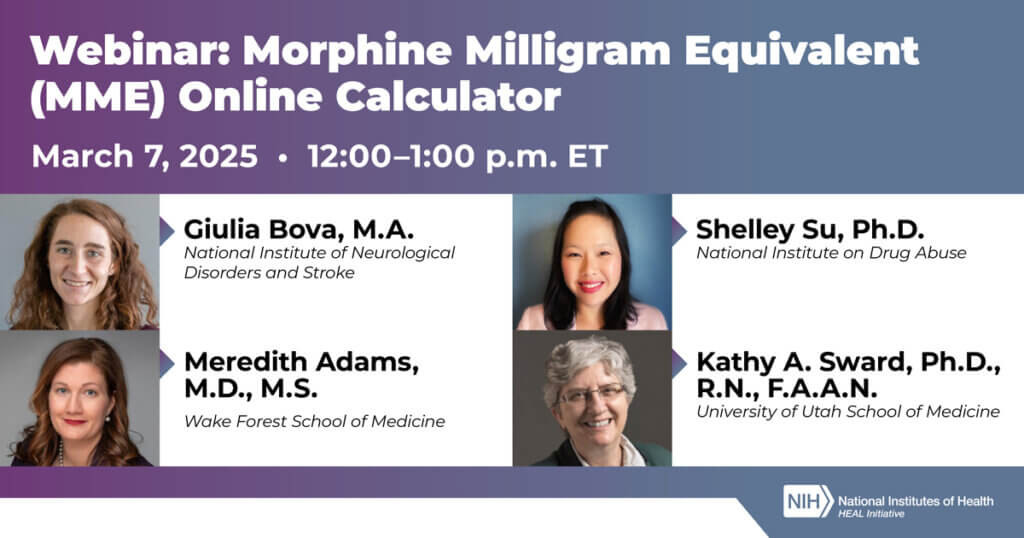 The NIH HEAL Initiative’s Common Data Elements (CDE) program this week announced the release of an online tool to calculate morphine milligram equivalents (MME), a standardized metric for reporting prescribed opioid use. In a webinar scheduled for Friday, March 7, speakers from the CDE program will explain the tool, demonstrate how researchers can use the tool to calculate MMEs for research purposes, and answer questions from researchers about the use of the tool for calculating and reporting MME data.
 The NIH Pragmatic Trials Collaboratory is pleased to welcome
  A new case study from the NIH Pragmatic Trials Collaboratory highlights an interim reassessment of sample size during an ongoing cluster randomized trial. The case study was
  The National Center for Complementary and Integrative Health (NCCIH), with support from the Helping to End Addiction Long-term® Initiative, or NIH HEAL Initiative®, published a notice of funding opportunity for pragmatic clinical trials within the infrastructure of the NIH-DOD-VA Pain Management Collaboratory (PMC).
 The Chronic Pain and Fatigue Research Center at the University of Michigan is requesting applications for the HEAL National K12 Clinical Pain Career Development Award (HEAL K12).
 The NIH HEAL Initiative issued a