
November 29, 2021: New Article From the NIH Collaboratory Examines Use of Incentives and Payments in Pragmatic Clinical Trials

Head shot of Dr. Andrew Garland
Dr. Andrew Garland

Members of the NIH Collaboratory’s Ethics and Regulatory Core examined the use of incentives and payments to patients included in pragmatic clinical trials. Their findings and preliminary recommendations are published in the December issue of Clinical Trials.

Incentives and payments to patients are used in both pragmatic trials and conventional explanatory trials. However, because pragmatic trials typically evaluate interventions in the context of “real-world” clinical settings, the use of incentives and payments can raise logistical, ethical, and regulatory challenges.

Dr. Andrew Garland, a postdoctoral fellow at the Johns Hopkins Berman Institute of Bioethics who works in the Ethics and Regulatory Core, and who is the lead author of the article, reviewed 9 NIH Collaboratory Trials that used incentives and other payments to patients. Garland and coauthors Dr. Kevin Weinfurt and Dr. Jeremy Sugarman used these examples to describe how the standard conceptual framework for ethical payments and incentives may not always be appropriate for pragmatic trials.

Read the full report.

This work was supported within the NIH Collaboratory by the NIH Common Fund through a cooperative agreement from the Office of Strategic Coordination within the Office of the NIH Director. This work was also supported by the NIH through the NIH HEAL Initiative.

October 18, 2021: Application Period Opens for Postdoctoral Fellowship in Ethics and Regulatory Aspects of PCTs

Johns Hopkins Berman Institute of Bioethics logoThe Johns Hopkins Berman Institute of Bioethics this week opened the application period for its 2022-2023 postdoctoral fellowships, including a Postdoctoral Fellowship in the Ethics and Regulatory Aspects of Pragmatic Clinical Trials.
From the announcement:

The Johns Hopkins Berman Institute of Bioethics invites applications for a Postdoctoral Fellowship in the Ethics and Regulatory Aspects of Pragmatic Clinical Trials. This position includes pursuing independent research, working alongside faculty members involved with the ethics and regulatory aspects of large-scale pragmatic clinical trials and participating in the Hecht-Levi Postdoctoral Fellowship in Bioethics.

The postdoctoral fellow is expected to pursue one or more projects addressing the ethics and regulatory aspects of pragmatic clinical trials in collaboration with Berman Institute faculty members. The Fellow will actively engage with the Ethics and Regulatory Cores of the NIH Health Care Systems Research Collaboratory and the Pragmatic and Implementation Studies for the Management of Pain to Reduce Opioid Prescribing (PRISM) Resource Coordinating Center.

As a member of the Hecht-Levi cohort of Bioethics Postdoctoral Fellows at the Berman Institute, the Fellow will have access to Berman Institute faculty and resources, including weekly seminars, presentations, discussions with leading academics and policy makers, professional development training, outreach efforts, and teaching opportunities commensurate with experience and background.

Read the full information about the fellowship. Applications are due by Friday, December 19, 2021.

October 5, 2021: FDA Issues Draft Guidance on Use of EHRs and Claims Data to Support Regulatory Decision Making

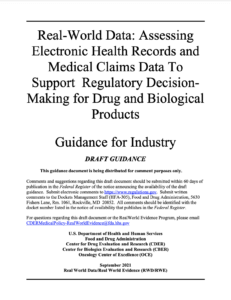
Cover page of FDA draft guidanceThe US Food and Drug Administration (FDA) last month published draft guidance on the use of electronic health records (EHRs) and claims data to support regulatory decision making.

“Real-World Data: Assessing Electronic Health Records and Medical Claims Data To Support Regulatory Decision-Making for Drug and Biological Products” is part of the FDA’s series of guidances to satisfy the real-world evidence provisions of the 21st Century Cures Act. The guidance provides recommendations on the use of real-world data gathered from EHRs and claims data to support regulatory decisions about effectiveness and safety. It addresses selection of data sources, development and validation of definitions for study design elements, and data provenance and quality.

The comment period for the draft guidance ends on November 29, 2021.

July 14, 2021: New Resource from the Ethics and Regulatory Core

The Collaboratory’s Ethics and Regulatory Core has recently explored issues around data monitoring in pragmatic clinical trials (PCTs). Important considerations for data monitoring in this context are related to the design, intent, and operational features specific to PCTs. Data Monitoring in Pragmatic Clinical Trials: Points to Consider suggests a set of key areas to evaluate:

  • Composition of Data Monitoring Committees
  • Use of health systems records data
  • Study design and statistical analysis
  • Monitoring adherence
  • Futility
  • Safety
  • Efficacy

“Finding ways to describe and disseminate experiences with PCT DMCs should be encouraged in an effort to improve practices and policies.” (Ethics and Regulatory Core)

June 23, 2021: NIH to Host Webinar on Access to Controlled Data

NIH logoThe NIH will host a webinar titled “Streamlining Access to Controlled Data at NIH: Tackling Challenges and Identifying Opportunities” on July 9 from 10:00 am to 1:00 pm ET. Registration for the event is open to all interested participants.

This webinar will explore perspectives on the challenges and opportunities in accessing controlled data stewarded by the NIH. The event will include opportunities to hear from experts on the topic and to ask questions and provide ideas with follow-up activities. The webinar will be of particular interest to data scientists and investigators who use NIH data resources.

Organized by the NIH Controlled Data Access Coordination Working Group, the webinar will help inform the group’s recommendations to NIH leadership on ways to streamline access to controlled data.

Read the webinar agenda and register today.

April 23, 2021: COVID Clinical Trials: The Intermountain Healthcare Experience (Samuel M. Brown, MD, MS)

Speaker

Samuel M. Brown, MD, MS
Associate Professor and Director of Pulmonary/Critical Care Research
Intermountain Healthcare
Associate Professor, University of Utah

Topic

COVID Clinical Trials: The Intermountain Healthcare Experience

Keywords

COVID-19; Public health; Integrated health system; COVID-19 treatment trials

Key Points

  • Intermountain Healthcare is a nonprofit, community-based healthcare system that maintains an academic referral center and several hospitals in Utah.
  • During the pandemic, the health system was able to integrate COVID-19 research with urgent clinical, operational, and public health needs. The health system currently supports 15 randomized clinical trials in COVID-19 research, investigating immunologic and virologic therapies.
  • Collaboration and communication across divisions were essential elements to the successes achieved.
  • Among the challenges of conducting the COVID-19 trials, there remains a wish for a comprehensive risk management solution and regulatory reform.

Discussion Themes

Could we establish a robust program that provides better training and pay for study coordinators? These staff have direct contact with participants for recruitment and retention and can make or break a trial.

What aspects of institutional culture contributed to the success of conducting these trials?

What is needed is a clinical research ecosystem that appropriately balances regulatory oversight with the agility to answer urgent health questions.

Read more about Intermountain Healthcare’s experiences with COVID-19 clinical trials in these recent publications:

Tags

#pctGR, @Collaboratory1

April 22, 2021: Materials From the NIH Collaboratory Steering Committee’s Virtual Meeting Now Available

On April 14 and 15, 2021, more than 100 participants joined the online Steering Committee meeting to discuss important considerations for Collaboratory trials and the embedded pragmatic clinical trial ecosystem at large, including adaptations made due to COVID-19, data sharing models and experiences, barriers encountered, and lessons learned. All presentations are available for download.

April 1, 2021: Grand Rounds Podcast with Dr. Susan Ellenberg on DSMBs for COVID-19 Trials is Available

Prof. Susan EllenbergIn the latest episode of the NIH Collaboratory Grand Rounds podcast, Dr. Adrian Hernandez and Dr. Susan Ellenberg continue their discussion about the challenges of DSMBs and COVID-19 trials. The full March 5 Grand Rounds webinar with Dr. Ellenberg is also available.

March 5, 2021: Data and Safety Monitoring Boards for Trials of COVID-19 Vaccines: The Challenges (Susan S. Ellenberg, PhD)

Speaker

Susan S. Ellenberg, PhD
Professor of Biostatistics, Medical Ethics, and Health Policy
Perelman School of Medicine
University of Pennsylvania

Topic

Data and Safety Monitoring Boards for Trials of COVID-19 Vaccines: The Challenges

Keywords

COVID-19; Data Monitoring Committee (DMC); Data and Safety Monitoring Board (DSMB); Pandemic; Vaccine trials; Monitoring boundaries; Safety and efficacy; NIH

Key Points

  • With COVID-19, everyone, globally, is an “affected community.” This brings a strong sense of urgency for DSMBs.
  • Several COVID-19 vaccine candidates are studied under the NIH umbrella. A single DSMB, constituted in mid-2020, oversees all these COVID-19 trials and reports to that trial’s Oversight Group.
  • Subgroup issues have been important in COVID-19 vaccine trials. The DSMB monitors carefully for representation of subgroups of interest in trial participants, including those over age 65, Black, Hispanic, and participants with comorbidities that may predispose them to more serious disease.

Discussion Themes

Has there been pressure to prematurely discontinue any of the COVID-19 vaccine trials?

How accurate is the post-vaccine data being collected—especially since these vaccines have only emergency use authorization?

What are your thoughts on future trial design if we have another pandemic?

See more COVID-19 resources for researchers and access other webinars in the COVID-19 Grand Rounds series on the Collaboratory’s COVID-19 resource page. Read more about data and safety monitoring in the Living Textbook.

Tags

#pctGR, @Collaboratory1