Discussant: Eric B. Larson, MD, MPH, Kaiser Permanente Washington Health Research Institute
Speakers: Vince Mor, PhD, Brown University School of Public Health; Greg Simon, MD, MPH, Kaiser Permanente Washington Health Research Institute; and Lynn DeBar, PhD, MPH, Kaiser Permanente Washington Health Research Institute
Held at the Washington State Convention Center in Seattle, this large gathering of health services researchers and policy analysts will include workshops, poster and podium sessions, emerging issues panels, policy roundtables, and special topic sessions. Other NIH Collaboratory members planning to present at the meeting include Leah Tuzzio, MPH, Jerry Jarvik, MD, MPH, Miguel Vazquez, MD, Kathryn James, MPH, Gloria Coronado, PhD, and Beverly Green, MD, MPH.
“Attendees will learn about the challenges of pilot testing, studying patient-reported outcomes, using existing data, and the multiple levels of implementation in dynamic systems.” – Leah Tuzzio, Kaiser Permanente Washington Health Research Institute
For details, visit the meeting event site at http://www.academyhealth.org/events/site/2018-annual-research-meeting.
A recent study published in BMC Medicine found that many randomized controlled trials (RCTs) self-labeled as “pragmatic” were actually explanatory in nature, in that they assessed investigational medicines compared with placebo to test efficacy before licensing. Of the RCTs studied, one-third were pre-licensing, single-center, or placebo-controlled trials and thus not appropriately described as pragmatic.
Appropriately describing the design and characteristics of a pragmatic trial helps readers understand the trial’s relevance for real-world practice. The authors explain that RCTs suitably termed pragmatic compare the effectiveness of 2 available medicines or interventions prescribed in routine clinical care. The purpose of such pragmatic RCTs is to provide real-world evidence for which interventions should be recommended or prioritized.
The authors recommend that investigators use a standard tool, such as the CONSORT Pragmatic Trials extension or the PRECIS-2 tool, to prospectively evaluate the pragmatic characteristics of their RCTs. Use of these tools can also assist funders, ethics committees, and journal editors in determining whether an RCT has been accurately labeled as pragmatic.
The BMC Medicine article cites NIH Collaboratory publications by Ali et al. and Johnson et al., as well as the Living Textbook, in its discussion of pragmatic RCTs and the tools available to assess their relevance for real-world practice.
“Submissions of RCTs to funders, research ethics committees, and peer-reviewed journals should include a PRECIS-2 tool assessment done by the trial investigators. Clarity and accuracy on the extent to which an RCT is pragmatic will help [to] understand how much it is relevant to real-world practice.” (Dal-Ré et al. 2018)
The FDA is conducting a public workshop on Monday, March 19, to obtain input from stakeholders—including patients, patient advocates, academic and medical researchers, expert practitioners, drug developers, and other interested persons—to inform the drafting of a patient-focused drug development guidance as required by the 21st Century Cures Act. Workshop attendees will discuss considerations for development and submission of a proposed draft guidance regarding patient experience data submitted by an external stakeholder. The guidance is intended to help stakeholders continue progress in developing new medicines to respond to patient’s needs.
Registration for the event, either in person or via a live webcast, ends March 12. More meeting details, including background materials, will be posted by FDA as available.
The groundbreaking “All of Us” research program, which aims to enroll and track more than a million people, is asking prospective researchers, community organizations, and citizen scientists for suggestions regarding potential research questions. Ideas can be submitted through a special research page and are due by February 23, 2018. At a Research Priorities Workshop in March 2018, meeting attendees will use the input to set research priorities that will drive the development of the All of Us research platform and associated tools.
At the NIH Collaboratory Steering Committee meeting in May 2017, we asked Ellen Tambor, a member of the Stakeholder Engagement Core, to reflect on the first 5 years of the Core’s work and the challenges ahead. She says it's key for stakeholder engagement to take place throughout the entire healthcare system, from leadership to the frontline providers and staff. And, because of the nature of pragmatic trials conducted in clinical settings, engagement is essential from the early stages through trial completion. Tambor also suggests asking two questions to ensure the right people are involved throughout pragmatic research: Who is going to use the evidence that results from the study? Who will help ensure that the study is implemented as seamlessly as possible?
"Pragmatic trials take stakeholder engagement to a new level of importance in terms of both the scope of engagement and the array of potential stakeholders." Ellen Tambor
A new research project modeled on the NIH Health Care Systems Research Collaboratory has been created to investigate non-drug approaches to helping U.S. service members and veterans manage chronic pain. The U.S. Department of Health and Human Services, the U.S. Department of Defense (DoD), and the U.S. Department of Veterans Affairs (VA) jointly announced the NIH-DoD-VA Pain Management Collaboratory project this week. The project, which includes funding for 12 NIH Collaboratory Trials over the next 6 years, will focus on large-scale, cost-effective, pragmatic trials conducted in military and VA healthcare systems.
The Pain Management Collaboratory Coordinating Center (PMC3) at Yale University will establish work groups to assist NIH Collaboratory Trials and provide support similar to that offered by NIH Collaboratory Core groups. A team from Duke Clinical Research Institute is leading one of the NIH Collaboratory Trials, a trial designed to improve access to recommended non-drug therapies for low back pain in the VA Health Care System.
Read more:
Yale researchers receive federal grants to study pain management in veterans, active military members
DCRI’s Steven George receives funding for non-drug pain management research project
As part of their ongoing effort to improve the speed and efficiency of conducting clinical trials, the NIH-FDA Joint Leadership Council has created a draft clinical trial protocol template. The template contains instructional and sample text intended to assist NIH-funded investigators in writing protocols for phase 2 or 3 clinical trials that require Investigational New Drug (IND) or Investigational Device Exemption (IDE) applications. Feedback is sought from investigators, investigator-sponsors, institutional review board members, and other stakeholders involved in protocol development and review.
Our goal is to provide an organized way for creative investigators to describe their plans so that others can understand them. – Dr. Pamela McInnes, NIH
Details on the rationale and development of the protocol template are on these blog posts:
Notice Number: NOT-OD-16-043. Responses accepted through April 17, 2016.

You can access the template document as well as a template shell, comment form, and other resources at NIH’s Clinical Research Policy website.
A new article published in the journal Trials provides a look at how the Pragmatic–Explanatory Continuum Indicator Summary, or PRECIS, rating system can be applied to clinical trials designs in order to examine where a given study sits on the spectrum of explanatory versus pragmatic clinical trials.
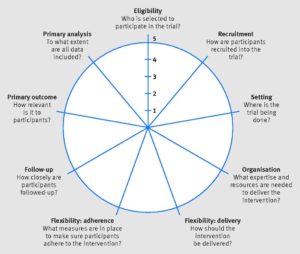
The PRECIS-2 criteria are used to rate study designs as more or less “pragmatic” according to multiple domains that include participant eligibility, recruitment methods, setting, organization, analysis methods, primary outcomes, and more. In this context, “pragmatic” refers to trials that are designed to study a therapy or intervention in a “real world” setting similar or identical to the one in which the therapy will actually be used. Pragmatic trials stand in contrast to explanatory trials, which are typically designed to demonstrate the safety and efficacy of an intervention under highly controlled conditions and in carefully selected groups of participants, but which may also be difficult to generalize to larger or more varied populations.
PRECIS-2 Wheel. Kirsty Loudon et al. BMJ 2015;350:bmj.h2147. Copyright 2015 by British Medical Journal Publishing Group. Used by permission.
Clinical trials are almost never wholly “explanatory” or wholly “pragmatic.” Instead, many studies exist somewhere on a spectrum between these two categories. However, understanding how these different attributes apply to trials can help researchers design studies that are optimally fit for purpose, whether that purpose is to describe a biological mechanism (as in an explanatory trial) or to show how effective an intervention is when used across a broad population of patients (as in a pragmatic trial).
In their article in Trials, authors Karin Johnson, Gila Neta, and colleagues applied PRECIS-2 criteria to 5 pragmatic clinical trials (PCTs) being conducted through the NIH Collaboratory. Each trial was found to rate as “highly pragmatic” across the multiple PRECIS-2 domains, highlighting the tool’s potential usefulness in guiding decisions about study design, but also revealing a number of challenges in applying it and interpreting the results.
Study authors Johnson and Neta will be discussing their findings during the NIH Collaboratory’s Grand Rounds on Friday, January 22, 2016 (an archived version of the presentation will be available the following week).
Johnson KE, Neta G, Dember LM, Coronado GD, Suls J, Chambers DA, Rundell S, Smith DH, Liu B, Taplin S, Stoney CM, Farrell MM, Glasgow RE. Use of PRECIS ratings in the National Institutes of Health (NIH) Health Care Systems Research Collaboratory. Trials. 2016;17(1):32. doi: 10.1186/s13063-016-1158-y. PMID: 26772801. PMCID: PMC4715340.
You can read more about the NIH Collaboratory PCTs featured as part of this project at the following links:ABATE (Active Bathing to Eliminate Infection)
LIRE (A pragmatic trial of Lumbar Image Reporting with Epidemiology)
PPACT (Collaborative Care for Chronic Pain in Primary Care)
STOP-CRC (Strategies & Opportunities to Stop Colon Cancer in Priority Populations)
TIME (Time to Reduce Mortality in End-Stage Renal Disease)
Additional Resources

An introductory slide set on PCTs (by study author Karin Johnson) is available from the Living Textbook:

Introduction to Pragmatic Clinical Trials
The University of Colorado Denver - Anschutz Medical Campus publishes an electronic textbook on pragmatic trials:

Pragmatic Trials: A workshop Handbook
Gloria Coronado, PhD, and Beverly Green, MD, MPH, Principal Investigators, STOP CRC Trial
Drs. Beverly Green and Gloria Coronado and colleagues have published an article in Clinical Trialsdescribing the challenges of recruiting participants into large, multisite pragmatic clinical trials—particularly at the health system level. STOP CRC is one of the NIH Collaboratory’s pragmatic clinical trial, which are intended to provide a framework of implementation methods and best practices to enable participation of varied health care systems in clinical research.
STOP CRC is testing a culturally tailored, health care system–based program to improve colorectal cancer screening rates in a community-based collaborative network of federally qualified health centers. The authors observed that recruiting sites to participate in pragmatic trials is time-intensive and involves both preparing materials and organizing face-to-face meetings with staff and clinic leaders. Yet little is known about the characteristics of nonparticipating sites and clinic-level factors that may influence willingness to participate in a pragmatic trial.
“Our findings underscore the importance of assessing and reporting recruitment success at the organizational and/or clinic level in order to know the external validity of the findings and may inform future efforts to select and recruit health systems to participate in pragmatic research.” (Coronado, et al. Clin Trials 2015)
The National Patient-Centered Clinical Research Network (PCORnet) has recently made a draft protocol for its first randomized clinical trial available for stakeholder review. Researchers, clinicians, patients and the public are all invited to read the current draft of the study protocol and provide comments and feedback.
The ADAPTABLE Study (PDF), which will investigate whether lower- or higher-dose aspirin is better for preventing heart attack and stroke in patients at risk for heart disease, is PCORnet’s first randomized pragmatic clinical trial. Designed to leverage PCORnet’s Clinical Data Research Networks (CDRNs) and Patient-Powered Research Networks (PPRNs), the trial will serve as twofold purpose: answering a clinical question of direct importance for patients, families, and healthcare providers, and serving as a demonstration of PCORnet’s capabilities in conducting clinical research on a national scale.
Links to the proposed study protocol, a survey tool for capturing feedback, and other information about ADAPTABLE Study, including press releases, fact sheets, and infographics, are available at the link below: