Grand Rounds April 21, 2023: Personalised Cooler Dialysate for Patients Receiving Maintenance Haemodialysis (MyTEMP): A Pragmatic, Cluster-randomised Trial (Amit Garg, MD, MA, FRCPC, FACP, PhD; Stephanie N. Dixon, PhD MSc)

Speakers

Amit Garg, MD, MA (Education) FRCPC, FACP, PhD
Associate Dean, Clinical Research, Schulich School of Medicine and Dentistry
Lead, Institute for Clinical Evaluative Sciences Kidney, Dialysis and Transplantation Provincial Program
Director, Institute for Clinical Evaluative Sciences (ICES) Western Facility
Nephrologist, London Health Sciences Centre
Professor, Medicine, Epidemiology & Biostatistics, Western University

Stephanie N. Dixon, PhD MSc
Staff Scientist, Institute for Clinical Evaluative Sciences Kidney, Dialysis and Transplantation Research Program
Biostatistician, London Health Sciences Centre


Keywords

MyTEMP, Pragmatic Clinical Trials, Ethics, Biostatistics


Key Points

  • For each hemodialysis treatment clinicians typically set the temperature of dialysate on the machine to 36.5 or 37.0 degrees Celsius. The reasoning for this temperature is unclear, though it likely represents what was considered the average body temperature of most patients.
  • In a recent international survey of more than 270 centers, nearly half now use a cooler temperature dialysate in patient care of less than or equal to 36.0 degrees C. This change in practice is based on data that suggests the at cooler (vs. standard) temperature dialysate is beneficial. However, in two recent systematic reviews the overall quality of evidence for dialysate cooling was deemed low with a high risk of bias.
  • The MyTEMP trial is a pragmatic, cluster randomized controlled trial in Ontario, Canada, to determine if adopting a default center-wide policy of personalized cooler dialysate is superior to a standard temperature dialysate of 36.5 degrees C.
  • MyTEMP was innovative and pragmatic, implemented as part of a learning healthcare system, with covariate constrained randomization, registry-based, and embedded in routine care delivered by more than 2,000 nurses at 84 centers.
  • During the 4-year study period, about 8,000 patients were randomized for the personalized cooler dialysate and about 7,400 were randomized for the standard temperature dialysate. The mean temperature for the standard group was 36.4 degrees C, and the mean temperature for cooler group was 35.8 degrees C.
  • The primary composite outcome was cardiovascular mortality or hospital admission with MI, stroke, or heart failure. There is a high risk of these events in the hemodialysis population with a cumulative instance at 30% at 4 years. There was no appreciable difference in the estimate for the cooler temperature group. Additionally, the cooler temperature group reported a higher likelihood of discomfort.
  • The lack of cardiovascular benefit and higher likelihood of patient discomfort provides no justification to adopt cooler dialysate as a center-wide policy vs. use of 36.5 degrees. After MyTEMP, centers in Ontario stopped adopting colder temperature dialysate as a center-wide policy, and patients felt less discomfort during hemodialysis care.
  • Cluster randomized trials of hemodialysis center-wide policies raise complex ethical issues. Many patients who receive hemodialysis are vulnerable. A patient or their nephrologist could decide to opt-out of the randomly allocated center-wide default policy but could not opt out of the symptom data but not de-identified health records. The REB approved the MyTEMP request to use an altered patient consent process because the research was deemed of minimal risk to patients.
  • MyTEMP worked with patients and caregivers to develop the trial, and Kidney Patient and Family Advisory Councils guided the choice of additional outcomes. Participants were debriefed on the trial results.

Learn more

Read about the MyTEMP trial in The Lancet.

Read about the MyTEMP statistical analysis plan.

Discussion Themes

We run into situations where we are talking to stakeholders and thinking about criteria for waiver of consent and it’s just not right. Where the risks and benefits are equal, but I wouldn’t want to be randomly assigned. There is a natural assertion of autonomy. Did some of these questions of autonomy vs. risk come up? I think it is very complex, and it is not black and white. You need to identify the principles before the process. In terms of the dialysis component, in routine care we get consent when we start treatment but there are many things in the background. As a clinician when I am providing care, I’m not discussing these concerns; we are talking about other things. Am I delivering great medicine when I’m not sure what to do here when there is practice variability?

Tags

#pctGR, @Collaboratory1
April 27, 2023: New Chapter Describes Intervention Delivery and Complexity

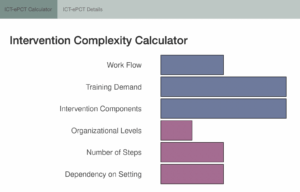
The NIH Pragmatic Trials Collaboratory published a new chapter of its Living Textbook of Pragmatic Clinical Trials this week. The chapter, “Intervention Delivery and Complexity,” illustrates that—although an intervention may be simple—the actual delivery of the intervention may be complex due to factors such as new workflows, special training of frontline staff, and the number of components in the intervention. This chapter reviews what makes an intervention’s delivery complex and frameworks and guidance for studying complex interventions.

The chapter also highlights an online Intervention Complexity Calculator developed by the NIH Pragmatic Trials Collaboratory to evaluate the complexity of delivery of a trial intervention. To develop the tool, principal investigators of embedded pragmatic clinical trials shared critical drivers of complexity that affected their ability to implement an intervention and discern treatment effects. The tool consists of 6 domains comprised of internal and external factors that can impact complexity.

Intervention Complexity Calculator

An article describing the tool and its development was also published in Contemporary Clinical Trials.

April 20, 2023: Workshop on Essentials of Embedded Pragmatic Clinical Trials Offered at AcademyHealth 2023 Annual Research Meeting

Logo for AcademyHealthThe NIH Pragmatic Trials Collaboratory is partnering with AcademyHealth to offer a 1.5 day pre-conference workshop at the 2023 Annual Research Meeting in Seattle, Washington. The workshop, “Driving Tomorrow’s Outcomes Through Clinical Research in Real-World Settings: Essentials of Embedded Pragmatic Clinical Trials Workshop,” will provide an introduction to the investigative opportunities for embedded health systems research, along with strategies for conducting clinical trials that provide real-world evidence necessary to inform both practice and policy. Workshop attendees will have the opportunity to participate in facilitated, hands-on learning activities and to interact with Principal Investigators of current and past embedded pragmatic clinical trials (ePCTs).
Firsthand ePCT experiences and case studies from the NIH Pragmatic Trials Collaboratory will support and illustrate the topics presented and demonstrate how ePCTs in real-world settings are driving tomorrow’s outcomes. Speakers will include program officers and senior staff from NIH Institutes and senior investigators from the NIH Collaboratory Trials and the Coordinating Center Leadership.

The learning objectives of the workshop include:

  • To clarify the definition of ePCTs and explain their utility.
  • To introduce attendees to the unique characteristics and challenges of designing, conducting, and implementing ePCTs within diverse health care systems.
  • To increase the capacity of health services researchers to address important clinical questions with ePCTs in real-world settings, driving tomorrow’s research outcomes.

Workshop details and registration
Friday, June 23, 2023, 8:15 a.m.-4:25 p.m.
Saturday, June 24, 2023, 8:00 a.m.-12:00 p.m.
Seattle Convention Center, Seattle, WA

April 4, 2023: New Quick Start Guide Pulls Together Resources for ePCT Project Managers

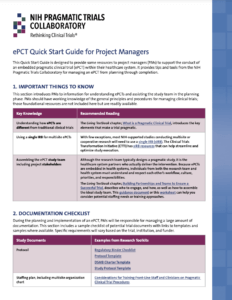
Screenshot of Quick Start Guide for Project ManagersThe NIH Pragmatic Trials Collaboratory is pleased to announce the latest resource as part of its Quick Start Guide series. These Quick Start Guides are intended to support the successful conduct of embedded pragmatic clinical trials (ePCTs). The ePCT Quick Start Guide for Project Managers links to resources for project managers to support the conduct of ePCTs within healthcare systems.

The guides serve as annotated tables of contents, pointing readers to essential content in the Living Textbook to help successfully launch an ePCT and partner with healthcare systems leaders. They also link to recommended readings, documentation checklists, research toolkits, study documents, regulatory documents, oversight documents, and additional resources.

“We are excited to share this new tool with the research community,” said Tammy Reece, project director for the NIH Collaboratory Coordinating Center. “Pragmatic trials can pose unique challenges even for experienced project managers. Our hope is that this guide will serve as a useful resource throughout the entire life cycle of ePCTs—from planning through completion.”

The Quick Start Guide for Investigators is designed for clinical investigators interested in learning how to conduct an ePCT. The Quick Start Guide for Researcher and Healthcare Systems Leader Partnerships is designed to help clinical investigators partner with healthcare system leaders to support the successful conduct on an ePCT.

March 29, 2023: This Friday’s PCT Grand Rounds Features Novel Approach to Lowering Blood Pressure in QUARTET USA Trial

Headshot of Dr. Jody CiolinoIn this Friday’s PCT Grand Rounds, Jody Cioliono will present “Efficacy and Safety of a Quadruple Ultra-Low-Dose Treatment for Hypertension (QUARTET USA): Results From a Randomized Controlled Trial.” The Grand Rounds session will be held on Friday, March 31, 2023, at 1:00 pm eastern.

The QUARTET USA trial tested a novel approach to lowering blood pressure compared with standard-dose monotherapy. The trial was embedded within a network of federally qualified healthcare centers in the Chicago metropolitan area. Ciolino is an associate professor of preventive medicine (biostatistics) and director of the master of science in biostatistics program in the Northwestern University Feinberg School of Medicine.

Join the online meeting.

March 23, 2023: AJOB Calls for Peer Commentaries on Ethics in Pragmatic Trials

American Journal of Bioethics cover imageThe American Journal of Bioethics (AJOB) this week issued a call for peer commentaries for a forthcoming special issue on pragmatic clinical trials. Both of the target articles for the special issue are from the NIH Pragmatic Trials Collaboratory’s Ethics & Regulatory Core.


Unlike AJOB‘s typical Open Peer Commentaries, commentaries for the special issue may be written either in response to the 2 target articles or on the topic of pragmatic trials in general. Proposals of approximately 1 paragraph are due Friday, April 7, and should be submitted via the AJOB editorial website.

After evaluating the proposals, the journal’s editorial office will contact authors to inform them of whether their proposal has been selected to be submitted as a full Open Peer Commentary. Invited commentaries will be due Wednesday, April 26. Authors are limited to a single Open Peer Commentary.

Target articles:

  • “Think Pragmatically: Investigators’ Obligations to Patient-Subjects When Research is Embedded in Care” by Stephanie Morain and Emily Largent: Growing interest in embedded research approaches—where research is incorporated into clinical care—has spurred numerous studies to generate knowledge relevant to the real-world needs of patients and other stakeholders. However, it also has presented ethical challenges. An emerging challenge is how to understand the nature and extent of investigators’ obligations to patient-subjects. Prior scholarship on investigator duties has generally been grounded upon the premise that research and clinical care are distinct activities, bearing distinct duties. Yet this premise—and its corresponding implications—are challenged when research and clinical care are deliberately integrated. After presenting three case studies from recent pragmatic clinical trials, we identify six differences between explanatory trials and embedded research that limit the application of existing scholarship for ascertaining investigator duties. We suggest that these limitations indicate a need to account for the implications of usual care and to move beyond a narrow focus on the investigator-subject dyad, one that better reflects the team- and institution-based nature of contemporary health systems.
  • “Do Clinicians Have a Duty to Participate in Pragmatic Clinical Trials?” by Andrew Garland, Stephanie Morain, and Jeremy Sugarman: Clinicians have good moral and professional reasons to contribute to pragmatic clinical trials (PCTs). We argue that clinicians have a defeasible duty to participate in this research that takes place in usual care settings and does not involve substantive deviation from their ordinary care practices. However, a variety of countervailing reasons may excuse clinicians from this duty in particular cases. Yet because there is a moral default in favor of participating, clinicians who wish to opt out of this research must justify their refusal. Reasons to refuse include that the trial is badly designed in some way, that the trial activities will violate the clinician’s conscience, or that the trial will impose excessive burdens on the clinician.

Open Peer Commentaries are typically between 500 and 1500 words and contain no more than 10 references. A guide to writing an Open Peer Commentary is available under the Resources section “Instructions and Forms” on the AJOB editorial website.

March 15, 2023: IMPACt-LBP Enrolls First Patient in Study of Collaborative Care for Low Back Pain

IMPACt-LBP, an NIH Pragmatic Trials Collaboratory Trial, enrolled its first study participant this week. Congratulations to the IMPACt-LBP study team for reaching this important project milestone!

IMPACt-LBP investigators
Dr. Christine Goertz, Dr. Adam Goode, Dr. Jon Lurie, and Dr. Rishi Chakraborty

Led by investigators at Duke University and Dartmouth University, IMPACt-LBP is a cluster randomized trial of a multidisciplinary collaborative team approach for low back pain versus usual care. In the intervention arm, patients with a primary complaint of low back pain are referred to physical therapists and chiropractic doctors as first-line providers. The study will determine whether receiving first-line care from these “primary spine practitioners” improves physical function, decreases pain and opioid prescriptions, improves patient satisfaction, and decreases costs and utilization of healthcare services.

Logo for the IMPACt-LBP Demonstration Project

Learn more about IMPACt-LBP in this interview with investigators Christine Goertz, Adam Goode, and Rishi Chakraborty. The study was awarded continuation to the UH3 implementation phase last summer.

IMPACt-LBP is supported within the NIH Pragmatic Trials Collaboratory by the National Center for Complementary and Integrative Health, with additional support from the National Institute of Arthritis and Musculoskeletal and Skin Diseases and the National Institute of Child Health and Human Development.

March 8, 2023: Biostatistics Core Sponsors This Week’s PCT Grand Rounds on Estimands in Cluster Randomized Trials

Headshot of Brennan KahanIn this Friday’s PCT Grand Rounds, Brennan Kahan of University College London will present “Estimands in Cluster-Randomized Trials: Choosing Analyses That Answer the Right Question.” This session is sponsored by the NIH Pragmatic Trials Collaboratory’s Biostatistics and Study Design Core Working Group.

The Grand Rounds session will be held on Friday, March 10, 2023, at 1:00 pm eastern.

Kahan is a senior research fellow in the Institute of Clinical Trials and Methodology at University College London.

Join the online meeting.