NIH & FDA seek feedback on new clinical trial protocol template


As part of their ongoing effort to improve the speed and efficiency of conducting clinical trials, the NIH-FDA Joint Leadership Council has created a draft clinical trial protocol template. The template contains instructional and sample text intended to assist NIH-funded investigators in writing protocols for phase 2 or 3 clinical trials that require Investigational New Drug (IND) or Investigational Device Exemption (IDE) applications. Feedback is sought from investigators, investigator-sponsors, institutional review board members, and other stakeholders involved in protocol development and review.

Our goal is to provide an organized way for creative investigators to describe their plans so that others can understand them. – Dr. Pamela McInnes, NIH

Details on the rationale and development of the protocol template are on these blog posts:

Notice Number: NOT-OD-16-043. Responses accepted through April 17, 2016.

You can access the template document as well as a template shell, comment form, and other resources at NIH’s Clinical Research Policy website.

Task Force Releases Recommendations for National Medical Device Evaluation System

A new report (PDF) containing recommendations for the creation of a national registry system for evaluating and monitoring medical devices has been released for public comment today. The report, a joint project of the Medical Device Registry Task Force and cover_19aug2015 the Medical Device Epidemiology Network (MDEpiNet), is available on boh the US Food and Drug Administration (FDA) website and on  the MDEpiNet website.
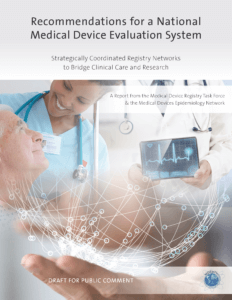
The report reflects the results of a year-long effort, prompted by the FDA’s Center for Devices and Radiological Health (CDER), that  is focused on fostering a national system for monitoring the use of medical devices in the “real-world” setting of patient care, once the devices have been approved for the market (known as “postmarket surveillance”).

The term “medical devices” encompasses a wide range of technologies, including implantable pacemakers, cardiovascular stents, robotic surgical devices, and artificial joint replacements, among many others. At present, information about the use of these devices in routine care settings, including safety issues reported by doctors and patients, is collected in a variety of registries and health record systems. A  networked national system, such as the one described in the task force report, would be able to unite and build upon both existing and novel data resources, thereby improving safety monitoring and accelerating the development of new devices:

“Task Force recommendations for [Coordinated Registry Network] CRN architecture, and thus for the National System, center on leveraging existing, self sustaining electronic resources, such as device registries, electronic health records, administrative data and even social media and personal mobile device sources.”

The Task Force Report offers recommendation in several key areas, including:

  • Establishing a national dialog about medical device evaluation that includes all stakeholders;
  • Leveraging existing efforts in the arena of device registries and electronic data systems;
  • Describing the desired characteristics of a national Coordinated Registry Network (CRN) for medical devices;
  • Outlining priorities for developing and refining medical devices in multiple therapeutic areas;
  • Identifying and improving methods for analyzing data on medical devices; and
  • Addressing network governance and issues related to patient privacy and informed consent.

Each of these key areas also features suggested pilot projects designed to inform ongoing efforts.

A related perspective article summarizing the National Registry System project has also been published online in the Journal of the American Medical Association.


Related Links


FDA Issues Draft Guidance on Use of Electronic Informed Consent (eIC)


On March 9, 2015, the U.S. Food and Drug Administration (FDA) issued draft guidance on the Use of Electronic Informed Consent in Clinical Investigations (document opens as a PDF). In a question-and-answer format, the guidance provides recommendations for investigators, sponsors, and institutional review boards (IRBs) on the use of electronic media and processes to obtain informed consent for FDA-regulated clinical investigations of medical products, including human drug and biological products, and medical devices, and combinations thereof.

Electronic informed consent, or eIC, refers to the use of electronic systems and processes to convey information related to the study and to obtain and document informed consent. Electronic media formats may include text, graphics, audio, video, podcasts, and interactive websites, biological recognition devices, and card readers. Use of electronic systems may allow for rapid notification to study participants of any amendments pertaining to the informed consent, promote timely entry of eIC data into the study database, and allow for timely collection of the informed consent data from remote locations.

The guidance provides answers to these questions:

  • How should the information in the eIC be presented to the subject?
  • How and where may the eIC process be conducted?
  • How and when should questions from subjects be answered?
  • What steps may be taken to facilitate the subject’s understanding of the information being presented?
  • What steps may be taken to ensure that new or additional information is conveyed to the subject during the course of the clinical investigation?
  • Does FDA allow the use of electronic signatures to document eIC?
  • What special considerations should be given to the use of eIC for pediatric studies?
  • Should subjects receive a copy of their eIC and have easy access to the material and information presented to them in their eIC?
  • What steps can be taken to help ensure confidentiality of the information once eIC is obtained?
  • Can HIPAA authorizations for research, which are frequently combined with informed consent documents, be obtained electronically?
  • What are the IRB’s responsibilities in the eIC process?
  • What eIC documentation does FDA require for submission with applications?
  • What steps can be taken to ensure the system archives the documents appropriately?
  • What materials or documents will FDA require during an inspection?

The comment period ends May 7, 2015. Users can submit electronic comments using the docket number HHS-OPHS-2015-0002 at the Federal eRulemaking Portal: http://www.regulations.gov.


New Search Feature for FDA Guidance Documents


A new feature on the FDA.gov website allows you to search for FDA guidance documents on all topics from one convenient location:

FDA Guidance Document Search Feature

Guidance documents represent the FDA’s current thinking on particular topics and are used by stakeholders to understand the agency’s interpretation of regulations and policies.

There are approximately 3,000 guidance documents available on the site, which can be searched by keyword or filtered by date issued, FDA organizational unit, subject, draft or final status, and comment period.

The search feature was implemented in January 2015 in response to site visitor feedback.


FDA Releases Action Plan to Encourage Greater Patient Diversification in Trials


In August 2014, the Food and Drug Administration (FDA) released an action plan (link opens as a PDF) aimed at encouraging more diverse patient participation in drug and medical device clinical trials. The Action Plan to Enhance the Collection and Availability of Demographic Subgroup Data includes 27 responsive and pragmatic actions, divided into 3 overarching priorities:

  • Data quality: improving the completeness and quality of demographic subgroup data collection, reporting, and analysis
  • Participation: identifying barriers to subgroup enrollment in clinical trials and employing strategies to encourage greater participation
  • Transparency: making demographic subgroup data more available and transparent

The plan follows an August 2013 report to Congress on these concerns and reflects the agency’s commitment to encouraging the inclusion of a diverse patient population (with reference to sex, age, race, and ethnicity) in biomedical research that supports applications for FDA-regulated medical products. Increasing representation is a multifaceted challenge that requires a multifaceted approach and collaboration of federal partners, industry, healthcare providers, patients and patient advocacy groups, academicians, and community groups.

message from the Commissioner of the FDA contains background and details.


Grand Rounds (3-26-2014): Why Is the FDA Interested in the Collaboratory and PCORnet?

Update:

Archived video and slides  from the March 26 Grand Rounds are now available on the NIH Collaboratory Grand Rounds webpage.

Photograph of FDA CDER Director Janet Woodcock, MD
CDER Director Janet Woodcock, MD. Photo credit: FDA

The guest speaker for this Friday’s Collaboratory/PCORnet Grand Rounds presentation will be the FDA’s Janet Woodcock, MD. Dr. Woodcock is the current director of the Center for Drug Evaluation and Research (CDER), the division of the FDA primarily responsible for evaluating the safety and effectiveness of both prescription and over-the-counter drugs and biologic therapies marketed in the United States.

The Grand Rounds presentation will take place from 1:00-2:00 PM Eastern time on Friday, March 26. Archived video and slide sets from the presentation will be available early the following week; links to archived material will be provided in an update to this post.