Grand Rounds June 24: FDA Draft Guidance on Real-World Evidence (John Concato, MD, MS, MPH)

Speaker:

John Concato, MD, MS, MPH
Associate Director for Real-World Evidence Analytics
Office of Medical Policy (OMP)
Center for Drug Evaluation and Research (CDER)
Food and Drug Administration (FDA)

Topic: FDA Draft Guidance on Real-World Evidence
Date: Friday, June 24, 2022, 1:00-2:00 pm ET

Meeting Info: To check whether you have the appropriate players installed for UCF (Universal Communications Format) rich media files, go to https://dukemed.webex.com/dukemed/systemdiagnosis.php.

To join the online meeting:
Go to https://dukemed.webex.com/dukemed/j.php?MTID=m4c6e3e4827442a92338a5649cee613e6

Click ‘Connect to Audio”
Choose ‘Computer Audio’ or ‘I will call in’.
If using the ‘call in option’, follow the information from the dialog box that appears.
Be certain to use the Access Code AND the Attendee ID.

Troubleshooting:
If the URL above does not work, go to dukemed.webex.com and enter:
Meeting Number: 2622 682 0537
Meeting Password: 12345

For Audio ONLY:
Call-in toll number (US/Canada): 1-650-479-3207
Access code: 2622 682 0537

NOTE: For Toll-free users, the call-back (call me) services are also available.

April 14, 2022: FDA Announces New Draft Guidance for Increasing Enrollment of Diverse Populations in Clinical Trials

FDA logoThe US Food and Drug Administration (FDA) issued draft guidance yesterday recommending clinical trial sponsors develop a “Race and Ethnicity Diversity Plan” to ensure representative enrollment of racially and ethnically diverse participants in clinical trials developing medical products.
The draft guidance, Diversity Plans to Improve Enrollment of Participants From Underrepresented Racial and Ethnic Populations in Clinical Trials Guidance for Industry, updates previous FDA guidance issued in October 2016. The “Race and Ethnicity Diversity Plan” is recommended for studies submitting IDE or IND applications to the FDA for approval of an investigational drug or device. The updated guidance provides information about 5 elements that should be included in the plan:

  • Overview of the disease/condition
  • Scope of medical product development program
  • Goals for enrollment of underrepresented racial and ethnic participants
  • Specific plan of action to enroll and retain diverse participants
  • Status of meeting enrollment goals

Achieving heath equity for underrepresented racial and ethnic populations starts with appropriate representation in clinical trials. Disease burden is often higher for underrepresented populations, yet barriers to participation in clinical trials may prevent adequate enrollment. Improving racial and ethnic diversity in clinical trials ensures that results are generalizable and medical discoveries are safe and effective for all patients.

The draft guidance was a collaborative effort between the Oncology Center of Excellence’s Project Equity, the Center for Drug Evaluation and Research, the Center for Biologics Evaluation and Research, and the Center for Devices and Radiological Health.

Read the FDA news release.

October 5, 2021: FDA Issues Draft Guidance on Use of EHRs and Claims Data to Support Regulatory Decision Making

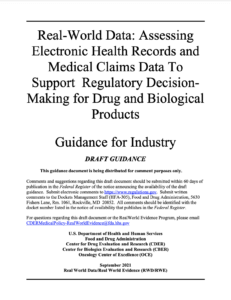
Cover page of FDA draft guidanceThe US Food and Drug Administration (FDA) last month published draft guidance on the use of electronic health records (EHRs) and claims data to support regulatory decision making.

“Real-World Data: Assessing Electronic Health Records and Medical Claims Data To Support Regulatory Decision-Making for Drug and Biological Products” is part of the FDA’s series of guidances to satisfy the real-world evidence provisions of the 21st Century Cures Act. The guidance provides recommendations on the use of real-world data gathered from EHRs and claims data to support regulatory decisions about effectiveness and safety. It addresses selection of data sources, development and validation of definitions for study design elements, and data provenance and quality.

The comment period for the draft guidance ends on November 29, 2021.

March 13, 2020: Impact of Regulatory Guidance on Evaluating Cardiovascular Risk of New Glucose-Lowering Therapies to Treat Type 2 Diabetes Mellitus–Lessons Learned and Future Directions (Abhinav Sharma, MD, PhD; Christopher Granger, MD)

Speakers

Abhinav Sharma, MD, PhD
Assistant Professor of Medicine
McGill University

Christopher B. Granger, MD, FAHA, FACC
Professor of Medicine
Director, Cardiac Intensive Care Unit
Duke University Medical Center

Topic

Impact of Regulatory Guidance on Evaluating Cardiovascular Risk of New Glucose-Lowering Therapies to Treat Type 2 Diabetes Mellitus–Lessons Learned and Future Directions

Keywords

Type 2 diabetes; Regulatory; Cardiovascular risk; Food and Drug Administration; FDA; Patient outcomes; Anti-hyperglycemic medications

Key Points

  • The hallmark of type 2 diabetes mellitus is insulin resistance and relative insulin deficiency. Ninety percent of all cases of diabetes are type 2 diabetes, and the diagnosis can occur at any age.
  • While people with type 2 diabetes can often initially manage their condition through exercise and diet, over time most people will require oral drugs or insulin.
  • Strategies are needed reduce the burden of cardiovascular outcomes in patients with diabetes.
  • In 2008, the U.S. Food and Drug Administration (FDA) issued guidelines for sponsors to demonstrate that their anti-hyperglycemic medications do not increase the risk of cardiovascular disease. In March 2020, the FDA updated the guidance in a draft for comment: Type 2 Diabetes Mellitus: Evaluating the Safety of New Drugs for Improving Glycemic Control Guidance for Industry.

Discussion Themes

Is the cardiovascular protection of some anti-hyperglycemic drugs independent of the effect on blood glucose?

How can regulators, industry, academia, payers, and patient advocacy groups assure that evidence generation to improve care is incentivized without undue regulatory burdens?

Should post-marketing studies include comparative effectiveness pragmatic trials in order to improve translation into clinical practice?

Read more on this topic from Sharma and colleagues in a recent publication in Circulation.

Tags
#pctGR, @Collaboratory1

January 18, 2019: NIH Collaboratory Investigators Respond to FDA’s Proposed Rule on Informed Consent

NIH Collaboratory leadership and NIH Collaboratory Trial Principal Investigators have responded to the U.S. Food and Drug Administration’s (FDA’s) proposed rule to allow for a waiver or alteration of informed consent.

“We applaud the proposed rule to allow for a waiver or alteration of informed consent for clinical investigations posing no more than minimal risk to a human participant and including appropriate safeguards.

We agree about the broad benefits described in the proposed rule—healthcare advances, reduction in burden from harmonizing FDA’s regulations with the Common Rule, and reduced burden and costs for the IRB…”

The full letter is available for download and includes the list of signatories.

January 11, 2019: FDA Releases Framework for Evaluating the Use of Real-World Evidence

To help fulfill the requirements of the 21st Century Cures Act by accelerating medical product development and fostering innovation and advances in medicine, FDA recently created a framework for evaluating the use of real-world evidence. The framework is intended to help evaluate trials that use real-world data for the creation of real-world evidence.

  • Real-world data: routinely collected information about a person’s health status in the electronic health record, claims, registries, and other sources, including patient-generated sources.
  • Real-world evidence: reliable, clinical information derived from real-world data about risks, benefits, and burdens of therapies.

This framework will apply to various pragmatic clinical trials embedded in health care systems and conducted as part of routine care (and will not apply to more traditional clinical trials conducted parallel to care).

Three main considerations are included in the framework:

  1. Will the real-world data be fit for use (do they reliably and adequately represent the concept)?
  2. Will the evidence generated by the trial provide adequate evidence to help answer regulatory questions?
  3. Will the conduct of the study meet FDA regulatory requirements?

December 3, 2018: FDA Calls for Comments on Proposed Rule to Allow Exceptions to the Requirement for Informed Consent in Minimal-Risk Research

The Food and Drug Administration (FDA) is proposing a rule to allow for a waiver or alteration of informed consent for clinical investigations posing no more than minimal risk to human participants. This rule would align FDA regulations with the Common Rule, reduce burden and costs for Institutional Review Boards, and be expected to lead to advances in healthcare.

“We expect benefits in the form of healthcare advances from minimal risk clinical investigations and from harmonization of FDA’s informed consent regulations with the Common Rule’s provision for waiver of informed consent for certain minimal risk research.” —  Federal Register /Vol. 83, No. 221

Currently, FDA allows a waiver or alteration of consent only in life-threatening situations. If aligned with the Common Rule, a waiver or alteration would be allowed if the IRB finds and documents that 1) the research involves no more than minimal risk, 2) the rights and welfare of subjects will not be adversely affected, 3) the research could not practicably be carried out without a waiver, and 4) the participants will be provided with additional pertinent information after completion of the trial.

Comments on the proposed rule are due by January 14, 2019.

October 19, 2018: A New Path Forward for Using Decentralized Clinical Trials (Jeffry Florian, PhD, Annemarie Forrest, Penny Randall, MD, MBA)

Speakers

Jeffry Florian, PhD
Clinical Analyst, Office of New Drugs
FDA Center for Drug Evaluation and Research (CDER)

Annemarie Forrest
Clinical Trials Transformation Initiative (CTTI)

Penny Randall, MD, MBA
VP and Global Therapeutic Head, CNS
IQVIA

Topic

A New Path Forward for Using Decentralized Clinical Trials

Keywords

Decentralized clinical trials; Telemedicine; Mobile health; Clinical Trials Transformation Initiative; FDA

Key Points

  • Decentralized clinical trials (DCTs) are defined as those executed through telemedicine, mobile, or local healthcare providers (HCPs), using procedures that vary from the traditional clinical trial model; for example, shipping investigational medical product directly to the trial participant.
  • DCTs are not “all or nothing.” They exist in a broad continuum and can expand the reach of traditional clinical trial sites.
  • Potential benefits of DCTs apply to all trials in all disease areas but may offer particular advantages in rare diseases, where patients are generally limited in number or are highly geographically dispersed.
  • Mobile HCP training is similar to that required for standard investigative sites: Good clinical practice, protocol-specific training, human subject protections, data protection, and clinical trial billing.

Discussion Themes

Will a decentralized trial lead to less diverse patient populations as participants will need to be technology literate and have access to technology?

Decentralized clinical trial safety monitoring plans should not be held to a higher standard than with traditional trials unless merited by a particular circumstance. It is important to develop protocol-specific safety monitoring and communication escalation plans.

Download CTTI’s recommendations for decentralized clinical trials.

Tags

#telemedicine #pctGR, @PCTGrandRounds, @Collaboratory1, @CTTI_Trials @IQVIA_global @US_FDA

September 14, 2018: Advancing the Use of Mobile Technologies for Data Capture & Improved Clinical Trials (John Hubbard, PhD, Barry Peterson, PhD, Cheryl Grandinetti, PharmD)

Speakers

John Hubbard, PhD
Healthcare Strategic Advisory Board
Genstar Capital

Barry Peterson, PhD
Independent Consultant

Cheryl Grandinetti, PharmD
Office of Compliance, Office of Scientific Investigations, Division of Clinical Compliance Evaluation
Center for Drug Evaluation and Research
Food and Drug Administration

Topic

Advancing the Use of Mobile Technologies for Data Capture & Improved Clinical Trials

Keywords

Clinical trials; Mobile health technologies; Clinical Trials Transformation Initiative; CTTI; FDA; Data integrity

Key Points

  • The goal of CTTI’s Mobile Clinical Trials program is to develop evidence-based recommendations that affect the widespread adoption and use of mobile technology in clinical trials for regulatory submission.
  • Potential benefits of using mobile technology include higher quality, patient-centric endpoints and fewer barriers to participation in clinical trials.
  • Data access issues to consider before selecting a mobile technology include:
    • How will the data generated by the mobile technology be accessed and used by the manufacturer?
    • What data will be provided by the manufacturer to the sponsor?
  • The mobile era creates new data security demands.

Discussion Themes

CTTI’s recommendations aim to help sponsors determine the right device to use, how to write the protocol for remote data capture, and how to protect and analyze the data.

Know what you want to measure before selecting the mobile technology. The appropriateness of the selection should be justified through verification and validation processes.

Ensure the authenticity, integrity, and confidentiality of data over its entire lifecycle.

To reduce risk in large trials, conduct feasibility studies before full implementation.

Visit CTTI for more recommendations and resources for mobile clinical trials.


Tags

@CTTI_Trials, @PCTGrandRounds, #MobileTech, #pctGR

March 7, 2018: FDA Offers Workshop on Submitting Draft Guidance on Patient Experience Data

The FDA is conducting a public workshop on Monday, March 19, to obtain input from stakeholders—including patients, patient advocates, academic and medical researchers, expert practitioners, drug developers, and other interested persons—to inform the drafting of a patient-focused drug development guidance as required by the 21st Century Cures Act. Workshop attendees will discuss considerations for development and submission of a proposed draft guidance regarding patient experience data submitted by an external stakeholder. The guidance is intended to help stakeholders continue progress in developing new medicines to respond to patient’s needs.

Registration for the event, either in person or via a live webcast, ends March 12. More meeting details, including background materials, will be posted by FDA as available.