October 20, 2017: Dr. Vincent Mor Shares Lessons From the Pragmatic Trial of Video Education in Nursing Homes (PROVEN) Trial

In this interview, Dr. Vincent Mor gives an update on the first years of the Pragmatic Trial of Video Education in Nursing Homes (PROVEN) project. Dr. Mor discussed the status of his trial, challenges and surprises, and advice he has for new investigators.

Dr. Mor’s advice: “The health care system must agree that the outcome your intervention is seeking to achieve is consistent with their mission. Your outcome goal should be something they care about.”

Read more from Dr. Mor in the full interview.

October 18, 2017: NIH Collaboratory Core Working Group Interviews: Reflections from the Biostatistics and Study Design Core

We recently asked Dr. Liz DeLong, Chair of the Biostatistics and Study Design Core, to reflect on the first 5 years of the Core’s work and the challenges ahead. She says the biggest impact of the Core has been working with the individual NIH Collaboratory Trials to provide a sounding board to discuss statistical challenges. Further, Core members have contributed to new knowledge through manuscripts that address key methodological issues related to pragmatic clinical trials. She’s hoping the Core will continue to push the boundaries of statistical methods in the coming years.

“The statisticians on the individual trials have not only developed excellent statistical methods for their own studies, but also contributed substantively to the Core.” Dr. Liz DeLong

Download the interview (PDF).

October 16, 2017: NIH Collaboratory Core Working Group Interviews: Reflections from the Stakeholder Engagement Core

At the NIH Collaboratory Steering Committee meeting in May 2017, we asked Ellen Tambor, a member of the Stakeholder Engagement Core, to reflect on the first 5 years of the Core’s work and the challenges ahead. She says it's key for stakeholder engagement to take place throughout the entire healthcare system, from leadership to the frontline providers and staff. And, because of the nature of pragmatic trials conducted in clinical settings, engagement is essential from the early stages through trial completion. Tambor also suggests asking two questions to ensure the right people are involved throughout pragmatic research: Who is going to use the evidence that results from the study? Who will help ensure that the study is implemented as seamlessly as possible?

"Pragmatic trials take stakeholder engagement to a new level of importance in terms of both the scope of engagement and the array of potential stakeholders." Ellen Tambor

Download the interview (PDF).

October 11, 2017: New grant awarded to Dr. Jeffrey Jarvik and his team of investigators to promote pragmatic musculoskeletal clinical research

Congratulations to Dr. Jeffrey Jarvik and his colleagues at the University of Washington for their recent grant award to establish the Core Center for Clinical Research (CCCR). The initiative will promote pragmatic, multi-institutional clinical research on musculoskeletal conditions, such as the diagnosis and treatment of back pain. The new center—the UW Center for Clinical Learning, Effectiveness And Research (CLEAR)—will investigate the effectiveness of interventions such as imagining tests, physical therapy, opioids, spine injections, and spine surgery, as well as approaches for implementation.  The National Institutes of Health (NIH)/National Institute of Arthritis and Musculoskeletal and Skin Diseases (NIAMS) are funding the 5-year, $3.7 million initiative, which will include pragmatic and comparative effectiveness trials and Core groups, including:

  • The Methodology Core, led by Patrick J. Heagerty PhD, Chair of the Department of Biostatistics, and Sean Mooney PhD, Professor of Biomedical Informatics and Chief Research Information Officer
  • The Resource Core, led by Janna Friedly MD, Associate Professor of Rehabilitation Medicine, and Danielle Lavallee PharmD PhD, Research Associate Professor of Surgery

Dr. Jarvik is a Professor of Radiology at University of Washington and the Principal Investigator the Collaboratory NIH Collaboratory Trial, the Lumbar Imaging with Reporting of Epidemiology (LIRE) trial.


October 10, 2017: NIH Collaboratory Core Working Group Interviews: Reflections from the Phenotypes, Data Standards, and Data Quality Core

At the NIH Collaboratory Steering Committee meeting in May 2017, we asked Drs. Rachel Richesson and W. Ed Hammond, Co-chairs of the Phenotypes, Data Standards, and Data Quality Core, to reflect on the first 5 years of their Core’s work and the challenges ahead.

Both were pleased with how the Core was able to provide guidelines for assessing data quality and the reporting of pragmatic trials, especially around issues with phenotypes and the use of electronic health record data. Future work in this area needs to advance the development of regulations and standards for the collection of clinical data to support learning healthcare systems.

“We’ve built a community in our Core that represents a diverse group of scientists and clinicians showing the many ways to look at data challenges.”
– Dr. Rachel Richesson

In Fall 2017, the Phenotypes, Data Standards, and Data Quality Core merged with the Electronic Health Records Core. The combined Core will continue to work on data standards and quality, and approaches to define clinical phenotypes and endpoints, extract information, and discover errors in data from healthcare systems.

Download the interview (PDF).
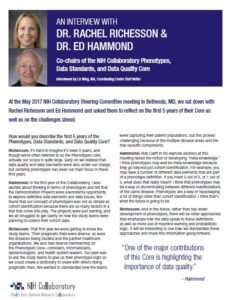
A PDF of the May 2017 interview with leaders of the Phenotypes Core Working Group.

October 5, 2017: NIH Collaboratory Launches Grand Rounds Podcast

The NIH Collaboratory is excited to announce the launch of a new podcast that is based on the popular Grand Rounds webinar series. At least once a month, we will release interviews with Grand Rounds speakers that delve into their topic of interest and give listeners bonus time with these featured experts.

The first two podcasts feature the following topics and speakers:

Please let us know what you think by providing your feedback through the podcast page.

We encourage you to listen and share the recordings with your colleagues!

October 3, 2017: New Collaboratory Article Explores Data Sharing and Embedded Research

In an article published in Annals of Internal Medicine, authors from the NIH Collaboratory describe concerns and solutions regarding data sharing and embedded research. Pragmatic research embedded in health systems uses data from the electronic health record and comes from a fundamentally different context than explanatory trials, which collect research-specific data. Data from embedded research have the potential to do harm if taken out of context or used for comparisons. Therefore, while the authors enthusiastically support data sharing, they also recognize that mandating data sharing may discourage health systems from volunteering to participate in embedded research.

“In an ideal world of transparency regarding healthcare processes and outcomes, health systems would have no expectation of or need for privacy regarding quality of health care delivery.  But the current world is not perfect, and unintentional disclosures from participation in embedded research could be far greater than that required for public quality measures. Health systems volunteering to participate in research to improve public health may not be willing to bear the additional risk of misuse of sensitive information.” — Simon et al. Ann Intern Med

The authors use examples from the NIH Collaboratory Trials to illustrate potential solutions, and emphasize that data sharing plans for embedded research should be developed in partnership with health system leaders in ways that maximize the amount of data that can be shared while protecting patient privacy and healthcare system interests.

October 2, 2017: New multi-agency initiative modeled on NIH Collaboratory to focus on non-drug approaches to managing chronic pain in U.S. service members and veterans.

A new research project modeled on the NIH Health Care Systems Research Collaboratory has been created to investigate non-drug approaches to helping U.S. service members and veterans manage chronic pain. The U.S. Department of Health and Human Services, the U.S. Department of Defense (DoD), and the U.S. Department of Veterans Affairs (VA) jointly announced the NIH-DoD-VA Pain Management Collaboratory project this week. The project, which includes funding for 12 NIH Collaboratory Trials over the next 6 years, will focus on large-scale, cost-effective, pragmatic trials conducted in military and VA healthcare systems.

The Pain Management Collaboratory Coordinating Center (PMC3) at Yale University will establish work groups to assist NIH Collaboratory Trials and provide support similar to that offered by NIH Collaboratory Core groups. A team from Duke Clinical Research Institute is leading one of the NIH Collaboratory Trials, a trial designed to improve access to recommended non-drug therapies for low back pain in the VA Health Care System.

Read more:

  • Yale researchers receive federal grants to study pain management in veterans, active military members
  • DCRI’s Steven George receives funding for non-drug pain management research project

September 27, 2017: Charter Template for Data Monitoring Committees for Pragmatic Clinical Trials Now Available

Data monitoring committee templateThe NIH Collaboratory Regulatory/Ethics Core has published a charter template that can be used to help establish a data monitoring committee (DMC) and associated procedures appropriate for oversight of pragmatic clinical trials. DMCs play an important role in protecting the welfare of trial participants and ensuring the integrity of a trial so that it can yield useful results. A charter defines the primary responsibilities of a DMC, its membership, the purpose and timing of its meetings, and its procedures and statistical monitoring guidelines.

In addition to procedures and guidance for DMCs generally, this new charter template contains suggested practices specifically for DMCs for pragmatic clinical trials, such as the recommendation that at least one DMC member have prior experience in conducting and interpreting data from this type of trial.

The charter template can be downloaded and customized by organizations to set up DMCs for pragmatic clinical trials and clearly outline their operations. For more information on special considerations in data and safety monitoring for pragmatic clinical trials, please see the Data and Safety Monitoring Living Textbook chapter.

September 21, 2017: New Article Highlights Generalizable Lessons Learned from the NIH Collaboratory

In a new article in BMC Medical Research Methodology, Dr. Kevin Weinfurt and colleagues share generalizable lessons learned from the first four years of the Collaboratory and their experiences with the NIH Collaboratory Trials.  The authors highlight some of the challenges encountered and solutions developed and discuss remaining barriers and opportunities for large-scale evidence generation using pragmatic clinical trials.

Read the full article: Pragmatic clinical trials embedded in healthcare systems: generalizable lessons from the NIH Collaboratory