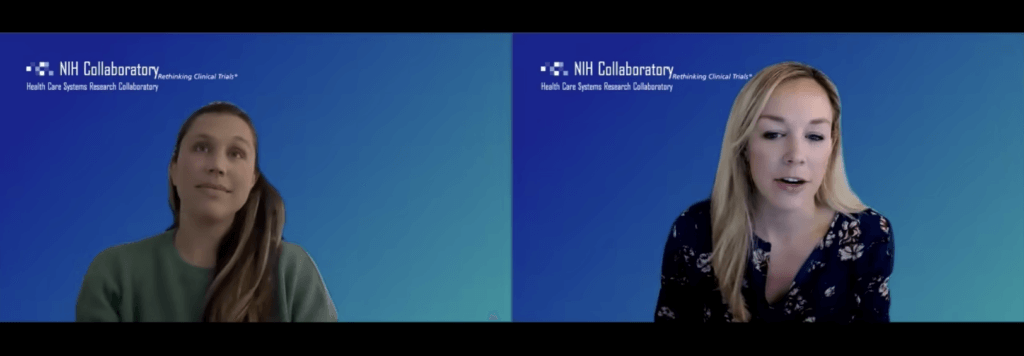
Leaders of the NIH Collaboratory’s Patient-Centered Outcomes (PCO) Core Working Group spoke in a recent Zoom-based interview about the Core’s latest accomplishments and ongoing collaborations with the NIH Collaboratory Trials.
“The purpose of the Core is to provide reusable and sustainable resources and tools to help project teams incorporate patient-centered outcomes and other patient-reported data in pragmatic clinical trials and the electronic health record,” said Dr. Emily O’Brien, an associate professor in population health sciences at Duke University and a cochair of the PCO Core.
“We address 3 components in any clinical research study: the needs of the clinician to provide care for the patient, the needs of the researcher, and the needs of the patient or the individual being treated,” added Dr. Christy Zigler, an assistant professor in population health sciences at Duke University and a cochair of the PCO Core. “To guide clinical researchers about PCO data collection, we usually think about 4 major considerations: adding IT infrastructure, deciding when PCOs are appropriate and choosing the best instrument, defining how to integrate PCO collection into the care process in a meaningful and appropriate way, and preparing for real-time reporting and statistical of PCO data,” Zigler said.
Last year, the PCO Core completed a survey of NIH Collaboratory Trials about cultural and linguistic adaptations of patient-centered outcome measures. The survey revealed significant barriers to researchers wanting to tailor instruments for their study populations.
“We wanted to know how and whether existing NIH Collaboratory Trials were adapting instruments for their populations of interest, either through translation, or cultural adaptation, or both,” said O’Brien. “This was really helpful to give us a sense of what barriers projects might encounter in the future… Planning ahead is critical, and having enough time and resources available to make these adaptations will be important for any projects that might benefit from having these adapted instruments available,” she said.
“We’re also thinking a lot about acceptability and burden of patient-centered outcomes,” said Dr. Zigler. “So we’re targeting PRISM NIH Collaboratory Trials within the first year of transition to implementation…and sending out a survey to gauge acceptability and burden at all levels, from the clinical care team, from the research side, and also from the patients themselves,” Zigler said.
Zigler and O’Brien also highlighted ongoing collaborations with the NIH Collaboratory’s other Core Working groups, including discussions with the Ethics and Regulatory Core about the ethical implications of integrating PCO data into clinical care and a consultation with the Electronic Health Records Core on integrating patient-centered and patient-reported outcomes into the electronic health record so that pragmatic clinical trial researchers can use them.
“Patient-centered outcomes data does not exist in a vacuum,” said O’Brien. “The data that are collected as part of NIH Collaboratory projects exist as part of both the larger study and also the larger health system within which the study is being conducted. So there are really clear connections between the PCO Core and the work that we do and all the other Cores, and those Cores have been a great resource for us as we’re advising projects on key issues that come up during the design and implementation phases of their studies,” she said.
View the full interview with Dr. Zigler and Dr. O’Brien.