Skip to content

COVID-19 Resources

Access the latest information on COVID-19 for clinical researchers
  • Home
  • About
    • NIH Collaboratory
      • Coordinating Center
      • NIH Collaboratory Trials
      • Core Working Groups
      • Steering Committee
      • Distributed Research Network
      • Our Impact
    • Living Textbook
      • Table of Contents
      • How to Use This Site
  • Resources
    • Data and Resource Sharing
    • Training Resources
    • Tools for Researchers
    • Publications
    • Knowledge Repository
  • Webinar
  • Podcast
  • News
    • News Feed
    • Calendar
    • Subscribe
return to home
Subscribe to Newsletter go to twitter feed go to linkedin go to blue sky feed
Search
NIH Collaboratory
Living Textbook of
Pragmatic Clinical Trials

COVID-19 Resources

Access the latest information on COVID-19 for clinical researchers
home button

Rethinking Clinical Trials

A Living Textbook of Pragmatic Clinical Trials

  • Design
    • What is a Pragmatic Clinical Trial?
    • Decentralized Pragmatic Clinical Trials
    • Developing a Compelling Grant Application
    • Experimental Designs and Randomization Schemes
    • Endpoints and Outcomes
    • Analysis Plan
    • Using Electronic Health Record Data
    • Building Partnerships and Teams to Ensure a Successful Trial
    • Intervention Delivery and Complexity
    • Patient Engagement
  • Data, Tools & Conduct
    • Assessing Feasibility
    • Acquiring Real-World Data
    • Assessing Fitness-for-Use of Real-World Data
    • Study Startup
    • Participant Recruitment
    • Monitoring Intervention Fidelity and Adaptations
    • Patient-Reported Outcomes
    • Clinical Decision Support
    • Mobile Health
    • Electronic Health Records–Based Phenotyping
    • Navigating the Unknown
  • Dissemination & Implementation
    • Data Sharing and Embedded Research
    • Dissemination Approaches for Different Audiences
    • Implementation
    • End-of-Trial Decision-Making
  • Ethics & Regulatory
    • Privacy Considerations
    • Identifying Those Engaged in Research
    • Collateral Findings
    • Consent, Disclosure, and Non-Disclosure
    • Data and Safety Monitoring
    • Ethical Considerations of Data Sharing in Pragmatic Clinical Trials
    • Ethics for AI and ML
    • IRB Responsibilities and Procedures

Pragmatic Elements: An Introduction to PRECIS-2- ARCHIVED

CHAPTER SECTIONS

ARCHIVED PAGE

Archived on July 31, 2025. Go to the latest version.

ARCHIVED – What is a Pragmatic Clinical Trial

Section 4

Pragmatic Elements: An Introduction to PRECIS-2- ARCHIVED

Expand Contributors

Kevin Weinfurt, PhD

Contributing Editors

Karen Staman, MS
Jonathan McCall, MS
Liz Wing, MA

Clinical trials that are considered “pragmatic” are designed to study a health intervention in a real-world setting that is similar or identical to the one in which the intervention will be implemented. PCTs thus stand in contrast to explanatory, or traditional, trials, which are usually designed to demonstrate the safety and efficacy of an intervention under highly controlled conditions and in carefully selected groups of participants.

Most clinical trials are situated somewhere along the spectrum between pragmatic and explanatory. The Pragmatic–Explanatory Continuum Indicator Summary (PRECIS; revised in 2015 as PRECIS-2) offers a framework to guide study teams to prospectively consider the pragmatic or explanatory nature of their trial across 9 domains (Loudon et al. 2015).

Watch the video module: Designing Pragmatic Trials That Are Fit for Purpose

Pragmatic–Explanatory Continuum

While ePCTs are designed to answer important, real-world clinical questions, tradeoffs in flexibility, adherence, and generalizability are inevitable. An ePCT may have some elements that are more pragmatic and some that are more explanatory. When planning the trial, it is essential to first ask, “What is the best trial design to answer the question of interest?” There is nothing inherently better or worse about a pragmatic versus traditional design. Rather, investigators should choose the degree of pragmatism for each element of the design (Figure) that will best answer the research question of interest. To evaluate the degree to which a trial is pragmatic, study teams are encouraged to read the detailed explanations of PRECIS-2, along with examples of how to apply the tool (Loudon et al. 2015).
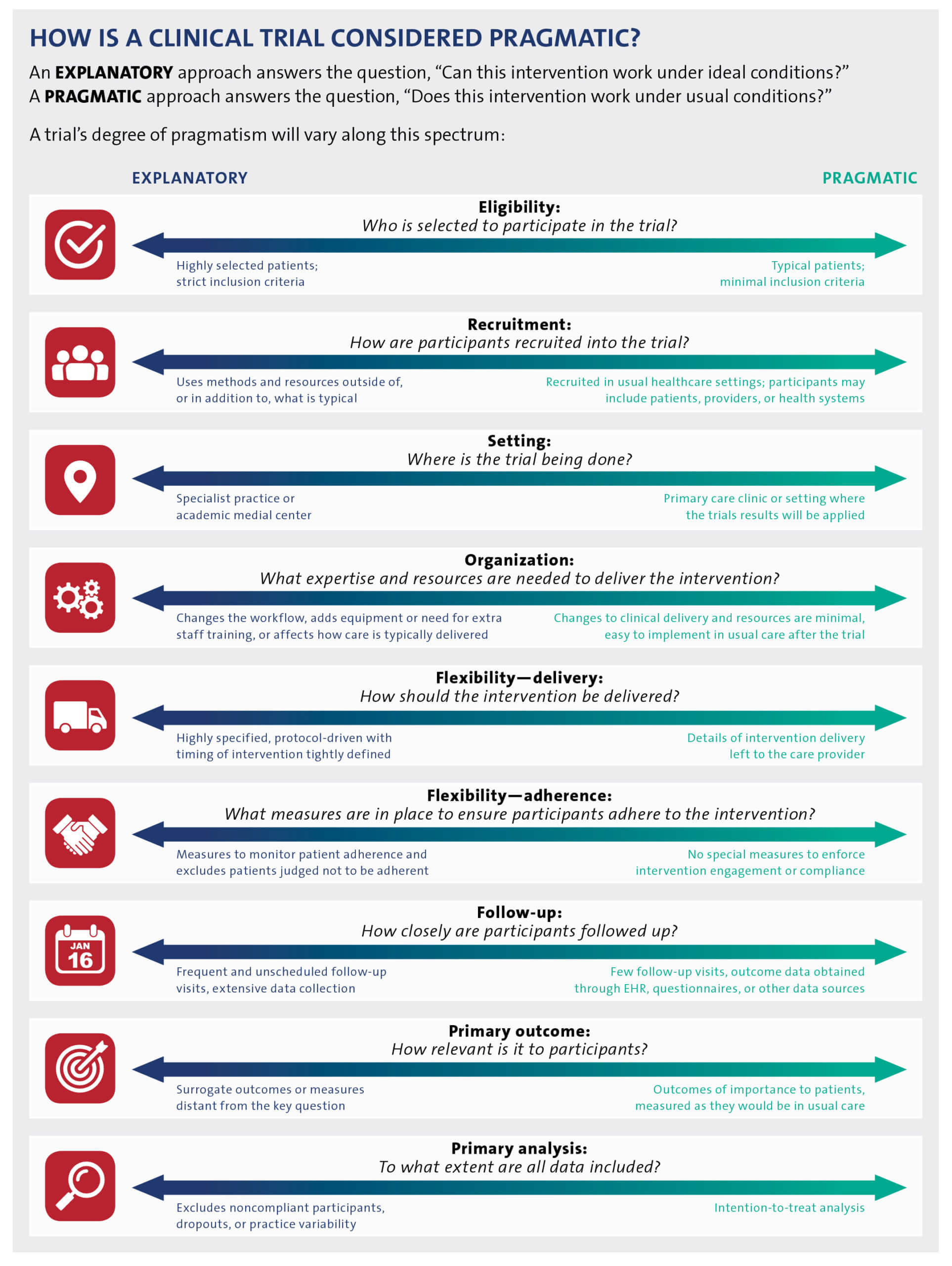
PRECIS-2 Wheel Diagram

In 2016, members of the Health Care Systems Interactions Core and colleagues applied the PRECIS-2 criteria to 5 PCTs supported by the NIH Collaboratory. Each trial was found to be “highly pragmatic” across the PRECIS-2 domains, highlighting the tool’s potential usefulness in guiding decisions about study design but also revealing a number of challenges in applying it and interpreting the results (Johnson et al. 2016). As another example, during the conduct of the PROVEN NIH Collaboratory Trial, members of the study team applied the PRECIS-2 domains in a novel manner to assess how dynamic adaptations shifted implementation to either a more explanatory or a more pragmatic approach (Palmer et al. 2018).
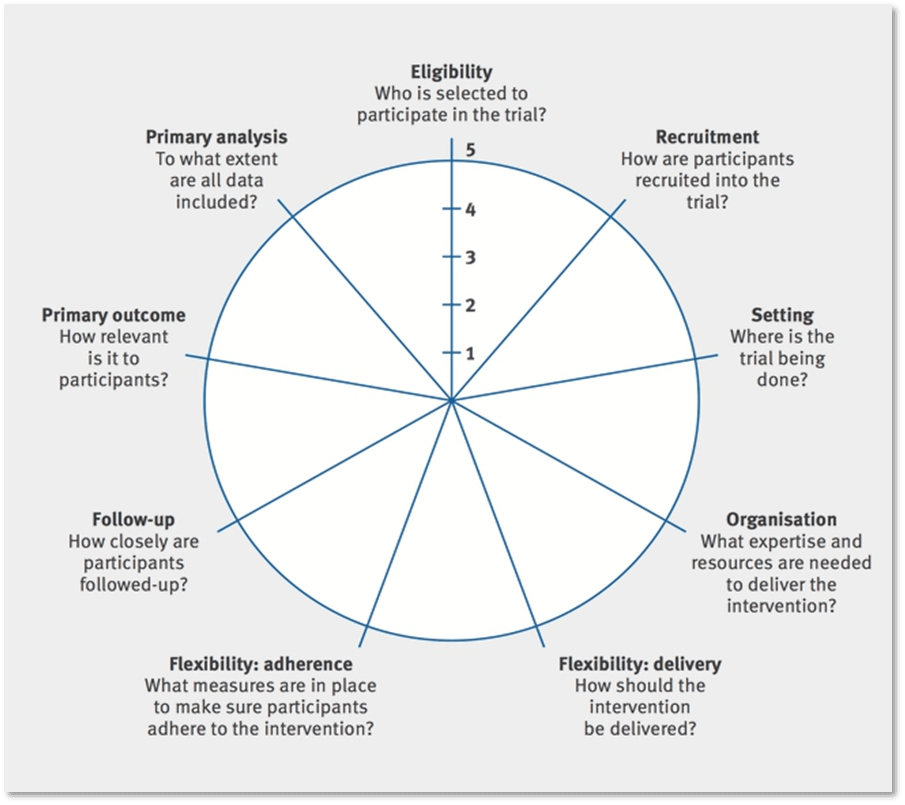
PRECIS-2: Kirsty Loudon et al. BMJ 2015;350:bmj.h2147. Copyright 2015 by British Medical Journal Publishing Group. Used by permission.

  • What would a PRECIS-2 wheel diagram look like for the trial you are developing?

The following Table illustrates key characteristics and examples of interventions that are more pragmatic than explanatory.

Characteristics and Examples of PCT Elements

Trial element Pragmatic characteristic Example
Research question Tests whether the intervention is effective in routine clinical practice
  • In people living with heart disease, what is the best dose of aspirin to use to prevent a heart attack or stroke?
  • For patients in non–critical care hospital units, what is the value of chlorhexidine bathing and nasal decolonization in reducing hospital‐associated infections compared with routine care?
  • In adult patients at risk for suicide, is collaborative care management or skills training better than usual care for patients with depression?
  • In people living with hypertension, is chlorthalidone more effective than HCTZ at preventing adverse cardiovascular outcomes?
Setting Embedded in the routine care setting such as primary care, community clinics, hospital units, or health systems
  • Standalone hemodialysis clinics
  • Physical therapy clinics
  • Federally qualified health clinics
  • Non–critical care hospital units within a large national healthcare system
  • Primary care clinic
  • Clinics within regional health systems serving underrepresented populations
Participants Eligible population requires little selection beyond the clinical indication of interest
  • People living with heart disease or hypertension
  • Clinics where the patient population has very low rates of colorectal cancer screening
  • Patients undergoing diagnostic spine imaging
  • Nursing home patients eligible for advance care planning
  • Patients managing multiple chronic conditions
Intervention and comparator Compares two or more real-world treatments using flexible protocols
  • Nighttime vs. daytime dosing of blood pressure medicine
  • 81 mg vs. 325 mg dose of aspirin
  • Dialysis session of 4.25 hours vs. standard session length
  • Universal decolonization (antiseptic bath and nasal ointment) vs. routine bathing
Outcomes Endpoints are clinically relevant to participants, funders, communities, and healthcare providers
  • Clarify the effectiveness of a behavioral treatment to prevent suicide or reduce pain
  • Define how EHR resources can be used to optimize guideline-based screening
  • Provide evidence for the best aspirin dose to prevent heart disease
  • Demonstrate improved methods for reducing hospital-associated infections
Clinical importance Purposely designed for making healthcare decisions in settings in which the intervention will be implemented
  • Trial results are translated into new national trauma guidelines
  • Trial results show that important clinical questions can be answered directly from patient data
  • Trial results show that epidemiological evidence in patients’ imaging reports can reduce unnecessary diagnostic and therapeutic interventions

Elements Adapted from Zwarenstein et al. 2008.

Previous Section Next Section

SECTIONS

CHAPTER SECTIONS
sections

  1. Why Are We Talking About Pragmatic Trials? – ARCHIVED
  2. The Embedded Pragmatic Clinical Trial Ecosystem – ARCHIVED
  3. Differentiating Between RCTs, PCTs, and Quality Improvement Activities – ARCHIVED
  4. Pragmatic Elements: An Introduction to PRECIS-2- ARCHIVED
  5. PRECIS-2 Case Study – ARCHIVED
  6. Key Considerations for PCTs – ARCHIVED
  7. Additional Resources – ARCHIVED

Resources

View a brief video introduction to PRECIS-2

Visit the PRECIS-2 website for more information on how to understand and use the tool

Members of the NIH Collaboratory’s Health Care Systems Interactions Core applied retrospective PRECIS-2 ratings to 5 NIH Collaboratory Trials, described in Johnson et al. Trials 2016

REFERENCES

back to top

Johnson KE, Neta G, Dember LM, et al. 2016. Use of PRECIS ratings in the National Institutes of Health (NIH) Health Care Systems Research Collaboratory. Trials. 17:32. doi:10.1186/s13063-016-1158-y. PMID:26772801.

Loudon K, Treweek S, Sullivan F, Donnan P, Thorpe KE, Zwarenstein M. 2015. The PRECIS-2 tool: designing trials that are fit for purpose. BMJ. 350:h2147. doi:10.1136/bmj.h2147. PMID: 25956159.

back to top

Palmer JA, Mor V, Volandes AE, et al. 2018. A dynamic application of PRECIS-2 to evaluate implementation in a pragmatic, cluster randomized clinical trial in two nursing home systems. Trials. 19:453. doi:10.1186/s13063-018-2817-y. PMID: 30134976.

Zwarenstein M, Treweek S, Gagnier JJ, et al. 2008. Improving the reporting of pragmatic trials: an extension of the CONSORT statement. BMJ. 337. doi:10.1136/bmj.a2390. PMID:19001484.


Version History

January 22, 2021: Added embedded video (change made by G. Uhlenbrauck).

May 14, 2020: Replaced the PRECIS-2 table with figure of PRECIS-2 continuum; added example of a PRECIS-2 wheel; added a Key Question; and added a reference to Palmer 2018 as part of the annual content update (changes made by L. Wing).

Published August 25, 2017

current section :

Pragmatic Elements: An Introduction to PRECIS-2- ARCHIVED

  1. Why Are We Talking About Pragmatic Trials? – ARCHIVED
  2. The Embedded Pragmatic Clinical Trial Ecosystem – ARCHIVED
  3. Differentiating Between RCTs, PCTs, and Quality Improvement Activities – ARCHIVED
  4. Pragmatic Elements: An Introduction to PRECIS-2- ARCHIVED
  5. PRECIS-2 Case Study – ARCHIVED
  6. Key Considerations for PCTs – ARCHIVED
  7. Additional Resources – ARCHIVED

Citation:

Weinfurt K. ARCHIVED – What is a Pragmatic Clinical Trial: Pragmatic Elements: An Introduction to PRECIS-2- ARCHIVED. In: Rethinking Clinical Trials: A Living Textbook of Pragmatic Clinical Trials. Bethesda, MD: NIH Pragmatic Trials Collaboratory. Available at: https://rethinkingclinicaltrials.org/archived-what-is-a-pragmatic-clinical-trial/pragmatic-elements-an-introduction-to-precis-2/. Updated September 25, 2025. DOI: 10.28929/092.

Footer Menu

  • How to Use This Site
  • About NIH Collaboratory
  • Enrollment Reporting
  • Grand Rounds
  • Funding Statement
Link to Twitter Link to LinkedIn Link to Blue Sky Link to NIH Collaboratory email

Reference in this Web site to any specific commercial products, process, service, manufacturer, or company does not constitute its endorsement or recommendation by the U.S. Government or National Institutes of Health (NIH). NIH is not responsible for the contents of any “off-site” Web page referenced from this server.

Log in
Privacy Statement
WordPress is a content management system and should not be used to upload any PHI as it is not an environment for which we exercise oversight, meaning you the author are responsible for the content you post. Please use this system accordingly. Site Map