


Dissemination Approaches for Different Audiences
Section 5
Dissemination to Patients
Dissemination Options for Trial Results
Lay audiences, including patients, caregivers, and others who are not experts in clinical research, often do not have access to clinical journals. Therefore, alternative dissemination media to scientific publications may be the most appropriate. Community-based research partners may already have communication channels open to patients and caregivers, and teaming with these partners from the beginning can help formulate the appropriate messages and the best means for disseminating results.
Key Point: When communicating with patients and research partners who are not routinely engaged in the clinical research enterprise, ensure that the information is accessible by disseminating through the following:
- Patient advocacy groups
- Government and study-specific websites
- Newsletters
- Emails
- Social media
- News media
Engagement Examples From PCORnet
A good example of a dissemination tactic aimed at patients and their caregivers comes from one of PCORnet’s Clinical Research Networks, PEDSnet, a network of children’s hospitals formed as a national evidence generation system to accelerate clinical research at lower cost. The PEDSnet website offers information about upcoming studies, opportunities to enroll in studies, summary results about the network’s impact, information about how to get involved in the network’s family and youth councils and become a patient and family advisor.
Another PCORnet Clinical Research Network, the PaTH Network, launched an innovative resource known as the Story Booth project. The project is an audio archive of patients living with an illness or experiencing a health challenge, with the goal of educating health researchers about patients’ and caregivers’ priorities and engaging patients and caregivers as research partners. The Story Booth website allows users to search for audio stories by the type of storyteller and by health experience.
Plain Language and Lay Summaries
When disseminating information to patients and other lay audiences, the use of plain language that is clear, professional, and easy to understand is recommended. The NIH created a 1-page guide to clarify the difference between observational studies and randomized clinical trials, but the guide does not communicate information about the unique aspects of pragmatic clinical trials, such as what is meant by embedded research, cluster randomized trials, or stepped-wedge designs. Communications aimed at a broader audience, such as the public, should explicitly define these terms. For communicating the results, the NIH also created a Checklist for Communicating Science and Health Research to the Public.
In brief, NIH recommendations for clinical trials are:
- Describe the clinical trial phase
- Give a breakdown of the study participants’ demographics
- Identify and explain the limitations of the study’s endpoint
- Surrogate endpoints
- Composite endpoints
- Check the study’s sample size and address potential limitations
- Clearly explain risk
- Absolute risk
- Relative risk/risk ratio
- Discuss both the benefits and drawbacks
Communicating the results of pragmatic (or embedded) research should include:
- The importance of the project and the gaps in knowledge the project is intended to address
- Rationale for a pragmatic approach, including an explanation of the study’s design
- Decisions the trial is intended to inform for patients, caregivers, and clinicians
- Use of data from the EHR and related privacy protections
- Generalizability of results
Lay summaries of study results can be an important strategy for disseminating results to research participants and the general public. For example, the Pediatric Trials Network (PTN) maintains an archive of “results at-a-glance” to share the results of the network’s clinical trials in plain language.
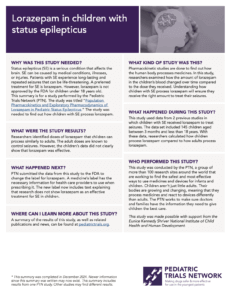
Lay summary of a PTN trial of lorazepam in children with status epilepticus
Lay summaries are also becoming an important and increasingly common approach by biomedical journals for improving the accessibility of results reporting. Many journals now require authors to prepare lay summaries to accompany their research articles. Goldstein and Krukowski (2023) described best practices for developing lay summaries.
Storytelling
Another dissemination tactic is to use storytelling methods. Presenting factual data and personal stories has been found to help people use the information and results from studies. Brason Lee commented in the American Journal of Public Health:
“It is about writing reports in a way that inspires readers to care enough to move forward. It is about showing readers rather than telling readers what it is like to be in a given situation….one of the greatest challenges in disseminating research for public policy use may ultimately rest in how the story is packaged for presentation.” (Lee 2015)
The communications departments in universities, research institutions, and healthcare systems can provide invaluable help in making a message clear and compelling.
The Patient-Centered Outcomes Research Institute (PCORI) offers a collection of stories about the impact of PCORI’s research on patients, researchers, and communities.
Resources for Patients
Several patient-oriented educational resources from government agencies and healthcare organizations are available for patients who want to learn more about clinical research. They include Basic Research Concepts from the US Department of Health and Human Services, Patient Resources from ClinicalTrials.gov, and the NIH Clinical Research Trials and Youwebsite.
SECTIONS
Resources
Returning Individual Research Results to Participants: Guidance for a New Research Paradigm
NIH Pragmatic Trials Collaboratory Rethinking Clinical Trials Grand Rounds; September 21, 2018
Returning Individual Research Results to Participants: Guidance for a New Research Paradigm
NIH Pragmatic Trials Collaboratory Rethinking Clinical Trials Podcast interview with Jeffrey Botkin and Consuelo Wilkins
Making Measurements Meaningful
NIH Pragmatic Trials Collaboratory Rethinking Clinical Trials Grand Rounds; October 18, 2018
Moving Beyond Return of Research Results to Return of Value
NIH Pragmatic Trials Collaboratory Rethinking Clinical Trials Grand Rounds; June 28, 2019
The Democratization of Medicine: Open Access, Social Media, AI, Apps, and Empowering the Patient as the Future of Clinical Research
NIH Pragmatic Trials Collaboratory Rethinking Clinical Trials Grand Rounds; August 7, 2020
A Cross-Sectional Study of GPT-4–Based Plain Language Translation of Clinical Notes to Improve Patient Comprehension of Disease Course and Management
NIH Pragmatic Trials Collaboratory Rethinking Clinical Trials Grand Rounds; March 28, 2025
REFERENCES
Botkin JR, Wilkins C. 2018. Returning Individual Research Results to Participants: Guidance for a New Research Paradigm. NIH Collaboratory Grand Rounds. https://rethinkingclinicaltrials.org/news/september-21-2018-returning-individual-research-results-to-participants-guidance-for-a-new-research-paradigm-jeffrey-botkin-md-mph-consuelo-wilkins-md-msci/. Accessed April 15, 2024.
Goldstein CM, Krukowski RA. 2023. The importance of lay summaries for improving science communication. Ann Behav Med. 57(7):509-510. doi: 10.1093/abm/kaad027. PMID: 37379509.
National Academies of Sciences, Engineering, and Medicine; Health and Medicine Division; Board on Health Sciences Policy; Committee on the Return of Individual-Specific Research Results Generated in Research Laboratories. 2018. Returning Individual Research Results to Participants: Guidance for a New Research Paradigm. Downey AS, Busta ER, Mancher M, Botkin JR, editors. Washington (DC): National Academies Press. PMID: 30001048.
Lee B. 2015. Storytelling to enhance the value of research. Am J Public Health. 105(4):e1. doi: 10.2105/AJPH.2014.302548. PMID: 25713935.
Wong CA, Hernandez AF, Califf RM. 2018. Return of research results to study participants: uncharted and untested. JAMA. 320(5):435-436. doi: 10.1001/jama.2018.7898. PMID: 29931289.
ACKNOWLEDGMENTS
Karen Staman, Gina Uhlenbrauck, and Liz Wing of the NIH Pragmatic Trials Collaboratory Coordinating Center served as contributing editors for previous versions of this chapter.