June 25, 2021: Medical Decision Making Seeks Submissions for EHR Theme Issue

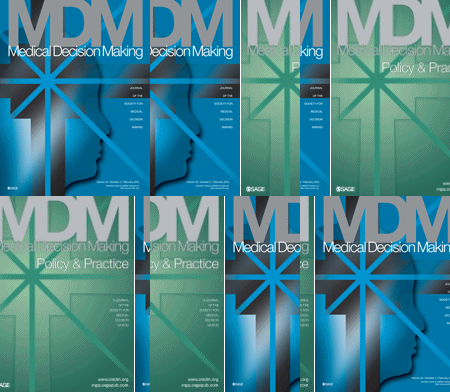
Cover of the journal Medical Decision Making

Medical Decision Making, an official journal of the Society for Medical Decision Making, has extended the submission deadline in its call for papers for a special theme issue on the use of electronic health record (EHR) data in health decision research. The new submission deadline is September 30, 2021.

“EHRs remain a rich and promising longitudinal data source on patient-level characteristics with a great deal of potential, but a lot of thinking and work remains to be done to take full advantage of them to produce high-quality evidence that can advance medical care and decision making,” the journal’s announcement said.

The journal’s editors are interested in papers that advance understanding of the strengths and limitations of using EHR data in health decision research, including:

  • critical reports investigating the usefulness, benefits, and limitations of using EHRs to address specific health policy questions or inform healthcare decision making;
  • empirical papers evaluating the impact of EHR use to inform decision making around patients, clinicians, healthcare improvement programs, or health policy;
  • exploration of the challenges that arise when using EHR data for research or for patient or clinician decision support (such as bias, confounding, heterogeneity, and missing data);
  • strategies for addressing the challenges of EHR data in decision making; and
  • issues that arise in different national contexts.

Read the full call for papers.

Study Recommends Shared Decision Making for Research on Medical Practices

Research on medical practices (ROMP) includes medical record reviews, comparative effectiveness research, quality improvement interventions, and point-of-care randomization, and may improve the efficiency, quality, and cost-effectiveness of medical care.

In a study by Maureen Kelly and colleagues recently published in The American Journal of Bioethics, researchers found that patients may not fully understand the rationale for ROMP or the extent to which this type of research already exists. Patients care most about how risks and consent are managed and communicated within the physician-patient relationship, view research as separate from usual care, and place their trust in their physician, whom they rely on to identify and filter risks.

Because current approaches to oversight, risk assessment, and informed consent are poorly suited to ROMP, the authors suggest a model of Shared Decision Making (SDM) as an approach to disclosure, consent, randomization and data sharing. With SDM, the physician engages the patient in the decision-making process and encourages conversations regarding the uncertainty of treatment options.

In a related commentary, Dr. Jeremy Sugarman urges consideration of the appropriateness of this analytic frame for ROMP due to the important differences between the primary aims of research and clinical care: in research the primary goal to generate information, while for clinical care, the primary goal is to benefit patients.

Reference: Kelley M, James C, Alessi Kraft S, et al. Patient Perspectives on the Learning Health System: The Importance of Trust and Shared Decision Making. 2015;15:4–17. PMID: 26305741. doi: 10.1080/15265161.2015.1062163.
For more information on RoMP, see the Grand Rounds Presentation from December 2014: A RoMP through the Empirical Ethics of Pragmatic Clinical Trials