


Consent, Disclosure, and Non-Disclosure
Section 4
Notification
When obtaining consent is not required, there may be good ethical reasons for notifying participants, as notification demonstrates respect for persons by recognizing participants as individuals who should be given information about activities that affect them (Propes et al 2024). In a recent article, leaders from the NIH Pragmatic Trials Collaboratory suggest that communicating information to participants should be the default, as notification can promote six important goals:
- Respect for persons
- Participant understanding of the research
- Participant understanding of their contributions
- Participant ability to voice any concerns
- Participant engagement, and
- Trust and trustworthiness (O’Rourke et al 2025).
“When a study is approved with a waiver of research consent, investigators and review committees should consider on a case-by-case basis what information, if any, to disclose to participants, and how it will be disclosed (O’Rourke et al 2025).”
Factors Shaping Notification Decisions
Several factors are relevant when considering whether to notify individuals about research—and, if so, what and how that information should be shared. A recent article (Morain et al 2026) reports on expert insights regarding decision-making about notification for PCTs conducted under a waiver of consent. While sharing information about research can, as noted previously, promote important goals, including respect for persons, transparency, and understanding of research, other factors may weigh against notification. One such factor weighing against notification is scientific validity, if notification were to change behavior and undermine the study. Additionally, study teams (and the participating health systems) must consider the opportunity costs of notification, and the corresponding implications for research and/or ongoing clinical operations. Decisions about notification should involve a range of research partners, including the research team, health system clinical and operational leadership, IRBs, and patient advocates.
Mechanisms for Notification
Researchers (and the IRB) may notify the patients included in research through different mechanisms, which can vary from a poster that provides a general or group notification (e.g., “We do research here”) to individual notification about a specific study. With any form of notification, there may also be an option to opt out and not participate in the research.
Individual Notification
Even when a waiver of consent is granted, some investigators provide individual notification to those included in the research and may offer an opportunity to opt out as a mechanism to preserve individual autonomy. Individual notification can occur through various methods, including a letter sent by mail, an email through a patient portal, individually provided flyers, or a discussion with a physician.
Example from a NIH Collaboratory Trial:
TiME (Dember et al 2019) trial information sheet
Group Notification
Group notification can include flyers and posters in clinics. The information can be specific to the study or a general statement that research is being conducted in that setting. For example, the Randomized Evaluation of Decolonization versus Universal Clearance to Eliminate MRSA (REDUCE MRSA) trial (Septimus et al 2014) compared 3 commonly used strategies for preventing methicillin-resistant Staphylococcus aureus (MRSA) infections in adult intensive care units of a single health system. Although a waiver of consent was granted, the IRB required that patients be informed of the study through notices posted in each ICU room.
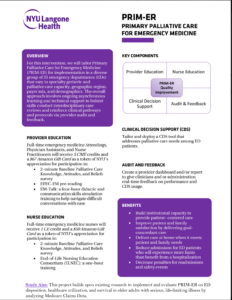
Example from a NIH Collaboratory Trial:
PRIM-ER (Grudzen et al 2019) Flyer
SECTIONS
REFERENCES
Dember LM, Lacson E, Brunelli SM, et al. 2019. The TiME trial: a fully embedded, cluster-randomized, pragmatic trial of hemodialysis session duration. J Am Soc Nephrol. 30:890–903. doi:10.1681/ASN.2018090945.
Grudzen CR, Brody AA, Chung FR, et al. 2019. Primary palliative care for emergency medicine (PRIM-ER): protocol for a pragmatic, cluster-randomised, stepped wedge design to test the effectiveness of primary palliative care education, training and technical support for emergency medicine. BMJ Open. 9:e030099. doi:10.1136/bmjopen-2019-030099.
Morain SR, Brickler A, Semler MW, Casey D. 2026. Patient notification about pragmatic clinical trials conducted under a waiver of consent: a qualitative study. Clinical Trials. 23(1):65-74. doi:10.1177/17407745251377730
O'Rourke PP, Ali J, Carrithers J, et al. 2025. Disentangling informing participants from obtaining their consent. Learn Health Syst e70014. doi:10.1002/lrh2.70014
Propes C, O’Rourke PP, Morain SR. 2024. Recurring and emerging ethical issues in pragmatic clinical trials. Circ: Cardiovascular Quality and Outcomes. 17. doi:10.1161/CIRCOUTCOMES.124.010847.
Septimus EJ, Hayden MK, Kleinman K, et al. 2014. Does chlorhexidine bathing in adult intensive care units reduce blood culture contamination? A pragmatic cluster-randomized trial. Infect Control Hosp Epidemiol. 35 Suppl 3:S17-22. doi:10.1086/677822. PMID: 25222893