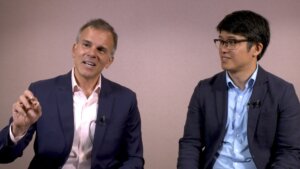
The planning phase of a pragmatic clinical trial is a critical time when research teams can hone their research questions, build relationships with healthcare system and community partners, and test assumptions about the trial’s implementation in real-world settings. At the NIH Collaboratory’s 2026 Annual Steering Committee Meeting, we spoke with Angelo Volandes and Sebastian Tong about the role of feasibility assessment in planning a successful trial.
“I think the biggest challenge for the feasibility assessment for pragmatic trials is one that we probably don’t talk enough about, and that’s the tension between meeting the timetable, the milestones, and an honest discovery process,” said Volandes. Volandes is the Anna Gundlach Huber Professor in Medicine at the Geisel School of Medicine and a co–principal investigator for ACP PEACE, an NIH Collaboratory Trial.
“So, from a principal investigator’s perspective, the way I suggest to others that they navigate this is to treat it as an investigation: generate hypotheses, collect data,” he said.
“[In the NIH Collaboratory’s Core Working Groups], I was open about the problems we had with engaging in rural areas and minoritized populations, and I got a lot of feedback about how we best engage with community partners,” recalled Tong, an associate professor of family medicine at the University of Washington and a co–principal investigator for AIM-CP, an NIH Collaboratory Trial.
“I wouldn’t have gotten that if I hadn’t been open about the problems we were having,” Tong said.
In the coming weeks, we will share more highlights from the 2026 Annual Steering Committee Meeting. Access the complete meeting materials.