



Text message–based reminders to patients who delayed refilling their cardiovascular medications did not improve medication adherence compared with usual care in the recently completed Nudge trial.
The results of the study were published online ahead of print in JAMA.
Nudge, an NIH Collaboratory Trial, was a randomized, pragmatic clinical trial embedded in 3 healthcare systems testing a variety of text messaging strategies to encourage patients to refill their cardiovascular medications. Poor medication adherence is common among patients with chronic conditions, and poor adherence to cardiovascular medications is associated with higher rates of adverse health outcomes, including hospitalization and mortality.
The study team randomly assigned 9501 patients who delayed refilling their cardiovascular medications to receive either usual care or 1 of 3 text message interventions: (1) a generic text message reminder to refill medication; (2) a text message reminder that incorporated “behavioral nudges”; and (3) a behavioral nudge text message reminder plus a chatbot that used preprogrammed algorithms to assess common barriers to medication adherence. The primary outcome was the proportion of days covered in the 365 days after randomization for all cardiovascular medication classes for which the patient had a refill gap at baseline.
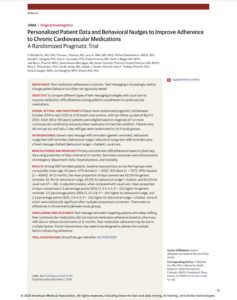 At the end of the trial, there were no statistically significant differences in the proportion of days covered with medication between the study groups. There were also no differences in emergency department visits, hospitalizations, and mortality. In a post hoc analysis exploring medication adherence in the first 3 months after a refill gap, the study team saw modest improvement in refill adherence with the text messaging strategies compared with usual care.
Given that most patients refilled their medications within 30 days of receiving a reminder text message, the authors concluded that the lack of benefit after 30 days may be related to “intervention decay” that has been seen with other interventions. “Additional interventions need to be rigorously tested to try to improve adherence to chronic cardiovascular medications,” they wrote.
Nudge was supported within the NIH Pragmatic Trials Collaboratory by a grant award from the National Heart, Lung, and Blood Institute.
“The feedback and guidance from the NIH Collaboratory’s Cores were instrumental to overcoming the challenges we faced in completing this project,” said Michael Ho, co–principal investigator for Nudge and a senior clinician investigator at Kaiser Permanente Colorado’s Institute for Health Research.